
You have the past papers, but finishing a full mock exam often leaves you with a vague sense of what went wrong. Did you miss a question because you forgot a concept, or because you ran out of time? An aggregate score hides these details. This article shows how to break down those papers into short, topic-specific quizzes that help identify weak areas and patterns, so you can target your revision more effectively.
Why Full Past Papers Alone Do Not Diagnose Weak Topics
A full USNCO practice paper covers a broad range of chemistry topics in a fixed time limit. When you complete it, your score reflects both your knowledge gaps and your test-taking stamina. If you miss a question on gas mixtures, was it because you forgot Dalton’s Law, or because you ran out of time? The aggregate score hides these details. Furthermore, reviewing a full paper often leads to superficial corrections, such as fixing arithmetic errors without addressing the underlying conceptual misunderstanding. Active recall through targeted quizzes forces you to retrieve specific principles under low-stakes conditions, revealing true mastery levels.
The site’s Exams page lists past papers from 1999-2025, and the site describes free past papers among its preparation services. That means the raw material is not the bottleneck for most serious students. The bottleneck is organisation. A folder of PDFs is not a diagnostic system. A tagged set of questions is.
The Topic-Tag Method: Sorting Selected Questions by Topic Area
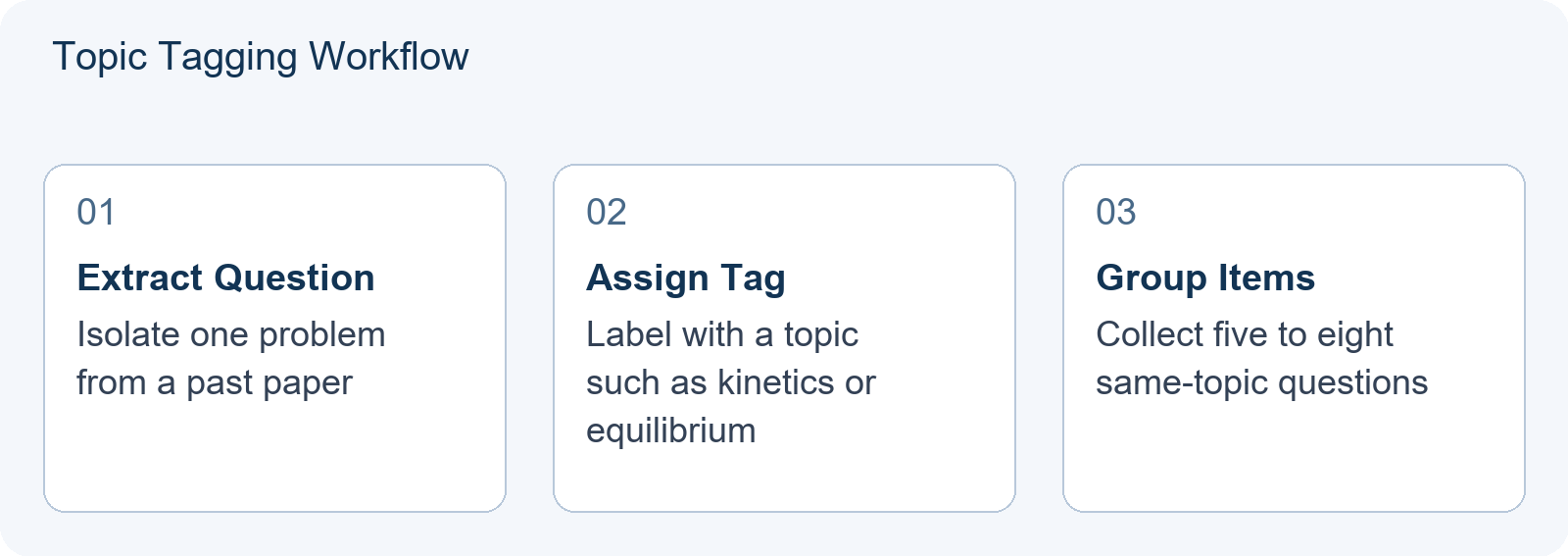
Instead of solving past papers only sequentially, extract individual questions and tag them by topic. Common chemistry areas you will meet in USNCO preparation include stoichiometry, equilibrium, acid-base chemistry, electrochemistry, kinetics, thermodynamics, organic structure, and descriptive inorganic chemistry. You can also use finer tags, such as equilibrium approximations, limiting reagents, or molecular geometry, if those are the exact areas where you lose marks.
Create a simple spreadsheet or physical index card system where each row represents a question from a specific year. Columns should include the source year, question number, broad topic, narrow topic, difficulty level, and your performance status. A useful status set might be: untried, correct and confident, correct but slow, wrong from content gap, wrong from arithmetic, and wrong from misread. This transforms a static PDF into a dynamic database of practice items.
Tag consistently. If you label one question as equilibrium and another as acid-base when both involve buffer calculations, your quiz sets will be misleading. Write a short one-line rule for each tag, such as: acid-base means proton transfer and pH; equilibrium means K, Q, ICE tables and Le Chatelier; thermodynamics means enthalpy, entropy and Gibbs energy. The goal is not perfect ontology. The goal is repeatable grouping so that five questions in one quiz genuinely test one skill cluster.
Building a 10-15 Minute Quiz Set Without Losing Exam Context
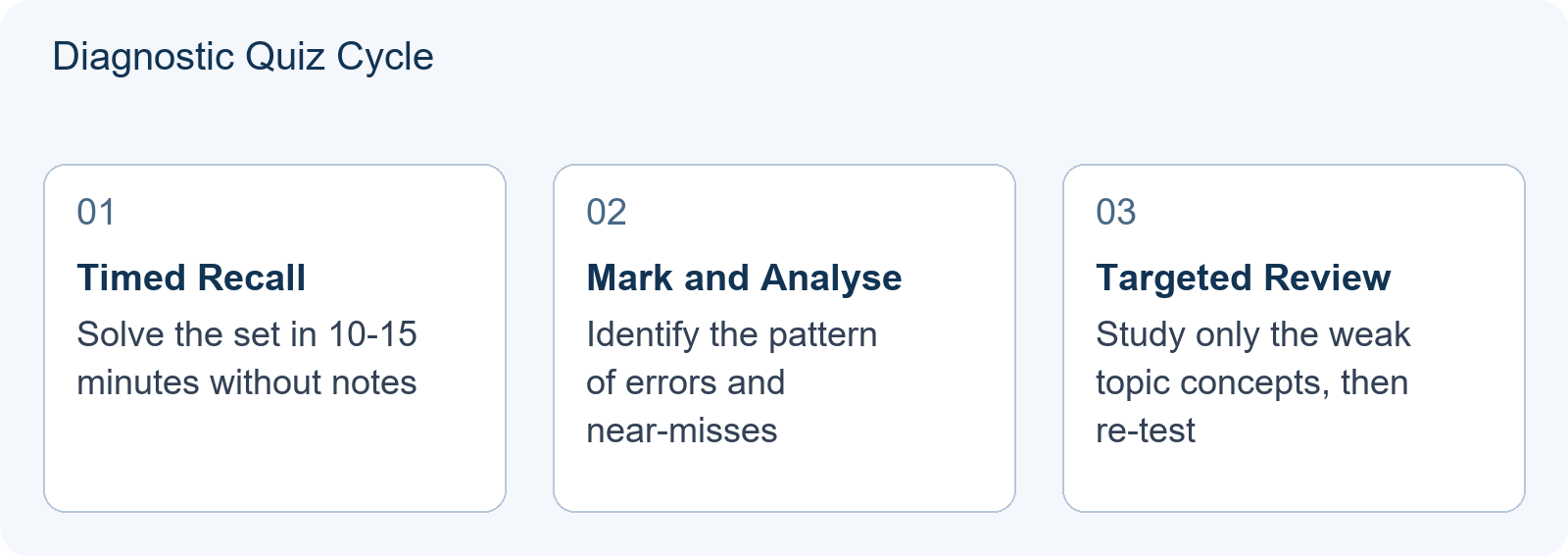
Once tagged, select five to eight questions from a single topic to form a quiz set. For example, pull all equilibrium approximation questions from three different years. Time yourself strictly for 10-15 minutes. This short duration mimics the pressure of individual exam sections without the fatigue of a full test. Crucially, do not look at the answer key until the timer stops. If you need a separate answer-key review method, the article on USNCO Past Papers: Requesting Explanations Beyond an Answer Key explains how to move from a final answer to a corrected method.
After the timer stops, mark your responses. A practical self-scoring rule is: if you missed more than two questions in the set, that topic is a priority for review. If you answered all correctly but felt uncertain, flag those questions for re-testing in a week. If you were correct and fast, retire those questions temporarily. You want your quiz bank to contain active learning items, not familiar items you recognise from last week.
Keep the exam context visible. Write the original source year and question number at the top of each quiz set. Do not silently rewrite questions unless you are deliberately creating a variation. If you create a variation, label it as a variation in your spreadsheet. That way, you can tell whether you are practising the original exam item or a modified teaching item.
Labelled Teaching Illustration: Turning One Equilibrium Question Into a Diagnostic Quiz
Note: This is a hypothetical teaching illustration, not an actual contest problem or official scoring guidance.
Consider a generic equilibrium question: For the reaction A ⇌ B with K = 100, if initial [A] = 1.0 M and initial [B] = 0 M, what is [B] at equilibrium? In a full paper, this might be buried among other topics. As a diagnostic quiz item, isolate it.
First, ask the student to write the ICE table. Let x equal [B] at equilibrium. Then [A] = 1.0 – x and [B] = x. Second, ask the student to justify whether the small-x approximation is valid. Here K = 100, so products dominate. The small-x approximation would require x to be much less than 1.0 M. That is not true in this case. Third, ask for the exact value. K = x / (1.0 – x) = 100, so x = 100/101 ≈ 0.990 M. The small-x approximation is invalid, even though a rough estimate of x ≈ 1.0 M is close. The student should state the exact value and explain why the approximation does not apply.
If the student fails step two, they may understand the algebra but lack conceptual judgment about when to approximate. If they fail step three, they may have the concept but need calculation practice. This is the diagnostic value of a quiz set: one question becomes several observable skills.
Using Quiz Results to Decide What to Review Next
Your quiz results should drive your study schedule. If you consistently fail quizzes on redox balancing, dedicate the next session to reviewing half-reaction methods and charge conservation. If you ace equilibrium quizzes but struggle with kinetics, shift focus there. This data-driven approach prevents wasting time on already-mastered topics. It also highlights patterns. If you always miss questions involving significant figures, your issue may be mathematical precision rather than chemical understanding.
Record the cause of each miss. Do not write only wrong. Write wrong because I used the small-x approximation when K was large, or wrong because I forgot to convert grams to moles, or wrong because I misread the graph axis. A structured error log turns isolated mistakes into a revision plan. The article on Why You Keep Losing the Same Marks: A Chemistry Error Log That Actually Works (2026) can help you keep those patterns visible.
Review in layers. First, redo the exact questions you missed. Second, do two or three new questions from the same topic. Third, schedule a mixed quiz that combines the weak topic with a previously strong topic. The mixed quiz checks whether you can still recognise the method when the question does not announce its topic.
When to Return to Full Timed Papers
Topic-specific quizzes build foundational competence, but they do not simulate the cognitive load of switching between unrelated topics rapidly. Once you achieve consistent high scores across multiple topic quizzes, return to full timed papers. Use these sessions to practise pacing and endurance. Compare your performance on full papers against your quiz data. If you scored well on quizzes but poorly on the full paper, the gap likely lies in time management or mental fatigue, not content knowledge.
For full-paper review, separate three questions. Did I know the chemistry? Did I choose the right method? Did I execute the method accurately under time pressure? If the answer to the first question is yes but the third is no, your next quiz sets should include shorter time limits on familiar topics. If the first question is no, your next quiz sets should isolate the missing concept and rebuild it before you return to mixed practice.
Marking your own work is part of this loop. The article on An Answer Key Is Not a Mark Scheme: How to Mark Your Own Chemistry Work (2026) is useful here because a final answer alone does not show whether your method would score in a written solution. Use it to decide whether your error was conceptual, procedural, or presentational.
Common Mistakes: Memorising Answers Instead of Testing Method
The biggest risk in building custom USNCO quizzes is inadvertently memorising the solution path for specific numbers. To avoid this, vary parameters when possible. If the original question uses K = 100, create a variant with K = 0.01 to test whether you can adjust your approximation strategy. If the original uses 1.0 M, try 0.10 M. Do not change the chemistry beyond what you can verify. The point is to test transfer, not to invent new contest problems.
Another mistake is treating a correct answer as proof of mastery. If you find yourself recalling the final number without deriving it, discard that question from your active rotation and replace it with a new one. Your goal is flexible application of principles, not rote recognition. A question you can solve only because you remember the answer is no longer a quiz item. It is a memory prompt.
Finally, do not let tagging become a substitute for doing the work. A beautiful spreadsheet with hundreds of tagged questions is still passive if you never close the notes and take a timed quiz. The system should feel slightly uncomfortable. If every quiz set feels easy, your tags are too broad, your time limit is too generous, or your question bank is too familiar.
FAQ
Do I need special software to tag my questions?
No. A simple spreadsheet or physical index cards works perfectly. The key is consistent labelling of topics such as equilibrium, stoichiometry, or kinetics so you can group them later.
Can I use questions from any year?
Yes. The site’s Exams page lists past papers from 1999-2025. Older questions are still valuable for testing fundamental principles, though newer ones may reflect current emphasis shifts.
What if I run out of questions for a specific topic?
Combine related topics. For example, merge acid-base and buffers into one quiz set. Or create clearly labelled variations of existing problems by changing numerical values to test the same concept. Do not pretend a variation is an original contest question.
Frequently Asked Questions
Do I need special software to tag my questions?
No. A simple spreadsheet or physical index cards works perfectly. The key is consistent labelling of topics such as equilibrium, stoichiometry, or kinetics so you can group them later.
Can I use questions from any year?
Yes. The site’s Exams page lists past papers from 1999-2025. Older questions are still valuable for testing fundamental principles, though newer ones may reflect current emphasis shifts.
What if I run out of questions for a specific topic?
Combine related topics. For example, merge acid-base and buffers into one quiz set. Or create clearly labelled variations of existing problems by changing numerical values to test the same concept. Do not pretend a variation is an original contest question.