
If you are revising electrochemistry for the USNCO and your answers keep coming out with a plausible magnitude but the wrong sign, the fault is almost always in one of three places: the direction of the cell diagram, the arithmetic of standard potentials, or the order of the reaction quotient. The fix is short enough to memorise and repeat under time pressure.
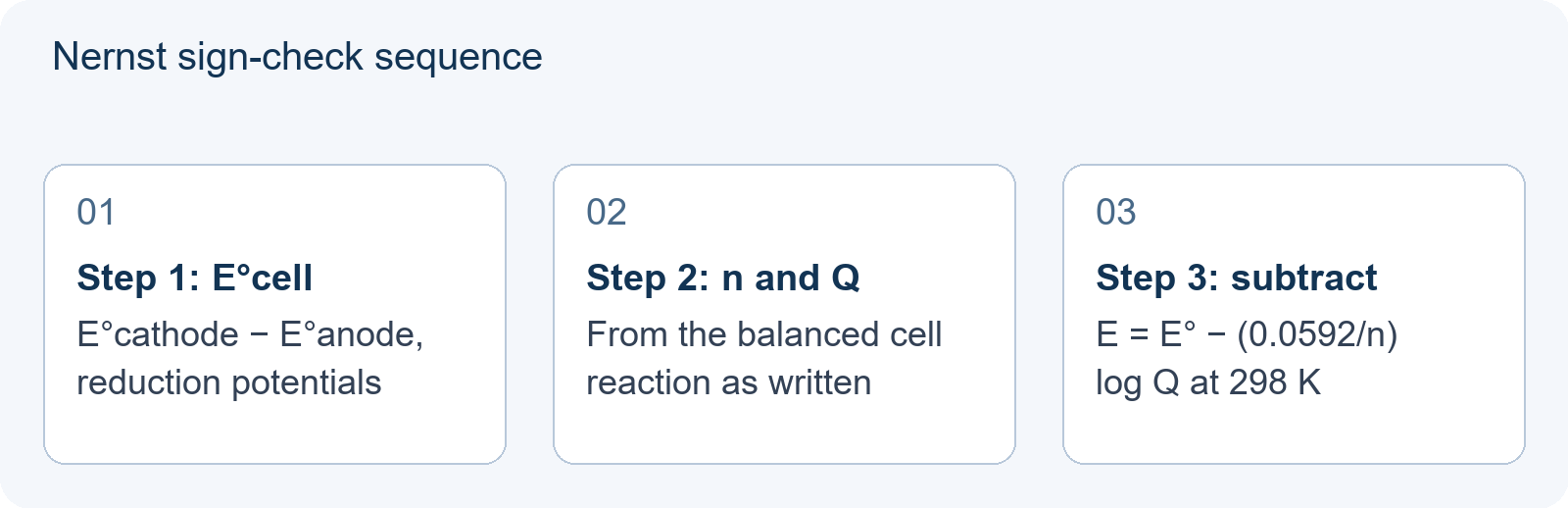
The short answer. In cell notation the electrode written on the left is the anode and the electrode on the right is the cathode. At standard conditions, E°cell = E°cathode − E°anode, with both values taken from a table of standard reduction potentials. For a nonstandard cell, E = E° − (0.0592/n)·log Q at 298 K, where Q is written for the balanced cell reaction exactly as the notation reads, left to right. Every error below is a quiet violation of one of those three sentences.
Read the notation as a sentence, not a picture
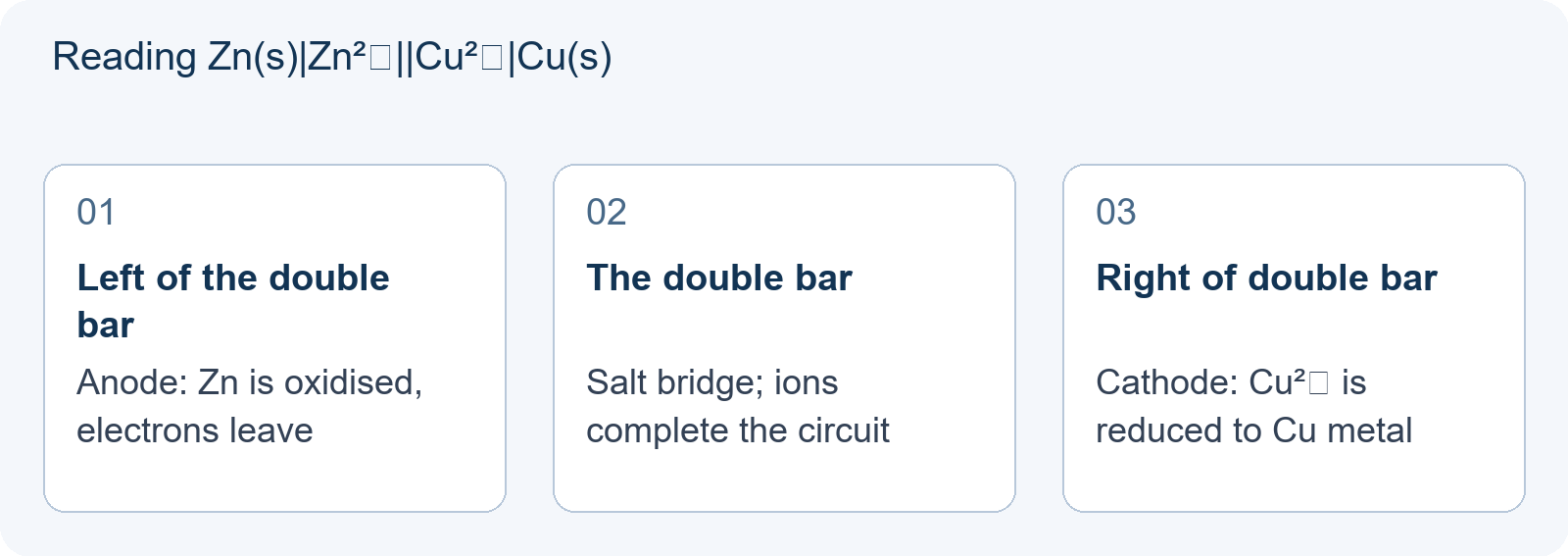
Cell notation is compressed prose. Read it left to right, in the same order as electron flow through the external circuit. Four symbols carry almost all of the meaning. A single vertical bar marks a phase boundary, such as solid zinc against aqueous zinc ion. A double vertical bar marks the salt bridge joining the two half-cells. A comma separates two species that sit in the same phase, which is how you spot a redox couple with no solid metal of its own. And an inert conductor such as platinum is written at the outer end of the side it serves, because a wire has to touch something.
Two consequences follow immediately. First, the left-hand compartment loses electrons: that is oxidation, so the left electrode is the anode. Second, anions in the salt bridge drift toward the anode compartment and cations toward the cathode compartment, restoring charge balance as the reaction proceeds. If you can say those two sentences about a diagram, you already know which way the reaction runs, and the rest is arithmetic.
The arithmetic itself depends on getting the half-reactions balanced first; the charge and atom audit described in USNCO Redox Balancing: Checking Both Charge and Atom Conservation is the prerequisite for everything on this page, because n and Q both come out of the balanced equation.
Teaching illustration 1: the standard zinc–copper cell
The following is a hypothetical teaching illustration written for this article. It is not an official USNCO question and does not reproduce any examination material.
Take the diagram Zn(s) | Zn²⁺(aq, 1.0 M) ‖ Cu²⁺(aq, 1.0 M) | Cu(s). Left side: zinc metal is oxidised, Zn → Zn²⁺ + 2e⁻. Right side: copper(II) ion is reduced, Cu²⁺ + 2e⁻ → Cu. So zinc is the anode and copper is the cathode, and electrons leave the zinc strip through the wire and arrive at the copper strip.
Both half-reactions involve two electrons, so the balanced cell reaction is Zn + Cu²⁺ → Zn²⁺ + Cu with n = 2. Using standard reduction potentials of +0.34 V for Cu²⁺/Cu and −0.76 V for Zn²⁺/Zn: E°cell = 0.34 − (−0.76) = +1.10 V. The positive value confirms the cell is galvanic as drawn. If your arithmetic gives a negative number here, you have either reversed the subtraction (which would give −1.10 V) or treated the tabulated −0.76 V as though it were +0.76 V and then subtracted it (which produces −0.42 V). That single slip is a common sign failure in this topic.
Where Q comes from, and where it usually goes wrong
The reaction quotient is built from the balanced cell reaction, using activities of dissolved and gaseous species and excluding pure solids and pure liquids, which are assigned an activity of 1. For Zn + Cu²⁺ → Zn²⁺ + Cu, that leaves Q = [Zn²⁺] / [Cu²⁺]. Writing [Cu] in the denominator is a common way to lose a mark on an otherwise correct calculation.
Now keep Cu²⁺ at 1.0 M and lower Zn²⁺ to 0.10 M. Q = 0.10 / 1.0 = 0.10, so log Q = −1. Then E = 1.10 − (0.0592/2)(−1) = 1.10 + 0.0296 ≈ +1.13 V. The sign check is chemical, not algebraic: zinc ion is the product, so removing it should pull the reaction to the right and increase the driving force. The voltage rose, as it must. Had the answer dropped below 1.10 V, Q would have been inverted.
Teaching illustration 2: a squared term and a Q greater than one
Also a hypothetical teaching illustration, not an official question.
Consider Cu(s) | Cu²⁺(aq, 1.0 M) ‖ Ag⁺(aq, 0.10 M) | Ag(s). Copper is oxidised on the left, silver ion reduced on the right. With E° = +0.34 V for Cu²⁺/Cu and +0.80 V for Ag⁺/Ag, E°cell = 0.80 − 0.34 = +0.46 V. Balancing gives Cu + 2Ag⁺ → Cu²⁺ + 2Ag, so n = 2 and Q = [Cu²⁺] / [Ag⁺]² = 1.0 / (0.10)² = 100.
Then E = 0.46 − (0.0592/2)(2) = 0.46 − 0.0592 ≈ +0.40 V. Drop the square and you get Q = 10, log Q = 1, and E ≈ 0.43 V — a small numerical difference that signals a missing stoichiometric coefficient to any marker reading your working. The stoichiometry matters because two silver ions are consumed for every copper ion produced.
Notice that E stays positive but falls. The cell is still spontaneous; it is simply less driven because the cathode reactant has been depleted. Push Q far enough and E reaches zero — that is the equilibrium condition, and it is the bridge between this topic and the approximation questions discussed in USNCO Equilibrium Approximations: Knowing When the Small-Change Shortcut Fails.
What you may not multiply
Standard electrode potentials are intensive: they are energy per unit charge, not energy. Doubling a balanced cell equation doubles ΔG° (because ΔG° = −nFE° and n doubles while E° does not) but leaves E° untouched. Students who double both the equation and the potential get an answer twice too large and cannot see why.
The self-correcting version is worth checking once. Take the copper–silver cell and double everything: 2Cu + 4Ag⁺ → 2Cu²⁺ + 4Ag. Now n = 4 and Q = [Cu²⁺]² / [Ag⁺]⁴ = 10⁴, so log Q = 4. The correction term becomes (0.0592/4)(4) = 0.0592, exactly as before, and E is still about +0.40 V. When the equation is scaled, n and log Q scale together and cancel. That cancellation is a good reason to stop worrying about which multiple of the equation you wrote — and a good reason never to scale E°.
The four-point sign check
Before you write a final voltage, run these four checks in order. They take under a minute and catch the errors described above.
| Check | Common wrong version | Correct version |
|---|---|---|
| Electrode order | Right-hand electrode treated as the anode | Left = anode (oxidation), right = cathode (reduction) |
| E° arithmetic | 0.34 − 0.76 = −0.42 V | 0.34 − (−0.76) = +1.10 V |
| Scaling | Doubling the equation doubles E° | E° unchanged; n and log Q change together |
| Q contents | Solids or water included | Only dissolved and gaseous species |
Add a fifth habit on top: with 0.0592 you are using log base 10, and with 0.0257 you are using the natural logarithm. Mixing the constant and the logarithm makes the correction term wrong by a factor of about 2.3 (or its reciprocal, depending on the mismatch), which is large enough to notice but small enough to be mistaken for a rounding slip.
Inert electrodes and the platinum question
Platinum appears when neither member of the redox couple is a solid conductor. In the couple Fe³⁺/Fe²⁺ both species are aqueous, so a strip of platinum is written at the outer edge to carry electrons: Pt(s) | Fe²⁺(aq), Fe³⁺(aq) ‖ … The comma tells you both iron species share one phase. Platinum is a conductor, not a reactant, and it never appears in Q.
The same logic handles permanganate. For Pt(s) | Fe²⁺(aq), Fe³⁺(aq) ‖ MnO₄⁻(aq), Mn²⁺(aq), H⁺(aq) | Pt(s), the half-reactions are MnO₄⁻ + 8H⁺ + 5e⁻ → Mn²⁺ + 4H₂O at +1.51 V and Fe³⁺ + e⁻ → Fe²⁺ at +0.77 V, giving E° = 0.74 V and n = 5. The quotient is Q = [Mn²⁺][Fe³⁺]⁵ / ([MnO₄⁻][H⁺]⁸[Fe²⁺]⁵), with water excluded. Hydrogen ion appears with an eighth power because the balanced half-reaction says so — Q is transcribed from the equation, never assembled from intuition. This is also why acidic permanganate work overlaps pH and buffer reasoning elsewhere in equilibrium questions.
Why this is a USNCO-relevant drill
A Hanlin Courses article published on 27 September 2026, translated as “UKChO/CCO/USNCO… Five Major Chemistry Competitions: Which One Is Your Match?”, describes USNCO content as covering all of AP Chemistry plus parts of first-year university chemistry, with multiple-choice questions testing breadth and short-answer questions testing depth. The same coaching comparison lists electrochemistry among the theoretical areas the paper emphasises, alongside inorganic chemistry, analytical chemistry and chemical equilibrium. That is a first-party teaching judgment about emphasis, not an official ACS blueprint, and it should be read that way.
The practical implication is narrow but useful. Breadth questions reward a fast, reliable electrode assignment; depth questions reward visible reasoning, which means the electrode labels, the balanced equation, the value of n and the quotient should all appear in your answer before the number does. A candidate who writes only “1.13 V” has thrown away every mark that depended on the chain. A topic list is not a timetable; your own error pattern is the better ordering signal.
USNCO is organised by the American Chemical Society (ACS). This site is an independent information and preparation resource and is not affiliated with ACS; participation eligibility and season arrangements are set by ACS and should be checked against its current published terms.
Turning the check into a study routine
The value of a sign check is that it also diagnoses which skill is weak. Work three diagrams from any textbook or past-paper source, without a mark scheme, and grade yourself against the four-point table rather than against the final answer. If E° arithmetic is right but Q is wrong, your problem is transcription, not electrochemistry. If the cell is spontaneous in the wrong direction, your problem is electrode assignment. If the number is right but the explanation is missing, your problem is written communication. These need different fixes, and a wrong answer alone will not tell you which one applies — which is why the routine in Why You Keep Losing the Same Marks: A Chemistry Error Log That Actually Works (2026) classifies errors by cause rather than by topic.
If you then look for outside preparation, arrive with evidence rather than a vague request. Bring two or three cell diagrams you have attempted, with your anode and cathode labels, your balanced cell reaction, your n, your Q, and the point where the arithmetic diverged from the expected sign. Specify the skill you want worked on — for example, “constructing Q from a half-reaction containing H⁺” or “explaining why E° is not doubled” — instead of asking broadly for electrochemistry help. A conversation framed that way lets whoever is teaching you check your chain in minutes and spend the session on the step that actually fails.
Finally, keep one sentence ready for the exam itself: left is anode, subtract reduction potentials, build Q from the balanced equation written left to right. It is short, it is checkable, and it covers the three ways this topic usually goes wrong.
General event background is available at Event background.
Frequently Asked Questions
In cell notation, which electrode is the anode?
The electrode written on the left. Cell notation is read left to right in the same order as electron flow through the external circuit, so the left-hand electrode loses electrons and is therefore the anode, where oxidation occurs. The right-hand electrode is the cathode, where reduction occurs. Reversing this order reverses the sign of the calculated cell potential.
Do I multiply E° when I multiply a half-reaction or the cell equation?
No. Standard electrode potentials are intensive quantities, measured per unit charge, so scaling a balanced equation leaves E° unchanged. What does change is n, the number of electrons transferred, and the reaction quotient Q. In the Nernst equation the two changes cancel: doubling the equation doubles n and squares Q, and the correction term (0.0592/n)·log Q stays the same.
Why does my Nernst calculation have the wrong sign?
The two usual causes are an inverted reaction quotient and a mis-signed standard potential. Products go in the numerator and reactants in the denominator, with pure solids and liquids excluded, and coefficients become exponents. On the potential side, remember that tables list reduction potentials, so the zinc couple is −0.76 V and E°cell = 0.34 − (−0.76) = +1.10 V, not −0.42 V. A quick chemical sanity check on which way the reaction should shift will usually catch the error.