
USNCO redox problems often look solved once the half-reactions are balanced for atoms, yet the most reliable students lose marks by skipping the final charge check. The exam rewards speed, but it punishes the assumption that atom balance alone guarantees a correct equation. This article works through the specific reasoning failure in the title, offers two contrasting teaching illustrations, and gives a short practice sequence you can use immediately.
Why Both Checks Matter
In acid-base or stoichiometry problems, atom conservation usually implies charge conservation automatically. Redox is different: electrons are transferred, so the total charge on each side can drift even when every element counts correctly. USNCO local and national papers routinely include problems where the balanced atoms still carry a net +1 or –1 that must be eliminated with H⁺, OH⁻, or H₂O. The skill the exam tests is not just balancing, but verifying.
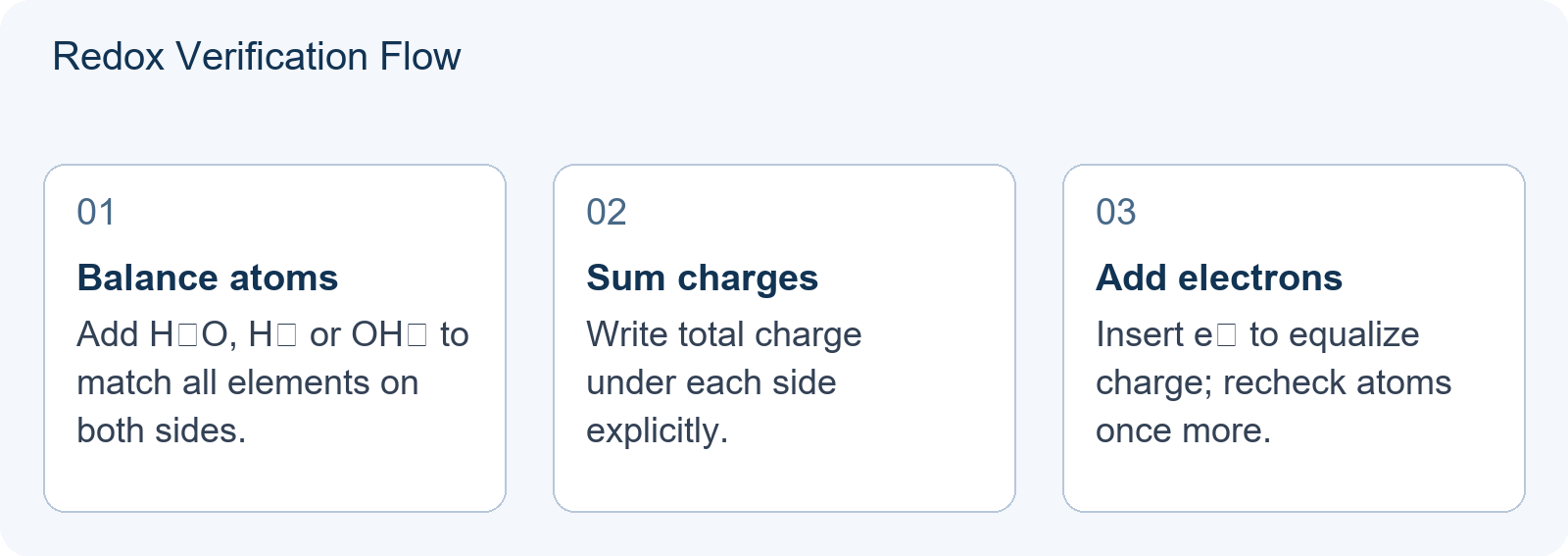
A useful observation from preparation practice is that students who write the charge total explicitly—below each side, like a third column—catch their own errors before they commit to an answer. Those who skip the explicit step often discover the mistake only after time has been lost.
Worked Teaching Illustration 1: The Standard Case
Teaching illustration—hypothetical problem for practice, not an official USNCO question.
Consider the reduction of permanganate in acidic solution. A student sets up:
Reduction: MnO₄⁻ → Mn²⁺
Step-by-step atom balance first:
- Balance Mn: already 1 on each side.
- Balance O with H₂O: MnO₄⁻ → Mn²⁺ + 4H₂O
- Balance H with H⁺: 8H⁺ + MnO₄⁻ → Mn²⁺ + 4H₂O
Now the charge check:
| Species | Charge contribution |
|---|---|
| 8H⁺ | +8 |
| MnO₄⁻ | –1 |
| Left total | +7 |
| Mn²⁺ | +2 |
| 4H₂O | 0 |
| Right total | +2 |
The left is +7, the right +2. Add 5e⁻ to the left:
8H⁺ + MnO₄⁻ + 5e⁻ → Mn²⁺ + 4H₂O
Verification: atoms—Mn 1, O 4, H 8 both sides; charge—left +8–1–5 = +2, right +2. Both atoms and charge now balance. This is the textbook path, and it works because the student did not stop after the H₂O step.
Worked Teaching Illustration 2: Where the Shortcut Fails
Teaching illustration—hypothetical problem for practice, not an official USNCO question.
Now consider the oxidation of sulfite to sulfate in acidic solution. A student rushes and writes:
Oxidation: SO₃²⁻ → SO₄²⁻
The student adds H₂O to balance oxygen, then H⁺ to balance hydrogen, and finally electrons:
SO₃²⁻ + H₂O → SO₄²⁻ + 2H⁺ + 3e⁻
Atom check: S = 1 both sides; O = 4 both sides; H = 2 both sides. Atoms balance.
Charge check: left = –2; right = –2 + 2 + (–3) = –3.
The charge is off by one unit. The correct equation requires 2e⁻, not 3e⁻:
SO₃²⁻ + H₂O → SO₄²⁻ + 2H⁺ + 2e⁻
Verification: atoms—S 1, O 4, H 2 both sides; charge—left –2, right –2 + 2 – 2 = –2. This is the kind of slip—an extra electron—that atom balance alone cannot catch. The explicit charge column reveals the error immediately.
Teaching illustration note: basic-medium problems generate more overall errors than acidic-medium problems because students must track whether they are adding H⁺ or OH⁻. The explicit charge column removes that ambiguity.
The Common Mistake Pattern
Below is a diagnostic summary of the error types seen in preparation practice:
| Error | How it appears | Detection method |
|---|---|---|
| Correct atoms, wrong charge | Missing electrons or wrong multiplier | Write Σcharge under each side |
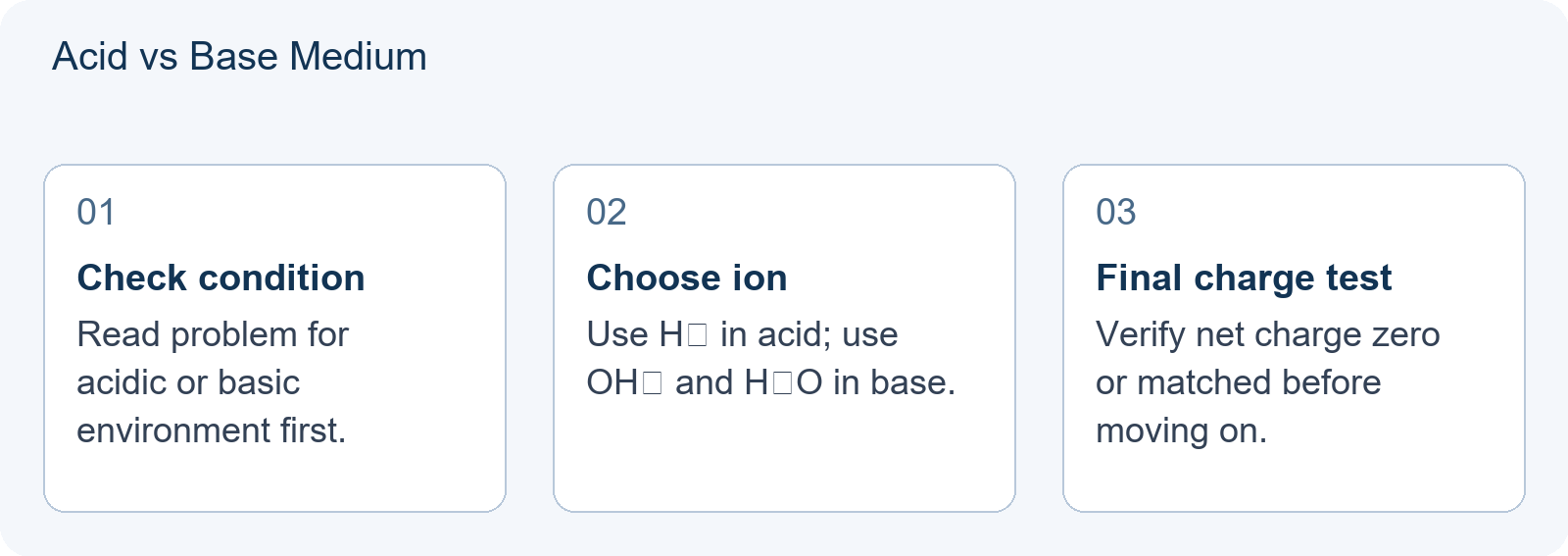
| Wrong medium (acid vs base) | H⁺ in basic solution or vice versa | Check problem statement first |
| Electron sign reversed | Oxidation has e⁻ on left | Verify: oxidation loses e⁻ (right), reduction gains e⁻ (left) |
| Water placed on wrong side | O balances but H does not | Recount H after O is fixed |
A Targeted Practice Sequence
For students preparing for the 2026 USNCO season, the following sequence builds the verification habit without requiring new content:
- Isolate the step: Take any five redox equations you have already solved. Cover the final line and redo only the charge check. If you cannot reconstruct the charge total mentally, you need the explicit column.
- Introduce one basic-medium problem: The switch from H⁺ to OH⁻ is the most common trigger for sign errors. Do one problem slowly with the charge column, then repeat it the next day without notes.
- Timed verification drill: Give yourself three minutes per half-reaction. The goal is not speed of balancing but speed of detecting an imbalance. This trains exam reflexes.
For broader context on how USNCO papers are structured and how to choose between local and national levels, see USNCO vs CCC: Which Chemistry Competition to Prepare for When You Cannot Do Both. If you are looking for deeper explanation resources beyond answer keys, USNCO Past Papers: Requesting Explanations Beyond an Answer Key provides guidance. For administrative details about registration through an ACS local section, see USNCO Registration Through an ACS Local Section: What the Coordinator Actually Needs From You.
What to Demonstrate Next
After working through the two illustrations above, a learner should be able to: write any half-reaction in acidic or basic medium; produce an explicit charge total for each side; and identify which of the four error types in the diagnostic table applies when a proposed equation is incorrect. This skill transfers directly to USNCO Part II (national exam) where multi-step redox problems carry the highest point weight.
Frequently Asked Questions
Why do I need a separate charge check if the atoms already balance?
Because redox reactions involve electron transfer. The number of atoms can be correct while the total charge differs by one or more units. USNCO problems are designed to test this exact oversight.
Should I write the charge total in exam conditions, or is it too slow?
With practice, the explicit charge total takes under ten seconds and prevents far costlier errors. The explicit column is recommended as standard working for all redox problems.
Does this apply to both Local and National USNCO exams?
Yes. Local exam redox questions are simpler but still require correct balancing. National exam Part II uses the same principle in more complex multi-step problems. The verification habit pays off at both levels.