
For students preparing for the U.S. National Chemistry Olympiad (USNCO), chemical equilibrium is a cornerstone topic. While broad reviews cover pH, buffers, and titration curves—as detailed in our companion article Aqueous Equilibrium, Decoded: pH, Buffers, Titration Curves and Ksp for the USNCO (2026)—specific calculation pitfalls often go unaddressed. One of the most common errors involves the “small-change” or “small-x” approximation. This shortcut assumes that the change in concentration () during reaction progress is negligible compared to the initial concentration. While useful, applying it blindly can lead to significant inaccuracies in competition settings where precision matters. This article uses original teaching illustrations, not official past-paper questions, to build your judgment.
The Logic Behind the Small-Change Shortcut
In many equilibrium calculations, particularly for weak acids or bases with small or values, the amount of reactant that dissociates is tiny relative to the starting amount. Mathematically, if the initial concentration is large and is small, we assume . This simplifies the equilibrium expression from to , allowing for a quick square-root solution.
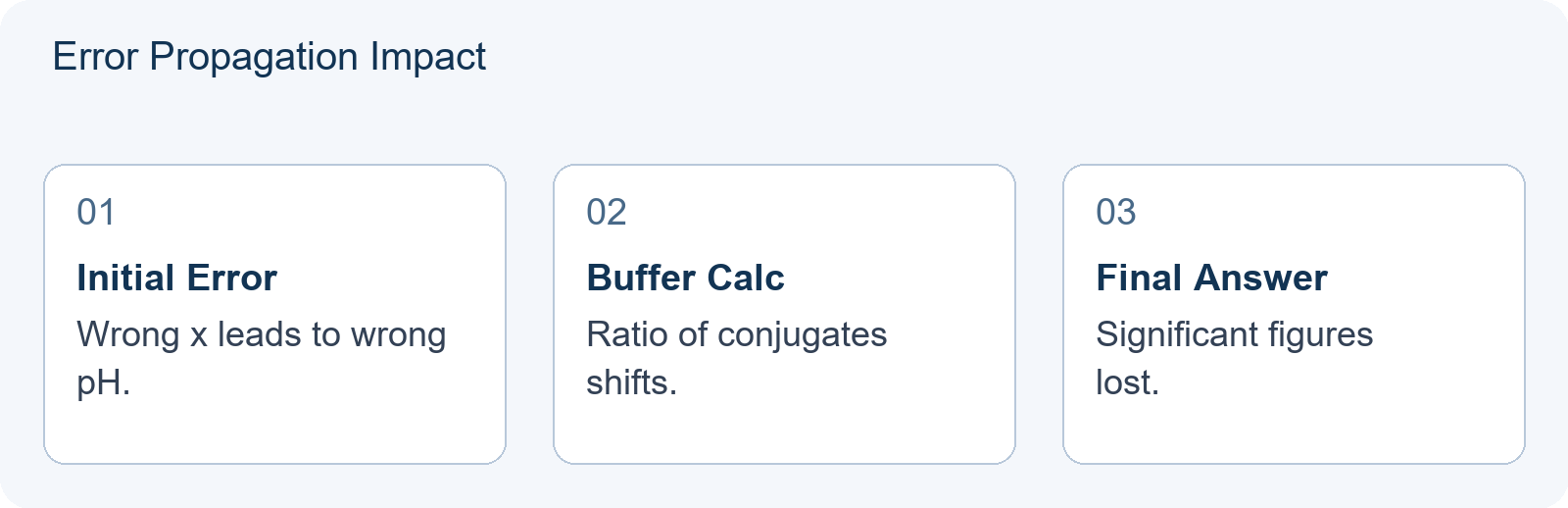
This method saves time and reduces algebraic complexity. However, USNCO problems are designed to test conceptual understanding alongside computational skill. If the assumption fails, the resulting error propagates through subsequent steps, potentially invalidating an entire multi-part question. Understanding the boundary conditions of this approximation is critical for high-level performance. The temptation to skip verification is strongest when time pressure peaks, yet this is precisely when an unchecked assumption proves most costly.
Teaching Illustration 1: Where the Shortcut Works
[Teaching Illustration — hypothetical scenario for instructional purposes]
Consider a weak acid HA with and initial concentration . Using the approximation:
To verify validity, check percent ionization: . Since this is well below the typical 5% threshold, the approximation holds. The exact quadratic solution, , yields . The difference is negligible—about 0.7%. In a timed exam, moving forward with the approximate value is efficient and accurate.
Teaching Illustration 2: Where the Shortcut Fails
[Teaching Illustration — hypothetical scenario for instructional purposes]
Now consider a weak base B with and initial concentration . Applying the same shortcut:
- (keeping extra digits for comparison)
Checking percent ionization: . This far exceeds the 5% rule. The assumption that fails because consumes nearly one-third of the initial material.
Solving exactly: rearranges to , giving . By the quadratic formula:
The approximate answer () overestimates the true value by approximately 18.6%. This magnitude of error would cascade into incorrect pH calculations or buffer capacity estimates in subsequent parts of a multi-step problem. Recognizing this failure mode before committing to the shortcut is the central skill this article targets.
Diagnostic Table for Decision Making
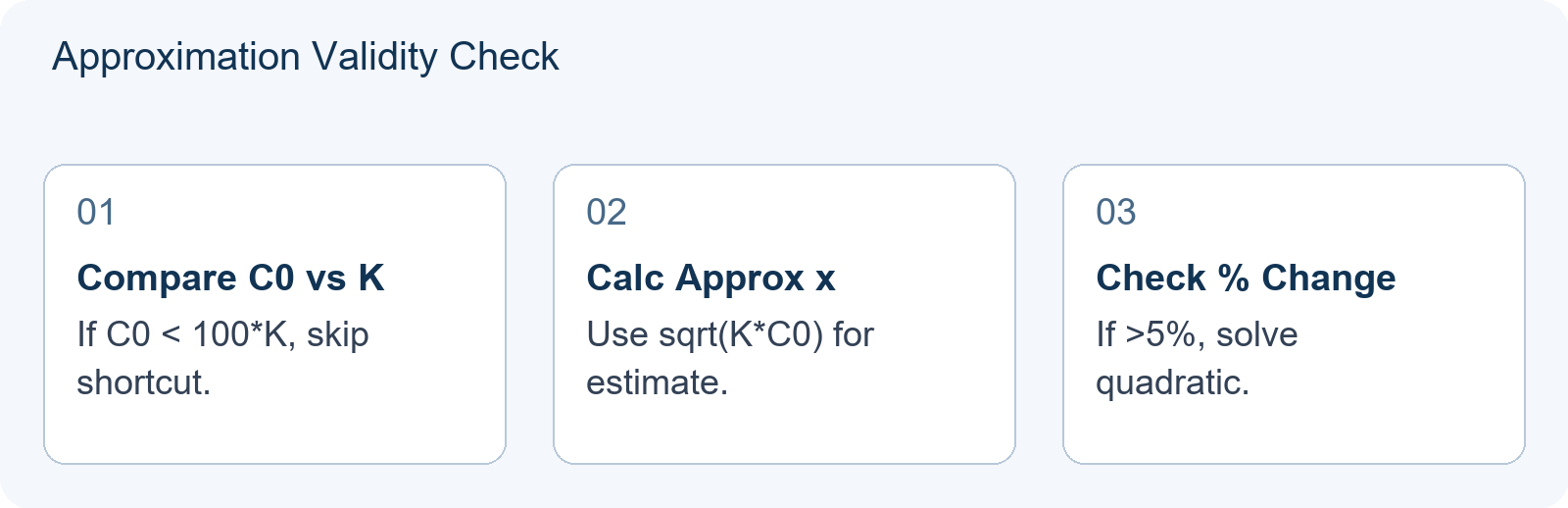
To avoid such errors, use a quick diagnostic before committing to the shortcut. The following table summarizes key indicators based on standard teaching practices for competitive chemistry preparation.
| Condition | Indicator | Action |
|---|---|---|
| High Initial Concentration | Approximation likely valid; proceed with shortcut. | |
| Low Initial Concentration | Approximation risky; solve quadratic exactly. | |
| Moderate Values | Calculate approximate , then check % ionization. | |
| Post-Calculation Check | % Ionization > 5% | Discard approximate result; re-solve using quadratic formula. |
The rule is a heuristic, not a law. Always prioritize the 5% ionization check as the final arbiter. For broader context on how equilibrium concepts connect to phase behavior and thermodynamics, see our analysis of Phase Diagrams, Vapour Pressure and Heating Curves: The USNCO Phase-Change Questions, Decoded (2026).
Targeted Practice Sequence
Building intuition for when to approximate requires deliberate practice. We suggest the following sequence for self-study:
- Identify Variables: Extract and from the problem statement immediately.
- Apply Heuristic: Calculate the ratio . If less than 100, flag the problem for exact solving.
- Solve & Verify: If you used the shortcut, calculate the percent change. If it exceeds 5%, redo the calculation using the quadratic formula.
- Reflect: Note whether the error direction (over/underestimation) aligns with theoretical expectations.
This process reinforces the connection between mathematical assumptions and physical reality. It also prepares you for the rigorous analytical demands of the National Exam. For a wider view of where equilibrium sits among the most challenging USNCO topics, refer to The Hardest USNCO Topics, Decoded: Thermodynamics, Equilibrium & Organic (2026).
Demonstrating Mastery
A learner should be able to demonstrate next-step proficiency by correctly identifying which of three mixed equilibrium problems require exact solutions versus approximations within five minutes. This speed and accuracy distinguish top-tier competitors who understand the underlying limits of their tools. The ability to diagnose approximation validity before committing to a calculation path is a hallmark of advanced problem-solving in chemistry olympiad preparation.
Frequently Asked Questions
Is the 5% rule absolute for USNCO?
No, it is a guideline. Some contexts may tolerate slightly higher errors, but for precise pH or buffer calculations, sticking to the 5% threshold ensures reliability.
What if I don’t have time to solve the quadratic?
In timed exams, if the ratio C0/K is clearly low, estimate the magnitude of error. Often, multiple-choice options will reflect the approximate vs. exact difference, helping you choose the closest valid answer.
Does this apply to gas-phase equilibria too?
Yes, the logic applies to any equilibrium expression where a term like (Initial – x) appears in the denominator. The same percentage change criteria determine validity.