
One of the most persistent sources of error in U.S. National Chemistry Olympiad (USNCO) preparation is not a lack of chemical knowledge, but a misapplication of thermodynamic conventions. Specifically, students often struggle with USNCO Calorimetry because they fail to explicitly define the “system” before assigning the sign to heat (). In introductory courses, this distinction is sometimes glossed over, leading to confusion when faced with multi-step synthesis or complex experimental data questions typical of the Olympiad.
The Core Principle: System vs. Surroundings
Thermodynamics is built on the first law: energy is conserved. In any calorimetry experiment, there are two distinct entities exchanging energy: the system (the reaction occurring) and the surroundings (the water, the calorimeter cup, the thermometer, etc.). The fundamental equation governing this exchange is:
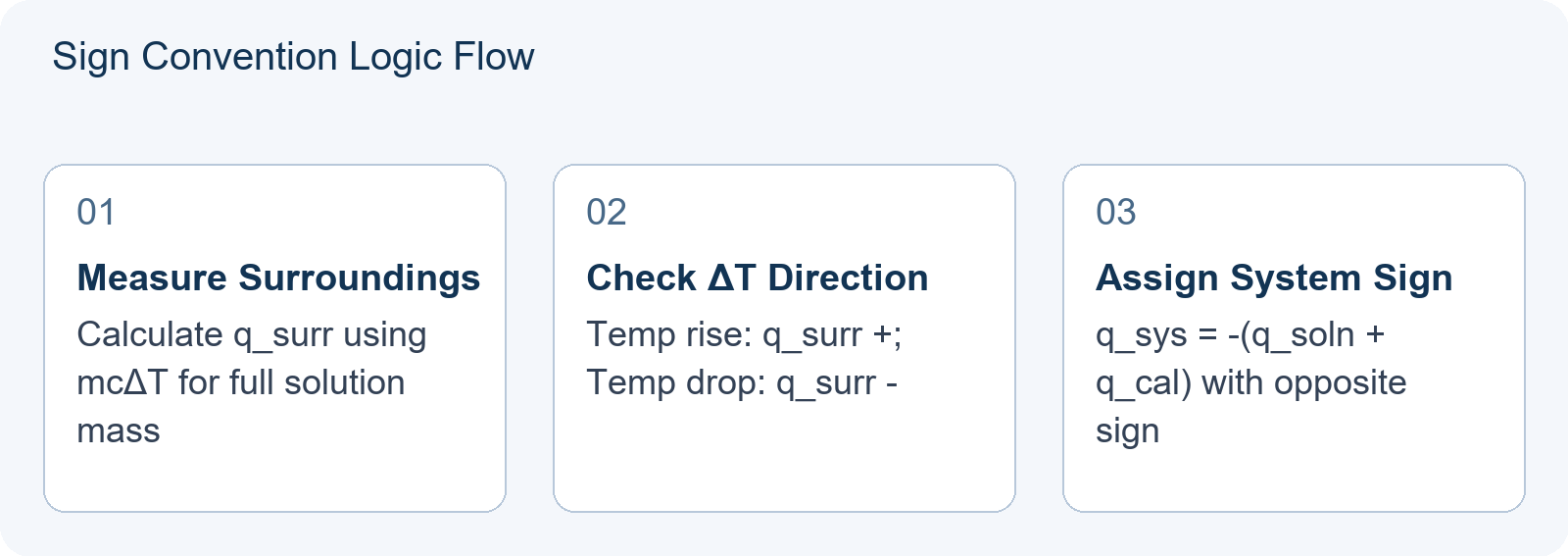
The complete energy balance assumes an adequately isolated apparatus and accounts for both solution and calorimeter heat. If the reaction releases heat (exothermic), is negative, and the surroundings gain that heat, making the sum of surroundings terms positive. Conversely, if the reaction absorbs heat (endothermic), is positive, and the surroundings lose heat.
The critical mistake occurs when students calculate using the formula for the water alone and then directly assign that value to the reaction enthalpy () without flipping the sign or accounting for the calorimeter. If the temperature of the solution rises, is positive, so is positive. However, since the solution gained heat from the reaction, the reaction must have lost heat. Therefore, must be negative. Failing to make this conceptual leap results in reporting an exothermic reaction as endothermic—a fatal error in scoring.
This same principle appears when students work with Where ΔH Actually Comes From: Formation Data, Bond Enthalpies, Hess Cycles and Calorimetry (2026), where the direction of a reaction determines whether a given enthalpy term is added or subtracted. The sign convention discipline developed in calorimetry transfers directly to those more advanced thermochemical calculations.
Worked Teaching Illustration: Neutralization Reaction
Note: This is a hypothetical teaching example designed to illustrate the logic, not an actual past contest problem.
Consider a student mixing 50.0 mL of 1.0 M HCl with 50.0 mL of 1.0 M NaOH in a coffee-cup calorimeter. The initial temperature of both solutions is 22.0°C. After mixing, the final temperature stabilizes at 28.9°C. Assume the density of the solution is 1.0 g/mL, the specific heat capacity () is 4.18 J/g·°C, and the heat capacity of the calorimeter cup and any heat loss to the environment are negligible.
Step 1: Calculate Heat Change of the Surroundings
The “surroundings” here are the aqueous solution. We calculate the heat absorbed by the solution:
- Total mass () = 50.0 g + 50.0 g = 100.0 g
- Temperature change () = = 28.9°C – 22.0°C = +6.9°C
Since is positive, the solution gained heat. Thus, is positive (+2884.2 J).
Step 2: Define the System and Flip the Sign
The “system” is the neutralization reaction: . By conservation of energy, the heat released by the system equals the heat gained by the surroundings (with cup heat neglected as stated):
This negative sign confirms the reaction is exothermic. If a student stops here and reports as positive, they have failed to distinguish between the measured quantity (temperature rise of solution) and the thermodynamic property of the reaction.
Step 3: Convert to Molar Enthalpy
To find , we divide by the moles of limiting reagent. Both HCl and NaOH are 0.050 L × 1.0 mol/L = 0.050 mol.
The sign and magnitude are correct because the system definition was rigorous and the assumptions (negligible cup heat, no heat loss) were explicitly stated.
Contrasting Case: Dissolving Ammonium Nitrate
Now consider a different scenario: dissolving ammonium nitrate () in water. This process is commonly used in instant cold packs. A student adds 5.0 g of to 50.0 g of water at 25.0°C. The temperature drops to 20.0°C. The specific heat capacity of the resulting solution is taken as 4.18 J/g·°C.
Step 1: Calculate Heat Change of the Surroundings
Here, the surroundings are the entire solution—both water and dissolved solute. We use the total solution mass:
- Mass () = 5.0 g + 50.0 g = 55.0 g (do not silently drop the 10% solute mass)
The solution lost heat; therefore, is negative.
Step 2: Define the System and Flip the Sign
The system is the dissolution process: .
The positive sign indicates the system absorbed heat from the surroundings, confirming the process is endothermic. This aligns with the physical observation of cooling.
Step 3 (Optional): Convert to Molar Enthalpy
For completeness, using g/mol for :
Common Pitfall Analysis
In many USNCO multiple-choice questions, distractors will offer answers with incorrect signs or masses. Students who mechanically apply using water mass only, or who report the raw value as without sign reversal, will select incorrect answers. The key diagnostic question is always: Did the surroundings get hotter or colder? If colder, the surroundings lost energy (), so the system gained energy ().
Bomb Calorimetry: Constant Volume Considerations
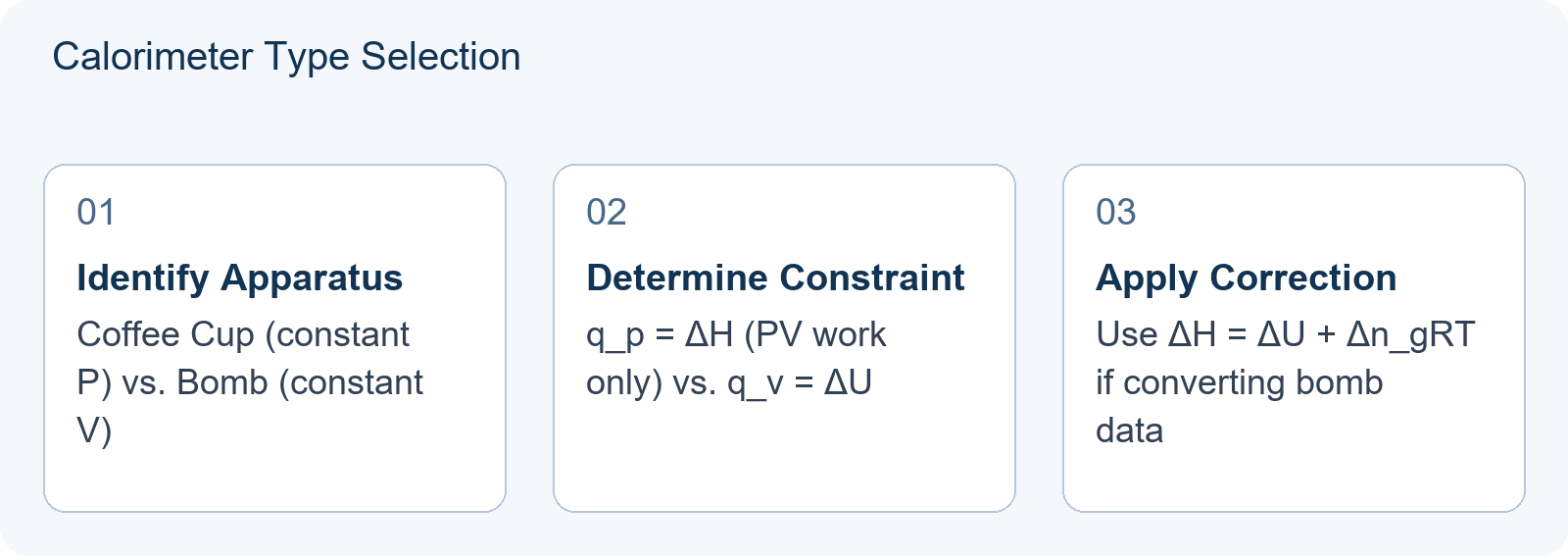
While coffee-cup calorimeters measure at constant pressure (where under conditions of pressure-volume work only), bomb calorimeters operate at constant volume, measuring internal energy change (, also written ). Under constant volume conditions with no other work, .
For reactions involving gases, and differ by the pressure-volume work term. Under ideal-gas assumptions and at the same temperature:
In USNCO problems, students must recognize whether the apparatus implies constant pressure or constant volume. If a problem states “bomb calorimeter,” the direct measurement is . To report enthalpy change, one must convert using the equation above. One must not call any bomb calorimetry result a “standard enthalpy” without verifying that standard-state conditions (1 bar, specified temperature, pure substances in their standard states) are actually met.
For the combustion of methane with liquid water as product: . Here, . At 298 K, the correction term is . While small relative to the total heat (~890 kJ/mol), ignoring it can lead to precision errors in high-level competition scoring.
Diagnostic Application: Identifying Your Error Pattern
To determine if you need targeted practice on this topic, attempt the following self-diagnostic. Do not look up formulas; rely on your current mental model.
- Scenario A: You mix two reactants in a beaker. The beaker feels hot to the touch. Is positive or negative?
- Scenario B: You dissolve a salt in water. The solution becomes cold. Is positive or negative?
- Scenario C: In a calculation, you find . What is ?
Correct Answers:
1. Negative (Exothermic: system loses heat to surroundings).
2. Positive (Endothermic: system gains heat from surroundings).
3. -500 J (Conservation of energy: ).
If you answered any incorrectly, your issue is likely conceptual rather than mathematical. Review the definition of “system” in every problem statement. Does the problem define the system as the “reaction mixture” or the “entire calorimeter assembly”? Usually, it is the reaction mixture, while the water/cup is the surroundings.
Strategic Preparation for USNCO
Understanding the sign convention is foundational, but USNCO also tests the ability to handle non-ideal conditions. For instance, heat loss to the environment is a common source of experimental error. In theoretical problems, you may be asked to correct for this using Newton’s Law of Cooling or extrapolating temperature-time graphs back to the time of mixing.
When preparing, focus on these areas:
- Graphical Analysis: Practice interpreting temperature vs. time plots. Identify the maximum/minimum temperature reached after mixing, accounting for heat loss trends.
- Unit Consistency: Ensure all masses are in grams, temperatures in Celsius (for ), and energies in Joules before converting to kJ/mol.
- Stoichiometric Linkage: Always link the calculated back to the number of moles reacted. A common trap is calculating per gram instead of per mole, or vice versa.
Additionally, review related topics such as Where ΔH Actually Comes From: Formation Data, Bond Enthalpies, Hess Cycles and Calorimetry (2026), where sign manipulation is equally critical. If you reverse a reaction, changes sign. If you multiply coefficients, scales accordingly. These algebraic manipulations mirror the physical reality of reversing or scaling the heat flow direction.
For students also considering USNCO vs UKChO: How the Two Biggest English-Medium Chemistry Olympiads Compare, note that both competitions test calorimetry, though the specific emphasis and problem structures differ. The sign convention discipline developed here pays dividends across both exams.
Those seeking structured practice should consult USNCO Past Papers: Requesting Explanations Beyond an Answer Key rather than answer keys alone. Calorimetry problems recur with predictable structures, and deliberate practice with full reasoning builds the automaticity needed under exam time pressure.
Conclusion: Rigor in Definition
Mastery of USNCO calorimetry requires more than plugging numbers into . It demands a clear mental picture of energy flow. Always ask: “Who is losing energy, and who is gaining it?” By consistently defining the system and applying the conservation principle , you eliminate the most common sign errors. This rigor supports accurate determination of enthalpies, essential for solving complex thermochemical cycles and predicting reaction feasibility in competitive chemistry contexts.
Frequently Asked Questions
Why does the temperature rise indicate a negative ΔH?
A temperature rise means the surroundings (solution) gained heat energy. Since energy is conserved, the system (reaction) must have lost that same amount of energy. Loss of energy by the system is defined as negative enthalpy change.
Do I need to account for the calorimeter’s heat capacity?
Yes, if the problem provides a calorimeter constant (C_cal). The total heat absorbed by surroundings is q_solution + q_calorimeter. Then q_system = -(q_solution + q_calorimeter). In simplified problems, cup heat may be stated as negligible.
Is ΔH always equal to q_p?
At constant pressure with only PV work, yes. However, in bomb calorimetry (constant volume), the measured heat is ΔU. You must convert ΔU to ΔH using ΔH = ΔU + Δn_gRT under ideal-gas assumptions. Also, do not call any bomb result a ‘standard enthalpy’ without standard-state conditions.