The USNCO and the UK Chemistry Olympiad (UKChO) are the two largest English-medium national chemistry competitions that both feed the International Chemistry Olympiad (IChO). The USNCO, run by the American Chemical Society (ACS), is built around a three-part National Exam that includes a hands-on wet-lab practical; the UKChO, run by the Royal Society of Chemistry (RSC), is primarily a written pathway. Here is how the two systems compare — and which past papers make the best training material for a student based in China.
Two national olympiads, one finish line
Both competitions exist to do the same job: identify a country's strongest pre-university chemistry students and select a small national team for the IChO, held each July. Beyond that shared destination they diverge — different organising bodies, different calendars, and noticeably different exam styles. For most students at an international school in China, the useful question is not “which one do I enter” but “which one gives me the best training material, and how do the two exam styles stretch me differently?” Both are national contests with their own eligibility rules; on the ACS side there is a narrow route for some students enrolled abroad, which we set out below.
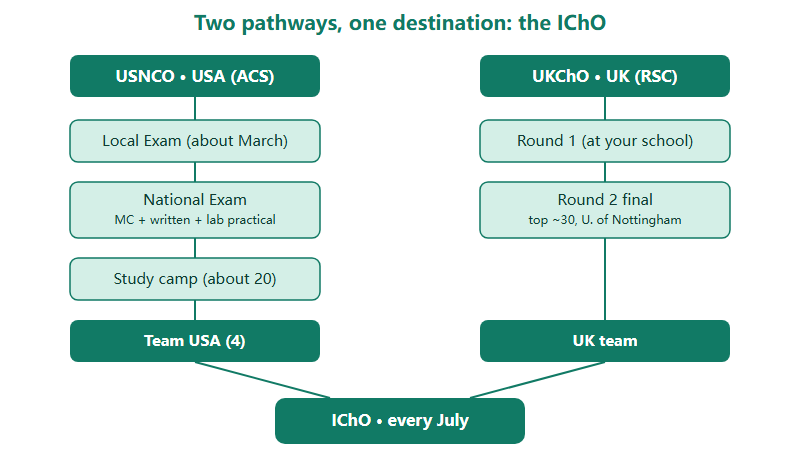
If you are new to the US side of this picture, our explainer on what the USNCO is and how it works lays out the four ACS stages. The short version: the USNCO runs a Local Exam, then a National Exam, then a residential study camp, and finally names four students to Team USA. The UKChO runs two rounds and then selects a UK team. Both roads end at the IChO.
USNCO vs UKChO at a glance
The table below summarises the two systems using facts published by each organiser. Because dates, mark schemes and exact formats are revised from year to year, always confirm the current details on acs.org (for the USNCO) and rsc.org (for the UKChO).
| Feature | USNCO (United States) | UKChO (United Kingdom) |
|---|---|---|
| Organiser | American Chemical Society (ACS) | Royal Society of Chemistry (RSC) |
| Entry stage | Local Exam, taken through an ACS Local Section (around March) | Round 1, sat at your own school (January–February) |
| Advanced stages | National Exam → residential study camp (about 20 students) → Team USA (4) | Round 2 final (roughly the top 30, at the University of Nottingham) → UK team |
| National / advanced exam format | Three parts: 60 multiple-choice (90 min), written free-response (105 min), and a laboratory practical (90 min) | Primarily written papers; Round 1 has been marked out of 84 — confirm current format on rsc.org |
| Hands-on lab practical | Yes — a wet-lab practical is built into the National Exam (Part III) | Primarily written pathway; confirm current Round 2 arrangements on rsc.org |
| Past papers for training | Multiple years available to practise with; worked solutions for selected years | Multiple years available; train alongside the official syllabus |
| Who can enter | Local Exam through an ACS Local Section — ACS states no citizenship condition at that stage; the National Exam, study camp and Team USA require US citizenship or permanent residency. US citizens and green-card holders enrolled at an accredited American school abroad compete through an ACS International Chemical Sciences Chapter. See our eligibility guide | UK-based school students — confirm eligibility with the RSC |
| Feeds into | IChO (as Team USA) | IChO (as Team UK) |
The biggest structural difference: a built-in lab practical
The most useful thing to understand about the USNCO is that its National Exam is not just a paper test. It has three parts: Part I is 60 multiple-choice questions in 90 minutes; Part II is a written free-response section (105 minutes) that rewards multi-step problem solving; and Part III is a genuine wet-lab practical (90 minutes) at the bench. Confirm current timings on acs.org, but the structure has long emphasised that a top US chemistry student must be able to think and pour, titrate and measure.
The UKChO's main pathway is written: Round 1 is a challenging paper sat at your own school, and the Round 2 final gathers the strongest students at the University of Nottingham. For the exact practical arrangements at each UKChO stage, check rsc.org rather than assuming they match the USNCO. What is worth noting is that the IChO itself always includes a long, mandatory practical exam alongside its theoretical paper — so the USNCO's bench component is excellent preparation for the international level, whichever national route a student ultimately qualifies through.
For a China-based student who is training on these papers rather than sitting either exam, this is the single most important takeaway: theory papers are only half of olympiad chemistry. If you want your self-study to mirror what these competitions actually demand, you have to practise real laboratory technique, not just calculation.
Where the Canadian and Chinese olympiads fit
The USNCO and UKChO are not the only national routes to the IChO. Canada runs its own selection (the Canadian Chemistry Olympiad, sometimes abbreviated CCO), and China has its own national olympiad — the Chinese Chemistry Olympiad, organised by the Chinese Chemical Society — which selects the team that represents China. Each of these has its own structure, calendar and eligibility rules that we do not reproduce here because they change and because we cannot verify every current detail from ACS sources.
If you are enrolled in the domestic Chinese school system and want to actually compete, the Chinese Chemical Society's national olympiad is the route to investigate first — confirm access and timelines through its official channels. If you are at an international school following AP, A-Level or IB, entry into these national contests is usually restricted — with one real exception on the US side. Per ACS, a US citizen or permanent resident who has been enrolled for at least a year at an accredited American school abroad, and is under 20, can compete through an ACS International Chemical Sciences Chapter; ACS's own published results have included students at such a school in Shanghai. If that is not you, the reliable, honest value here is training on the published past papers and syllabi. That is the theme of the next section.
Which past papers should a China-based student train on?
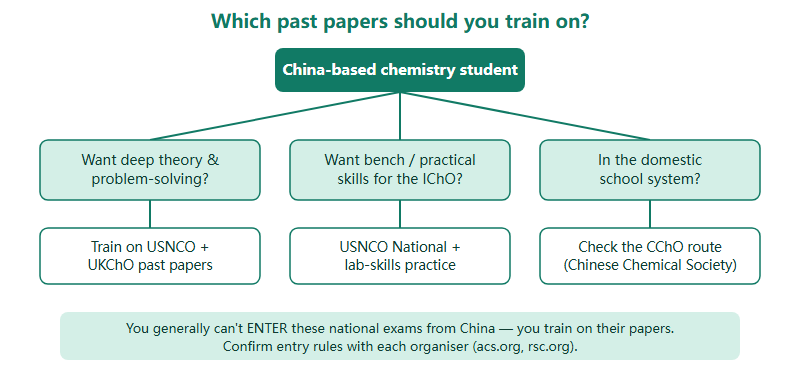
You generally cannot register for the UKChO from China, and the ACS route is open only to the students described above — so for most readers the goal is to use this material as a graded set of benchmarks. A sensible sequence looks like this:
- Build speed first. Recent USNCO Local Exams (60 multiple-choice questions in 90 minutes) train pace and accuracy under time pressure.
- Add depth next. USNCO National Part II (written problem solving) and UKChO Round 1 papers reward multi-step reasoning and punish shortcuts — they stretch you further than a typical school exam.
- Rehearse the bench. Because the IChO always has a practical, treat USNCO Part III-style tasks and core lab skills (titration, gravimetric analysis, calorimetry) as part of the curriculum, not an afterthought.
- Review with worked solutions, not just answer keys. The learning is in understanding why a step follows, especially in equilibrium, thermodynamics and electrochemistry.
Our team maintains a curated, organised pack of USNCO past papers with worked notes for selected years, and we keep adding to it over time (solutions do not yet cover every single year). For a method to actually learn from these papers — rather than grinding through them blindly — see our guide on how to use USNCO past papers effectively.
One last honest point. For most students in mainland China, sitting either exam is not possible: the UKChO is a UK-based contest (confirm with the RSC), and on the ACS side the National Exam is limited to US citizens and permanent residents, while the abroad route additionally requires at least a year at an accredited American school. There is also no individual sign-up form from abroad in any case — entry is arranged by a Local Section or an ACS International Chemical Sciences Chapter, not by the student — but that is a statement about the mechanism, not proof that no route exists. Being able to answer the questions is not the same as being eligible to compete. Your gain is the training, the benchmarking, and the deep chemistry you build along the way. For the specifics of who can and cannot take the US exam, read our piece on whether international students can take the USNCO, and confirm any entry question with ACS (acs.org) and the RSC.
Frequently asked questions
Is the USNCO harder than the UKChO?
Both are demanding at a high level. The USNCO National Exam adds a wet-lab practical and heavy written problem-solving; the UKChO is primarily written. Compare recent past papers to judge the level yourself.
Can a student in China enter the USNCO or UKChO?
For the UKChO, generally no — confirm with the RSC (rsc.org). For the USNCO it depends on the student: per ACS, a US citizen or permanent resident enrolled for at least a year at an accredited American school in China can compete through an ACS International Chemical Sciences Chapter, and ACS's published lists include such students. A student who is not a US citizen or permanent resident, at a school in mainland China, has no ACS route and trains on the past papers instead. Confirm with ACS (acs.org).
Which past papers should I train on first?
Start with recent USNCO Local papers to build speed, then USNCO National and UKChO Round 1 for depth. See our past-paper guide for a study method.
Do both olympiads lead to the IChO?
Yes. The USNCO selects Team USA and the UKChO selects Team UK; both send students to the International Chemistry Olympiad each July.
This is the USNCO information desk synchronising official ACS information for chemistry students in China, operated by Hanlin Education. The USNCO is run by the American Chemical Society (ACS), which sets all official rules and eligibility; the UKChO is run by the Royal Society of Chemistry (RSC). Always confirm current details on acs.org (and rsc.org for UK information). Any errors are corrected within 7 working days.