Students in China cannot sit the real USNCO — but a school chemistry club can stage a remarkably faithful USNCO-style mock exam using released papers, and get most of the training value of a real competition day. This playbook covers the whole cycle: choosing a paper, mirroring the timing, proctoring rules, grading, internal recognition tiers, and the review clinic afterwards that turns one exam day into a semester of progress.
Why a mock exam beats another study session
Solo past-paper practice is the backbone of USNCO-level self-study, but it systematically under-trains three things that only a room full of people can supply: real exam-day nerves, non-negotiable timing, and the social commitment that stops students from quietly abandoning a hard paper halfway. A club mock manufactures all three at essentially zero cost.
There is also a structural reason this matters for readers in China specifically. The real USNCO runs through ACS Local Sections and is designed for U.S. high-school students — there is no entry channel from China, as we lay out in our honest eligibility guide. A well-run school mock is the closest legitimate substitute for the competition-day experience, and for the students who organise it, the event itself becomes documented leadership: a dated, witnessed activity with participants, materials, and results.
One thing a mock is not: an official score. Never present internal mock results as USNCO results, on posters or in applications. “Scored 44/60 on the 2019 released national exam under club proctoring” is honest and impressive; anything implying official participation is fabrication.
Choosing the format: mirror the national exam’s parts
The released USNCO national exams give you a natural template. The national exam consists of a 60-question multiple-choice section (90 minutes), a written free-response section (105 minutes), and a laboratory practical (90 minutes) — the full structure is summarised in our foundation guide to the USNCO. For a school club, we recommend a three-tier menu rather than always attempting the full day:
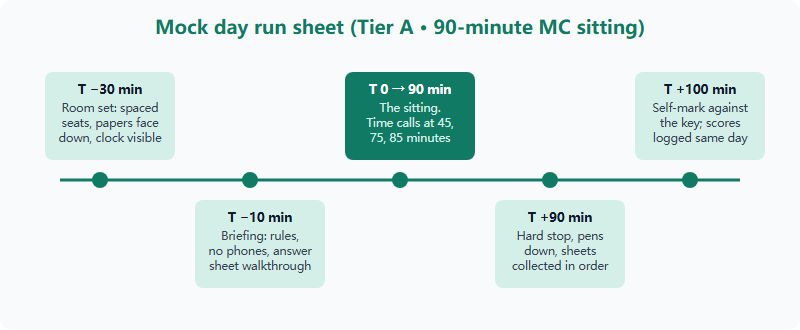
- Tier A — the 90-minute MC sitting (start here). One released multiple-choice paper, 60 questions, hard stop at 90 minutes. Easiest to proctor and grade; run it your first time.
- Tier B — MC + selected free-response. Add two or three free-response problems in a separate timed block, graded against the worked solutions by the club’s strongest members plus a supervising teacher.
- Tier C — the full-day simulation. MC, free-response, and a school-lab practical exercise designed with your teacher using standard school equipment (a titration with time pressure works well). Run this at most once or twice a year — it is an event, not a routine. Safety rules and what your school lab can legally do come first; your teacher decides the practical’s scope.
Paper supply: we maintain a gathered pack of released exams from 1999–2025, with worked solutions for many of the years — message us to get it, and see our guide to using the pack well for how to sequence papers across a season. Reserve two or three recent papers exclusively for mocks so nobody has seen them before exam day.
Proctoring rules that make the score mean something
A mock score is only as credible as its conditions. Publish these rules in advance and enforce them cheerfully but absolutely:
- Closed materials. Only what the released paper itself provides (periodic table and any data included in the paper). No textbooks, no notes, no phones anywhere near desks.
- Calculator policy set in advance. Decide one policy for your club, announce it before the day, and apply it to everyone equally — consistency is what makes scores comparable across sittings. (For the real exam’s current rules on permitted materials, always defer to acs.org.)
- One adult witness. Ask a chemistry teacher to be present for at least the start and finish. This costs them little and upgrades every score in the room from “self-reported” to “proctored.”
- No re-entry, no extra time. A student who leaves is done; the 90 minutes is a hard ceiling for everyone including the organisers.
- Same-day marking. Feedback decays fast. Mark against the key within the hour and log scores while the paper is fresh in everyone’s head.
Scoring, internal tiers, and the review clinic
Score the MC section simply: raw marks out of 60, no internal curve. For recognition, create club-internal tiers with your own names — “Distinction / Merit / Participation” or house names work fine. Do not borrow the official USNCO recognition vocabulary (the real programme names its national top tiers High Honors and Honors); using different words keeps a bright line between your event and the official one.
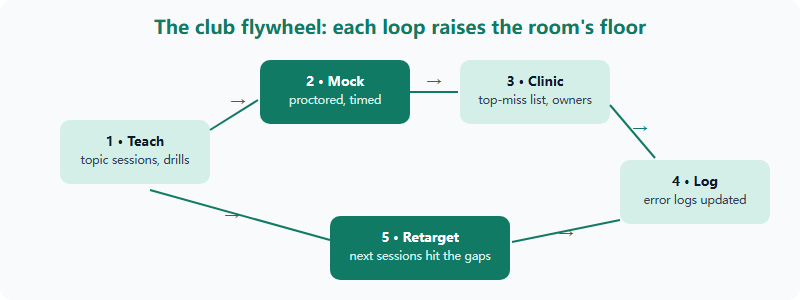
The review clinic one week later is where the value compounds. A format that has worked repeatedly in the school clubs we support:
- The top-miss list (15 min). The organisers tally the five questions most commonly missed and open the session with them. These are, by construction, the room’s shared weaknesses.
- Owner presentations (30 min). Each of the five questions is “owned” by a student who got it right (or researched it), presenting the full reasoning — not just the answer letter.
- Error-log sprint (15 min). Everyone writes their personal misses into their own error log, categorised by topic, before leaving the room. What is not logged that day is usually lost.
| Semester week | Club activity | Output logged |
|---|---|---|
| Weeks 1–3 | Topic sessions (stoichiometry → equilibrium → electrochemistry), 10-question warm-up sets | Attendance, warm-up scores |
| Week 4 | Mock #1 — Tier A (older released paper) | Baseline scores /60 |
| Week 5 | Review clinic for Mock #1 | Top-miss list, updated error logs |
| Weeks 6–9 | Topic sessions targeting the top-miss areas; free-response skeleton drills | Two graded free-response problems each |
| Week 10 | Mock #2 — Tier B (MC + 2 free-response) | Scores /60 + FR grades |
| Week 11 | Review clinic #2; compare Mock #1 → #2 curves | Per-student progress deltas |
| Weeks 12–14 | Optional Tier C full-day simulation (with teacher-designed lab block), end-of-term recognition | Semester report; certificates with club-internal tier names |
For the organisers: what this event does for you
If you are the student running this, keep records from day one: the date and paper used for each mock, participant counts, the top-miss lists, and the semester score curves. That file is simultaneously the club’s institutional memory and your own documented leadership — a concrete, witnessed activity rather than a title on a list. Pair it with your personal timed-practice record and you have the kind of evidence trail we describe in our admissions-story guide. And keep the framing honest everywhere it appears: you ran a USNCO-style program built on released ACS papers; the official olympiad, its rules, and its recognition tiers belong to ACS, and current details always live on acs.org.
FAQ
Is it allowed to use released USNCO papers for a school mock exam?
Released past exams are standard study materials for exactly this kind of practice. Run the event as clearly unofficial, keep ACS attribution on the papers, and never present results as official scores.
How many students do we need to make a mock worthwhile?
Even 5–8 students produces real exam pressure and a useful top-miss list. Above 20, recruit a second proctor and pre-print numbered answer sheets to keep collection orderly.
Should the lab practical copy the real USNCO practical?
No — design a school-safe exercise with your teacher using standard equipment. The goal is timed hands-on work, not replicating official tasks; your teacher owns all safety decisions.
Can our mock results appear in university applications?
Yes, if described honestly: name the released paper, the conditions, and the proctor. Never label mock results as USNCO participation or official recognition.
This page is maintained by the USNCO information desk, which synchronises official ACS information for chemistry students in China and is operated by Hanlin Education. The U.S. National Chemistry Olympiad is run by the American Chemical Society (ACS), which sets all official rules, dates, and eligibility requirements — always confirm current details on acs.org. If you spot an inaccuracy, we correct verified errors within 7 working days.