
Updated 23 September 2026.
USNCO past exams are not a single ladder where a higher raw score always means you are better prepared. The ACS preparation page separates Local exams and National exams, and the two archives do different jobs. Local papers are useful for broad diagnostics, while National papers are divided into Parts I, II, and III, each with a different demand. The right first paper depends on what you need to learn next, not on which year looks impressive.
Two archives, not one continuous score ladder
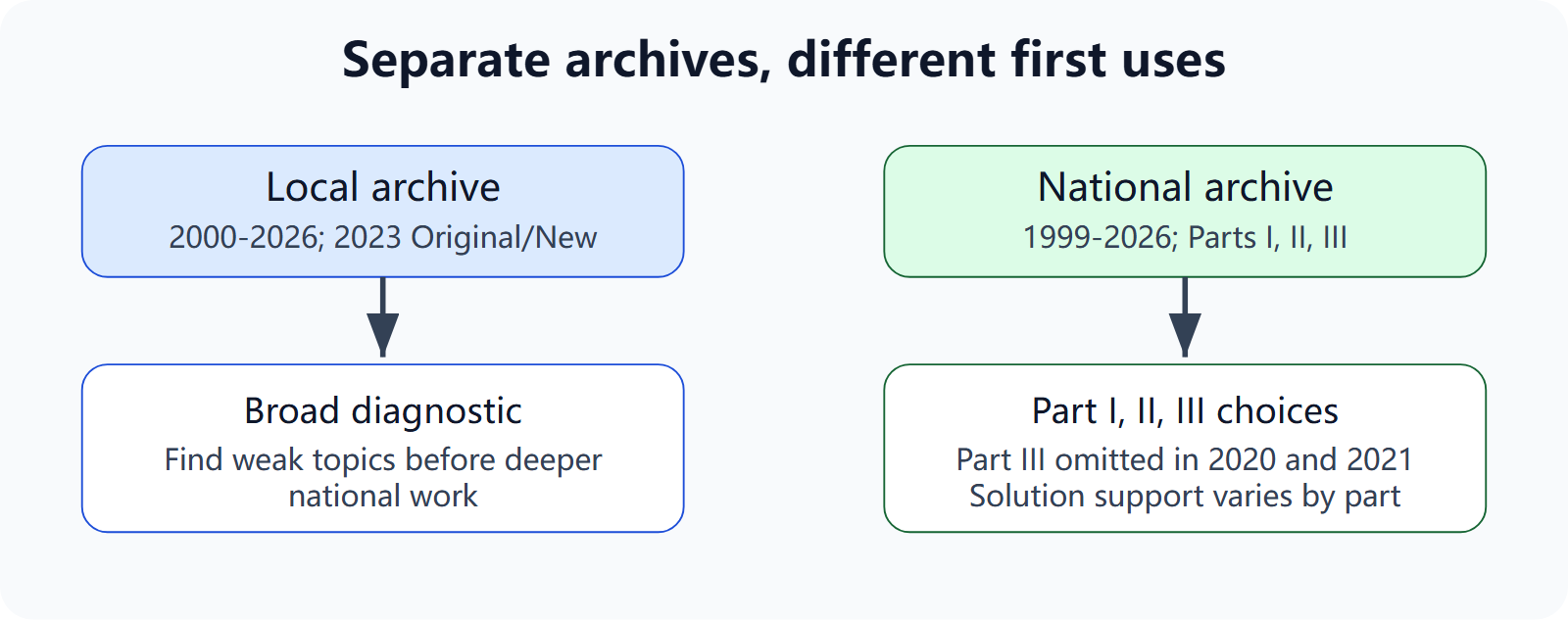
The ACS Prepare for Exams page, checked on 2026-09-23, lists Local exams from 2000 to 2026. It also lists 2023 as having Original and New versions. The same page lists National exams from 1999 to 2026 as Parts I, II, and III, and it explicitly omits National Part III in 2020 and 2021. That structure matters because a student who opens a random year may accidentally mix formats.
According to ACS, detailed solutions are embedded in National Parts II and III. Solution availability for Local exams and National Part I varies by year. A Local paper from one year may be a clean diagnostic, while another year may give less feedback. A National Part I paper may be useful for timing, but it should not be treated as having the same solution support as National Part II.
For site-specific background, our local exam overview explains how Local papers fit early preparation, and our national exam format guide explains the national sequence. If your target includes written answers, use the free-response preparation page with National Parts II and III. For lab-oriented work, the laboratory skills page helps you identify practical demands.
How to read the ACS listing without over-interpreting it
The ACS listing should be read as an inventory, not as a statement that every year is equally useful. Local exams from 2000 to 2026 form one archive, and the 2023 Original/New split shows that a single year can contain separate forms. National exams from 1999 to 2026 form another archive. Part I, Part II, and Part III ask different questions, so a missing Part III in 2020 or 2021 changes what that year can teach.
When you choose a year, ask what evidence you need. If you need answer explanations for self-study, National Part II or III may be more useful where available because ACS says detailed solutions are embedded. If you need a broad topic scan, a Local exam may be more useful even if its solution support varies. If you need multiple-choice pacing, National Part I is the relevant component, but you should check whether the file you receive includes an answer key or solution notes.
This also prevents a common mistake: building one continuous chart from 1999 to 2026. Such a chart would mix Local diagnostics, the National multiple-choice paper (Part I), the National written-response questions (Part II), and the National laboratory practicals (Part III), and it would include years with omitted components. Keep separate tracks: Local, National Part I, National Part II, and National Part III. The tracks can inform each other without being averaged into one fake score.
Which paper should you open first?
The simplest rule is to match the paper to the decision you are trying to make. If you do not know which topics are weak, start with a Local exam. If you already know your weak topics and need to practice national multiple-choice pacing, start with National Part I. If you need to learn how to present reasoning, choose National Part II. National Part III is a later-stage paper, and it should not be your first diagnostic because it is the most specialised and because some years do not contain it.
| Situation | First paper to use | Why | Caution |
|---|---|---|---|
| First diagnostic or returning after a break | Local exam | Broad coverage and a separate archive; useful for finding weak topics. | Do not compare its raw score with National papers. |
| Comfortable with multiple-choice timing | National Part I | Useful for national multiple-choice pacing; see the national format guide. | Solution availability varies by year. |
| Need written explanation practice | National Part II | Free-response work with embedded detailed solutions where ACS provides them. | Review reasoning, not only final answers. |
| Ready for advanced, later-stage work | National Part III where available | Two laboratory practicals assessing hands-on experimental technique; distinct in format from both the multiple-choice and written-response papers, so it needs its own preparation track. | Omitted in 2020 and 2021; not a first entry point. |
| Working with 2023 Local papers | Choose Original or New, then keep them separate | ACS lists two distinct 2023 Local versions. | Do not merge their scores into one trend. |
A source-grounded, illustrative decision example
Example (illustrative, not official advice): A student has completed one Local paper and finds that calculation speed is acceptable, but explanations are incomplete. Because ACS says detailed solutions are embedded in National Part II, the student chooses a National Part II paper available in the advisor’s pack. The student attempts the questions first, then compares written reasoning line by line. The student does not use a 2020 or 2021 National Part III because ACS shows Part III is omitted in those years. If multiple-choice pacing is the next need, the student adds a National Part I paper, remembering that Local and Part I solution coverage varies.
The point is not to collect years. The point is to choose the smallest paper that answers the next question.
Using different formats without forcing raw scores to compare
Raw totals from different USNCO papers are tempting to compare, but that habit creates false signals. A Local exam from 2004, a National Part I from 2015, and a National Part II from 2019 are not the same measuring instrument. They may differ in item style, answer format, solution support, and the role they play in the competition sequence. Even within Local exams, the 2023 Original and New versions should be handled as separate attempts rather than merged into one trend.
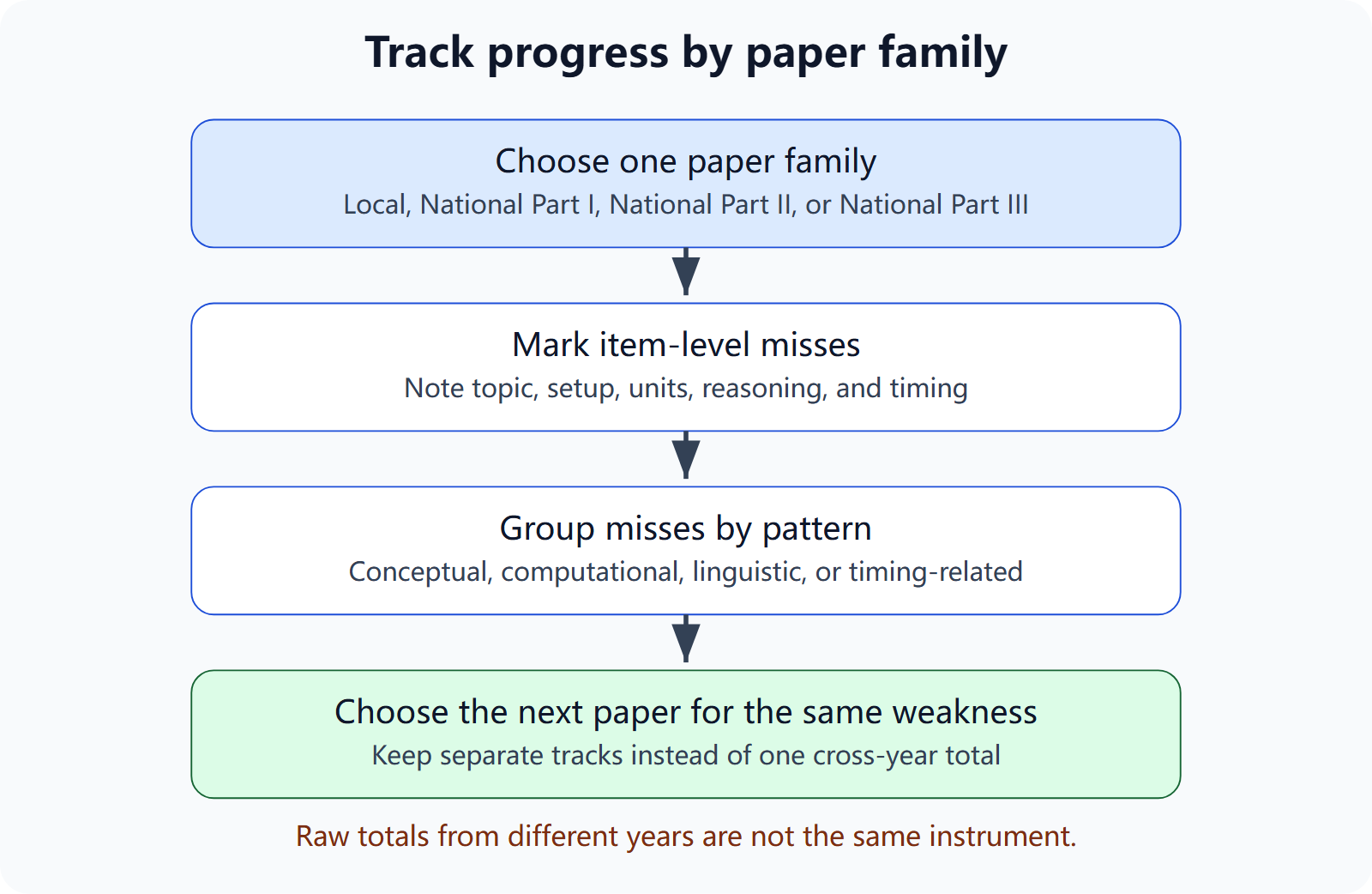
A safer method is to keep the paper family constant when measuring progress. If you are tracking Local diagnostics, compare your topic misses across Local papers. If you are tracking National Part I, compare pacing, guessed items, and topic misses within Part I. If you are working on National Part II or III, evaluate whether your written answer would earn credit for setup, reasoning, units, and final result. The goal is to turn a raw total into a list of repeatable chemistry decisions.
Use a loop: choose one paper family, mark items by topic and error type, decide whether each miss was conceptual, computational, linguistic, or timing-related, then select the next paper that tests the same weakness. This avoids saying, “I scored higher on a Local paper than on a National Part I, so I am worse at national papers.” The two scores answer different questions.
Solution coverage changes how you use a paper
Solution coverage should change your method. A paper with detailed solutions can support independent review: you attempt the problem, then compare your setup, units, significant figures, and final claim against the solution. A paper without reliable solutions is still useful, but it should be used differently. Treat it as a timed exposure exercise, mark items where reasoning was uncertain, and verify those items later with a teacher, textbook, or trusted source. This is especially important for Local papers and National Part I, where ACS says solution availability varies by year.
For National Part II and III, the embedded solutions are not just answer keys. They model the kind of response that earns credit. When reviewing, do not stop at the final number. Ask whether your answer showed the correct principle, selected reasonable data, handled units, and explained limitations when needed.
What the Hanlin pack does and does not promise
Hanlin teachers have collected and organised a free USNCO past-paper pack. It is meant to save you from hunting through scattered files, but it does not claim that every year, part, or worked solution is present. Some years have worked solutions; exact available years and files depend on what the advisor sends. Because ACS shows year-dependent omissions and variable solution coverage, check the current file list before making a study sequence.
What not to do with missing years and solution gaps
Do not treat missing National Part III in 2020 and 2021 as evidence that the skill was unimportant; it means that year’s archive does not contain that part. Do not judge a Local paper as easy or hard from one raw score. A file without solutions can still support timed practice if you later verify answers with a teacher or trusted source. Do not assume 2026 files are in our pack; ask for the current list.
Frequently asked questions
Which USNCO past exam should I practice first?
Start with a Local exam if you need a broad diagnostic. Move to National Part I when you are ready for a full national multiple-choice paper. Use National Part II later, because it consists of eight written-response questions that demand constructed answers rather than selection. Save National Part III for last, since it comprises two laboratory practicals that test hands-on experimental skills rather than paper-and-pencil problem solving.
Are Local and National raw scores directly comparable?
No. Local and National papers have different purposes, formats, and year-specific coverage. Analyse items within the same paper family instead of treating a Local score from one year as equal to a National score from another year.
Do all USNCO past papers include worked solutions?
No. ACS says detailed solutions are embedded in National Parts II and III, while Local and National Part I solution availability varies by year. In our organised pack, exact files depend on what the advisor sends.