The USNCO free-response paper — the written, second part of the American Chemical Society (ACS) National Exam (around 105 minutes) — is where chemistry depth is really tested. Unlike multiple choice, it is marked on your working, so a clear method, correct units and a logical chain can earn credit even when the final number is off. This guide shows how to write solutions that capture every available mark.
Why the free-response paper is different
Multiple choice rewards the right answer; the free-response paper rewards the right reasoning. On the National Exam’s written section, examiners follow a marking scheme that awards points for the steps of a solution — setting up the correct equation, substituting properly, carrying units, arriving at a defensible result. That has a powerful consequence: a question you cannot fully finish is still worth attempting, because a sound partial method banks partial marks. The students who plateau on this paper are usually the ones who write only the final figure and lose everything when it is slightly wrong.
There is a strategic reason this matters so much. The National Exam combines three parts into one score, and the recognition tiers — top 50 nationally earn High Honors, the next 100 earn Honors — are decided at the margin. A student who reliably banks partial method marks across every free-response question, rather than scoring full-or-nothing, accumulates exactly the kind of steady points that separate a placed candidate from a near-miss. In a field of more than a thousand advancing students, the few marks you save by always showing your working are not trivial; they are often the difference.
A note on scope before the technique. The USNCO is an official ACS competition for U.S. high-school students, entered through an ACS Local Section; there is no individual sign-up from abroad. So if you are in China, you will not be sitting this paper for real — but the public past papers reproduce it exactly, and learning to write disciplined worked solutions is one of the most transferable chemistry skills there is. For the wider exam structure see our guide to what the USNCO is; for honest eligibility detail see whether international students can take it. Exact rules and timings are set by ACS each year — confirm them on acs.org.
The anatomy of a top-scoring solution
Almost every free-response chemistry answer, whatever the topic, has the same skeleton. Make that skeleton visible on the page and you make the examiner’s job easy — which is exactly when full marks happen.
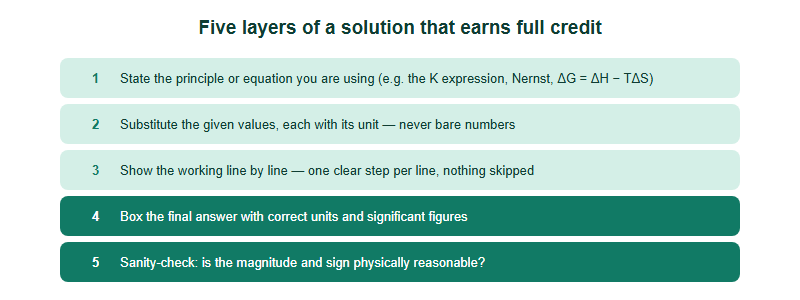
The single highest-value habit is layer two: carry units through every line. Units are not decoration — a dimensional check often catches a slipped exponent or an inverted ratio before it reaches your final answer, and an examiner following your working can award method marks even if arithmetic drifts at the end.
Where free-response marks are won and lost
After working through years of the public papers, the same handful of avoidable errors recur. The table below pairs each with the discipline that fixes it. None of this is exotic chemistry — it is exam craft, and it is the difference between a method that nets most of the marks and one that nets few.
| Where marks leak | What it looks like | The fix |
| Final answer only | Just a number, no working, slightly wrong → zero | Always show the setup and steps; bank partial credit |
| Missing units | Correct value, no unit or wrong unit | Attach units at every line; state the unit on the boxed answer |
| Significant figures | Over- or under-stated precision | Match sig figs to the least precise given datum |
| Sign errors | Wrong sign on ΔH, cell potential, or charge | Track sign conventions explicitly; sanity-check direction |
| Unbalanced equations | Reaction not balanced before a stoichiometry step | Balance first, including charge for redox half-reactions |
| Skipped steps | Two lines collapsed into one, logic invisible | One operation per line so the examiner can follow you |
This is general exam craft for written chemistry, not an official ACS marking scheme. The actual scheme and point allocations are set by ACS each year — treat acs.org and the released answer keys as the authority.
A 105-minute plan for the paper
Time management decides as much as chemistry on this section. With roughly 105 minutes for the written paper, the goal is to make sure every question you can answer actually gets answered — which means not stalling on the hardest one while easy marks elsewhere go uncollected.
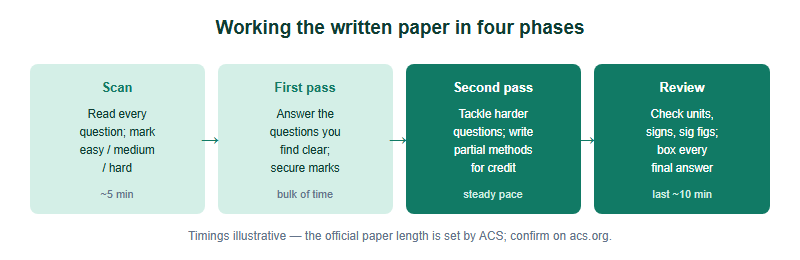
Two rules make this plan work in practice. First, never leave a question blank if you can write even the opening principle and a setup — that is where partial credit begins. Second, budget a hard stop on any single question; if you have spent your allotted minutes and are stuck, write what you have and move on, then come back in the second pass. A finished partial answer to every question almost always beats one perfect answer and three blanks.
The five layers in action: a worked illustration
To make the skeleton concrete, here is a generic, made-up problem written purely to show the shape of a strong answer — it is not from any official paper. Suppose a question gives you a reaction’s standard enthalpy and entropy change and asks whether it is spontaneous at a stated temperature. A bare-number answer (“yes”) earns little; a layered solution earns the method marks regardless. The contrast below is the whole lesson.
| What the examiner sees | Weak answer | Strong answer |
| Principle stated | (none) | ΔG = ΔH − TΔS; spontaneous if ΔG < 0 |
| Substitution with units | (none) | Values inserted with kJ, J/K and the temperature in kelvin |
| Working shown | (none) | Each line one step; the TΔS term converted to consistent units |
| Final answer | “Yes, spontaneous” | Boxed ΔG value with sign, then the spontaneity conclusion |
| Sanity check | (none) | A note that the sign of ΔG matches the expected direction |
Notice that the strong answer would still bank most of its marks even if the final arithmetic slipped — because every layer above the answer is independently creditable. The most common unit trap in exactly this kind of problem is mixing kJ and J: enthalpy is often given in kilojoules and entropy in joules per kelvin, and a student who forgets to reconcile them gets a final number that is off by a factor of a thousand. Showing the conversion as its own line both prevents the error and earns the mark.
How to train this skill with past papers
You cannot learn free-response craft from multiple choice — you have to write. The public USNCO past papers (1999–2025) come with answer keys, which makes them ideal for this: write a full solution in exam conditions, then mark yourself against the key not just on the final number but on method. Ask, for each question, “Would an examiner have awarded the step marks for what I wrote?” That self-marking is where most of the improvement happens.
A simple weekly loop works well: write one full free-response paper under time, then spend a separate session marking it slowly against the key and logging every step you lost a mark on. Over a few months, the recurring leaks — a units habit, a sign convention — get fixed for good. We set out the full paper-by-paper method, including how to fit the written paper alongside multiple choice and the practical, in our guide to using USNCO past papers to prepare. The skill you build there — disciplined, examinable worked chemistry — carries directly into university courses and any other olympiad, whether or not you ever sit the USNCO itself.
Frequently asked questions
How is the USNCO free-response paper marked?
On your working, not just the final answer. ACS examiners award points for the steps of a solution, so a sound partial method earns partial credit. Exact schemes are set by ACS each year — confirm on acs.org.
What is the most common way students lose marks?
Writing only the final number. If it is slightly wrong, the whole question scores zero — whereas a shown method with units and clear steps banks partial credit even when the arithmetic drifts.
How long is the free-response section?
It is the written part of the National Exam, around 105 minutes. The exact length is set by ACS and can change — always confirm current timings on acs.org.
Can I practise it if I am not in the U.S.?
Yes. The USNCO is for U.S. high-school students via an ACS Local Section, but the public past papers reproduce the paper exactly and are excellent written-chemistry practice for any student.
This is the U.S. National Chemistry Olympiad (USNCO) information desk, synchronising official ACS information — dates, rules, the syllabus, past papers and results — for chemistry students in China, operated by Hanlin Education. The USNCO is run by the American Chemical Society (ACS), which sets all official rules, marking and eligibility. Always confirm current details on acs.org. Confirmed errors are corrected within 7 working days.