AP Chemistry and the USNCO cover similar ground but are not the same race. AP Chemistry is a College Board exam that grades first-year university chemistry for credit; the USNCO is the American Chemical Society (ACS) competition that selects the U.S. team for the International Chemistry Olympiad. They share a syllabus core, but the USNCO goes deeper, faster and into the laboratory. AP is an excellent foundation for it — not a substitute.
Two exams, two different jobs
The clearest way to understand the gap is to look at what each exam is for. AP Chemistry exists to certify that a student has mastered an introductory college course, so that universities can award credit or placement. The USNCO exists to rank the strongest high-school chemists in the United States and narrow them, tier by tier, to a four-student team. One is a qualification; the other is a selection contest. That difference in purpose drives every difference in difficulty, format and pacing below.
It also shapes who sits each one. AP Chemistry is taken by hundreds of thousands of students worldwide every year, including many at international schools. The USNCO, by contrast, is an official ACS competition for U.S. high-school students, who enter through an ACS Local Section — there is no individual sign-up from abroad. So for a student in China, the honest framing is this: you may well take AP Chemistry as part of your curriculum, but the USNCO is not something you register for overseas. Its value to you is the public syllabus and past papers as a way to push your chemistry far past AP level. For the full picture of how the competition is structured, see our guide to what the USNCO is, and the honest account of whether international students can take it.
Side by side: format and scope
Here is the structural comparison. The AP figures below are the College Board’s published 2026 format; the USNCO figures are the National Exam structure synced from official ACS information. Treat year-specific details on both sides as subject to change, and confirm USNCO specifics on acs.org.
| AP Chemistry (2026) | USNCO National Exam | |
| Run by | College Board | American Chemical Society (ACS) |
| Purpose | College credit / placement | Selecting Team USA for the IChO |
| Total time | 3 hours 15 minutes | Roughly 4.75 hours across three parts |
| Multiple choice | 60 questions, 90 min (50%) | 60 questions, 90 min |
| Written / free response | 7 questions, 105 min (50%): 3 long + 4 short | Free-response paper, 105 min |
| Laboratory | None on the exam (labs are coursework) | Yes — a real bench practical, 90 min |
| Recognition | Score 1–5 | Top 50 nationally: High Honors; next 100: Honors |
The multiple-choice counts look identical, and the written sections are even the same length — which is exactly why the difficulty difference surprises people. The numbers match; the questions do not.
Where the real difficulty gap lives
If both exams have 60 multiple-choice questions and a written paper of similar length, why is the USNCO so much harder? The gap is not in topic list — it is in depth, speed and integration. Three differences do most of the work.
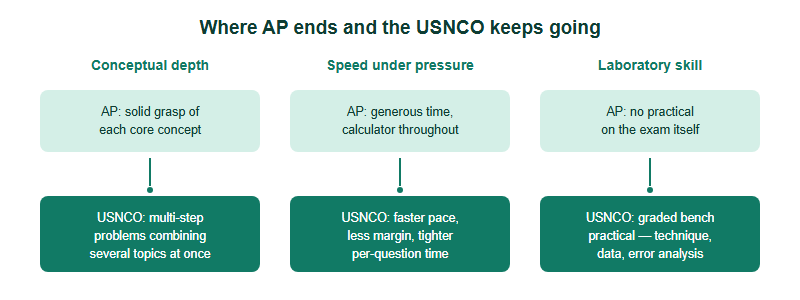
- Depth of problem. An AP question typically tests one idea cleanly — a single equilibrium, one stoichiometry chain. A USNCO question is more likely to stack several concepts into one problem: an equilibrium that feeds a thermodynamics calculation that ends in a Nernst-equation answer. You are not just recalling chemistry; you are routing it.
- Speed and self-reliance. The USNCO National Exam asks for 60 multiple-choice questions in 90 minutes — the same as AP — but the questions are denser, so the effective pace is harder. The written paper rewards clean, fast working rather than long exploratory answers.
- The laboratory. This is the dividing line. AP Chemistry has no practical on the exam; lab work is part of the course, not the test. The USNCO National Exam includes a genuine 90-minute bench practical graded on technique, observation and data analysis — a skill AP simply never measures.
Using AP Chemistry as a launch pad
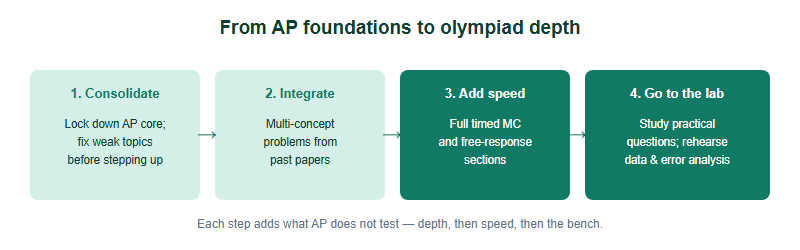
None of this means AP is wasted preparation — quite the opposite. AP Chemistry teaches the vocabulary, the core models and the calculation habits that the USNCO then stretches. A student who has genuinely mastered AP (not just scored a 5, but understood it) is in an excellent position to step up. The bridge is built by adding the three things AP does not push: integrated multi-topic problems, faster timed practice, and laboratory reasoning.
The most efficient bridge for any student — including one in China who cannot sit the official exam — is the USNCO past-paper library (1999–2025), which we have collected into a free pack with answer keys. Worked under timed conditions, these papers are calibrated to exactly the standard AP does not reach. We set out a full method in our guide to using USNCO past papers to prepare; the short version is below.
A topic-by-topic view of the step up
It helps to see the difference at the level of individual topics, because the gap is not uniform — some areas barely change from AP to olympiad standard, while others are transformed. The grouping below is a study aid, not an official weighting from either body; the authoritative scope is the College Board for AP and the published syllabus on acs.org for the USNCO. Use it to decide where your AP base is already close and where you have the most ground to make up.
| Topic area | At AP level | At USNCO level |
| Stoichiometry & solutions | Clean single-chain calculations | Embedded inside longer multi-part problems |
| Thermodynamics | Core ΔH, ΔS, ΔG relationships | Linked to equilibrium and electrochemistry in one question |
| Equilibrium & acids/bases | Standard ICE tables, buffers | Heavier algebra, less simplification handed to you |
| Kinetics | Rate laws, basic Arrhenius | Mechanism reasoning and data interpretation |
| Organic chemistry | Light: functional groups, naming | Deeper: mechanisms, stereochemistry, synthesis |
| Laboratory technique | Coursework only, not on the exam | Graded bench practical with data and error analysis |
The pattern is clear: organic chemistry and laboratory work are where AP-only students feel the biggest jump, because AP treats both relatively lightly. If you are bridging from AP, those two areas usually deserve the most of your extra study time — and the USNCO past papers are full of exactly the organic and practical questions that AP never asked you. For the full content map, see our breakdown of what the USNCO is and covers.
Which should you focus on?
For most international-school students, this is not an either/or. AP Chemistry is the curriculum exam you actually sit; treat it as the priority for your transcript and university applications. The USNCO material is then the enrichment layer — a way to deepen the same chemistry well beyond AP, build genuine problem-solving stamina, and signal serious subject interest. A student who does both well ends up with an AP score on the record and chemistry depth that most AP-only candidates never develop.
One caution worth stating plainly: do not let the prestige of the word “olympiad” pull you into chasing a competition you cannot enter. If you are outside the U.S., the realistic goal is mastery of the material, not a place on Team USA. That mastery is real, transferable and visible — and it is fully available to you through the public syllabus and papers, with no exam seat required.
Frequently asked questions
Is the USNCO harder than AP Chemistry?
Yes. They share a syllabus core, but the USNCO goes deeper, runs faster, integrates more concepts per question, and adds a graded laboratory practical that AP does not test on the exam.
Does a good AP Chemistry score mean I am ready for the USNCO?
It is a strong foundation, not a finish line. To bridge the gap, add integrated multi-topic problems, faster timed practice, and laboratory-reasoning work using the public past papers.
Can a student in China take the USNCO instead of AP?
No. AP Chemistry is widely available, but the USNCO is for U.S. high-school students via an ACS Local Section. Confirm any eligibility on acs.org; from abroad, use its papers to prepare.
Should I prioritise AP or USNCO study?
Prioritise AP for your transcript, then use USNCO material as enrichment to push the same chemistry past AP level. For most international-school students, both together is the strongest plan.
This is the U.S. National Chemistry Olympiad (USNCO) information desk, synchronising official ACS information — dates, rules, the syllabus, past papers and results — for chemistry students in China, operated by Hanlin Education. The USNCO is run by the American Chemical Society (ACS), which sets all official rules and eligibility. AP Chemistry details are set by the College Board. Always confirm current details on acs.org. Confirmed errors are corrected within 7 working days.