The U.S. National Chemistry Olympiad (USNCO) is the selection route through which the United States chooses its team for the International Chemistry Olympiad (IChO) — the global championship of secondary-school chemistry. Run by the American Chemical Society (ACS) since 1984, the USNCO narrows roughly 10,000 students across four tiers to a four-student Team USA that competes each July. Confirm current details on acs.org.
What the International Chemistry Olympiad is
The International Chemistry Olympiad is the world's premier pre-university chemistry competition. Each participating country sends a national team of up to four secondary-school students, and those teams sit a common set of theoretical and experimental examinations over roughly a ten-day event. The IChO is not a competition a student enters directly — you reach it by being selected onto your country's team through that nation's own qualification process. In the United States, that process is the USNCO.
Understanding this relationship is the single most clarifying fact for anyone researching the U.S. chemistry-olympiad system: the USNCO and the IChO are not two separate contests but two ends of one pathway. The USNCO is the domestic ladder; the IChO is the international summit that ladder is built to reach. For a fuller orientation on the domestic side, see our companion explainer, What Is the USNCO.
Team USA heads to the 2026 IChO
In 2026 the event is the 58th International Chemistry Olympiad, scheduled for 10–19 July 2026 in Tashkent, Uzbekistan, and the United States will be represented by a team of exactly four students selected through the USNCO pathway. The American program has a strong recent record at this level: at IChO 2025 in Dubai, all four U.S. team members won gold medals. That outcome is not an accident of a single strong year — it is the kind of result a deliberately steep, multi-stage selection system is designed to produce.
Per the ACS USNCO 2026 announcement, the four-member Team USA for the 58th IChO is Enzhi Chen (Princeton International School of Mathematics and Science, NJ), Ethan Cho (BASIS Scottsdale, AZ), Alex Dong (Shanghai High School International Division, Shanghai), and Liran Zhu (Troy High School, CA), with Phil Yao and Bowen Shan named as alternates. One detail is especially clarifying for readers in China: a selected team member attends an international division in Shanghai — which underlines that eligibility turns on citizenship and school accreditation, not on which country you physically sit in. Per ACS, a U.S. citizen or permanent resident who has been enrolled for at least one year at an accredited American school abroad and is under 20 competes through an ACS International Chemical Sciences Chapter — in Shanghai's case, the chapter that organises both the local and the national competition there — and that route runs the whole way to the National Exam, the Study Camp and Team USA. A Chinese-national classmate at the very same school, however able, has no ACS route to the team: the abroad provision requires U.S. citizenship or a green card. Same school, different passports, different answers. Confirm the current roster and host on acs.org.
For students in China who do not hold U.S. citizenship or a green card — the position most readers of this site are in — the takeaway is about standard, not entry: the chemistry depth required to reach a podium at the IChO defines a world-class benchmark you can measure your own preparation against, even though the U.S. route itself is open only to those who meet the ACS citizenship conditions.
The four-tier U.S. pathway that feeds the IChO
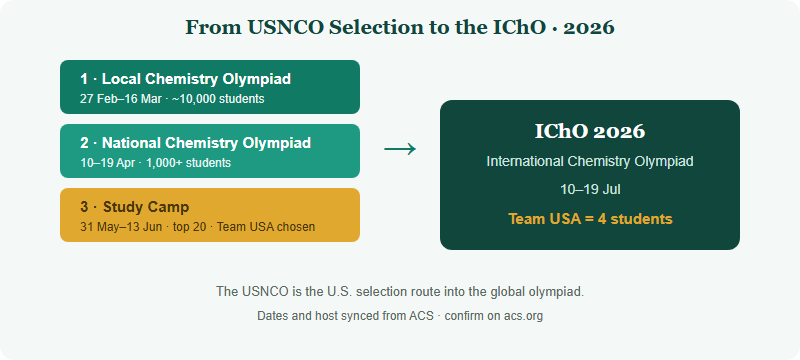
Founded by ACS in 1984, the USNCO is a multi-stage selection competition rather than a single test, and every tier is a filter that carries only the strongest performers forward. Entry happens through an ACS Local Section — the regional volunteer chapters of the American Chemical Society, or, for eligible students outside the United States, an ACS International Chemical Sciences Chapter — not through any individual national registration. From the local round onward, advancement is decided purely by exam performance. The four tiers run as follows in 2026:
- Tier 1 — Local Chemistry Olympiad (27 Feb–16 Mar): the entry point, administered by ACS Local Sections, with roughly 10,000 high-school students. Each section nominates its top scorers to advance.
- Tier 2 — National Chemistry Olympiad (10–19 Apr): more than 1,000 nominated students sit a rigorous three-part national exam. The top 50 earn High Honors and the next 100 earn Honors.
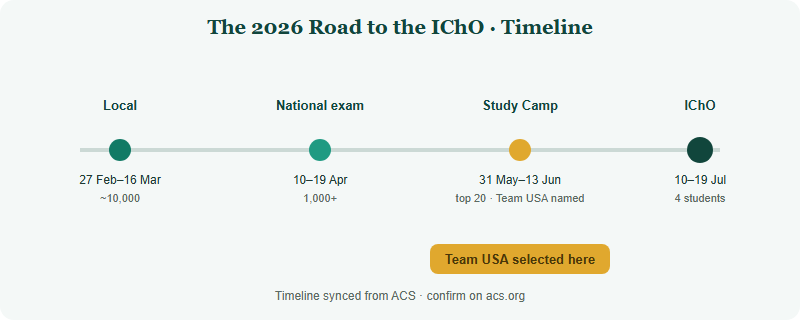
- Tier 3 — Study Camp (31 May–13 Jun): the top 20 national performers attend an intensive residential camp at the University of Maryland, where the four-member Team USA is chosen.
- Tier 4 — International Chemistry Olympiad (10–19 Jul): Team USA — four students — competes against national teams worldwide for medals.
The system is deliberately steep: tens of thousands begin at the local level, and exactly four represent the United States at the summit. The table below sets the route out tier by tier.
| Stage | 2026 dates | Scale | Role in selecting Team USA |
|---|---|---|---|
| Local Chemistry Olympiad | 27 Feb–16 Mar | ~10,000 students | Entry tier; top scorers nominated by each ACS Local Section |
| National Chemistry Olympiad | 10–19 Apr | 1,000+ students | Three-part exam; identifies the top 20 nationally |
| Study Camp | 31 May–13 Jun | Top 20, U. of Maryland | Final selection; the four-student Team USA is named |
| International Chemistry Olympiad | 10–19 Jul | Team USA = 4 students | Competes internationally for IChO medals |
The national exam: the gate to the team
The decisive filter on the road to the IChO is the National Chemistry Olympiad exam, because it determines who is invited to the Study Camp from which Team USA is drawn. It is a rigorous three-part assessment that goes well beyond a single multiple-choice paper, testing rapid recall and reasoning, extended written problem-solving, and hands-on laboratory technique in turn:
- Part I — Multiple choice: 60 questions in 90 minutes, testing breadth across the chemistry syllabus and speed of reasoning.
- Part II — Free-response written paper: 105 minutes of extended problems requiring full worked solutions, mechanisms and quantitative analysis.
- Part III — Laboratory practical: 90 minutes of hands-on experimental work, assessing technique, observation and data handling.
That laboratory component is significant precisely because the IChO itself is half experimental — the international event includes a full practical examination, so the U.S. selection process tests bench skill long before the team is chosen. For a closer look at that hands-on tier, see The USNCO Lab Practical: The Hands-On Component, Explained.
What this means for students in China
Eligibility for the USNCO is set by ACS, and it is worth stating precisely rather than as a blanket no. There is no individual sign-up from abroad — entry always runs through an ACS Local Section or, outside the United States, an ACS International Chemical Sciences Chapter — but that describes the registration mechanism, not the absence of a route. Per ACS, a student who is a U.S. citizen or permanent resident, has been enrolled for at least one year at an accredited American school (including such a school in China), and is under 20 competes through an ACS International Chemical Sciences Chapter: that student may sit the National Exam and can be selected for Team USA — which is precisely how a Shanghai-based student reached the 2026 team. A student at a high school in the United States who is not a U.S. citizen or green-card holder may sit the Local Exam only, and cannot be nominated to the National Exam whatever the score. And a student who holds neither U.S. citizenship nor a green card, studying at a school in mainland China, has no ACS route to the IChO — which is the position most readers of this site are in. Any eligibility question should be confirmed on the official ACS channels. Our dedicated explainer covers this directly and honestly: Can International Students Take the USNCO? Eligibility, Honestly.
The genuine value of this system for students in China is twofold. First, understanding the road to the IChO gives you a world-class yardstick: knowing what each tier tests and how steep the climb is lets you calibrate your own chemistry preparation against an international standard. Second, the USNCO publishes its past papers from 1999 to 2025 with answer keys, alongside the official syllabus — an exceptional, free way to build real chemistry depth. We do not reproduce the copyrighted exam text here; the productive method is to work through the official papers under timed conditions, mark against the published keys, and map every gap back to the syllabus. Training on the 90-minute multiple-choice format and the free-response style develops both speed and rigour that transfer to any rigorous chemistry pathway, whatever competition a student is ultimately eligible for.
Frequently asked questions
How does the USNCO connect to the IChO?
The USNCO is the U.S. selection route: its four tiers narrow ~10,000 students to the four-student Team USA that competes at the International Chemistry Olympiad.
When and where is the IChO in 2026?
The 58th International Chemistry Olympiad is scheduled for 10–19 July 2026 in Tashkent, Uzbekistan. Confirm current details on acs.org or the official IChO channels.
How many students are on Team USA?
Exactly four. They are chosen at the Study Camp (31 May–13 Jun) from the top 20 performers on the National Chemistry Olympiad exam.
Can students in China reach the IChO through the USNCO?
Some can. Per ACS, a U.S. citizen or permanent resident who has been enrolled for at least a year at an accredited American school in China and is under 20 competes through an ACS International Chemical Sciences Chapter — one member of the 2026 Team USA studies in Shanghai. A student who is not a U.S. citizen or green-card holder has no ACS route. Confirm eligibility on the official ACS channels.
This is the U.S. National Chemistry Olympiad (USNCO) information desk, synchronising the official competition information — dates, rules, the syllabus, past papers and results — for chemistry students in China, operated by Hanlin Education. The USNCO is run by the American Chemical Society (ACS), which sets all official rules and eligibility; the information here is synced from official ACS sources. Always confirm current details on acs.org. Confirmed errors are corrected within 7 working days.