For students preparing for the United States National Chemistry Olympiad (USNCO), USNCO past papers are the single most valuable resource available. However, a common misconception is that having the questions and the final answers is sufficient preparation. In reality, the gap between an answer key and a true explanation is where learning happens. This article clarifies what resources are actually available, how to interpret them, and why requesting or seeking deeper explanations beyond the basic key is critical for high-level performance.
The Reality of Resource Availability
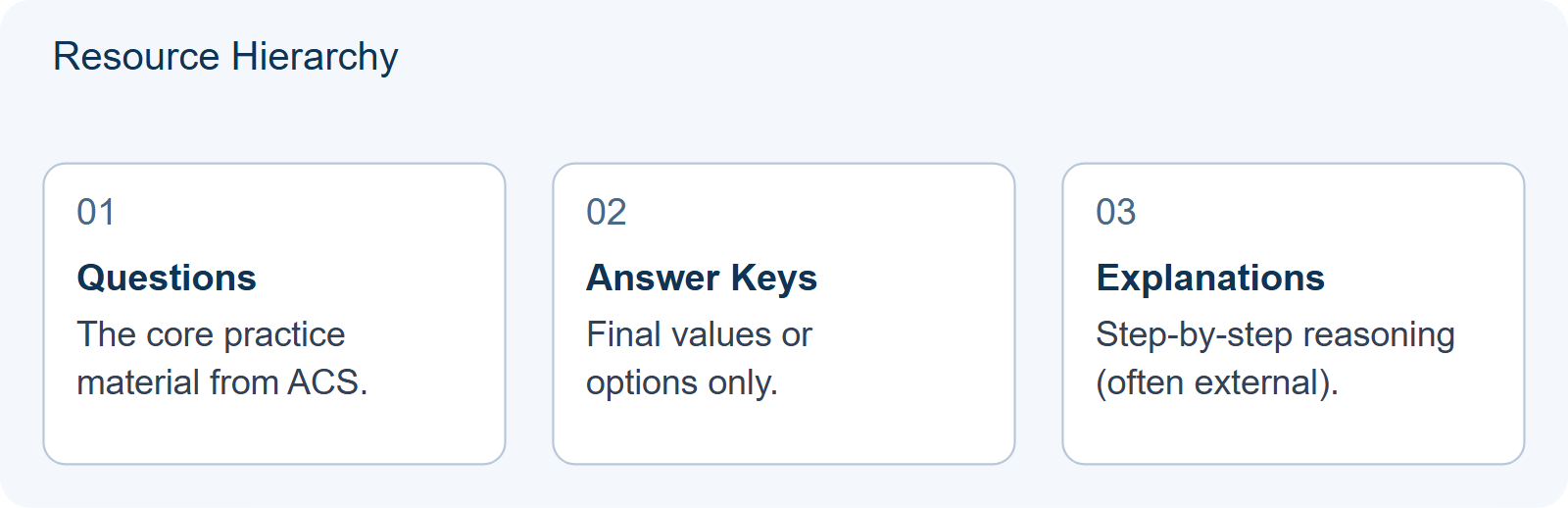
It is important to manage expectations regarding what constitutes a “complete” set of materials. According to current educational support providers like Hanlin, access to USNCO past papers typically includes local exam questions from recent years (e.g., 2016–2026) and national exam parts (e.g., 2021–2025). Crucially, these packages often come with “partial explanations” or worked solutions for selected years, rather than comprehensive, step-by-step mark schemes for every single question across the entire history of the competition.
Do not assume that a missing explanation means the material is flawed. Often, the official ACS releases provide only the correct multiple-choice options or final numerical answers. The pedagogical value lies in reconstructing the logic yourself or finding third-party breakdowns that explain why an option is wrong, not just which one is right.
Why an Answer Key Is Not Enough
USNCO questions, particularly in the National Exam, are designed to test deep conceptual understanding and multi-step reasoning. An answer key tells you the destination; it does not show the path. For example, if a question on thermodynamics yields a specific ΔH value, the key gives the number. It does not reveal whether you should have used Hess’s Law, bond enthalpies, or formation data. Without this distinction, students may memorize answers without mastering the underlying principles.
Seeking explanations beyond the key involves asking three questions for every problem:
- What concept is being tested? Is it stoichiometry, equilibrium, or organic mechanism?
- Where did I go wrong? Was it a calculation error, a misinterpretation of the prompt, or a knowledge gap?
- How would a top scorer approach this? What shortcuts or logical leaps are expected?
Strategic Use of Past Papers
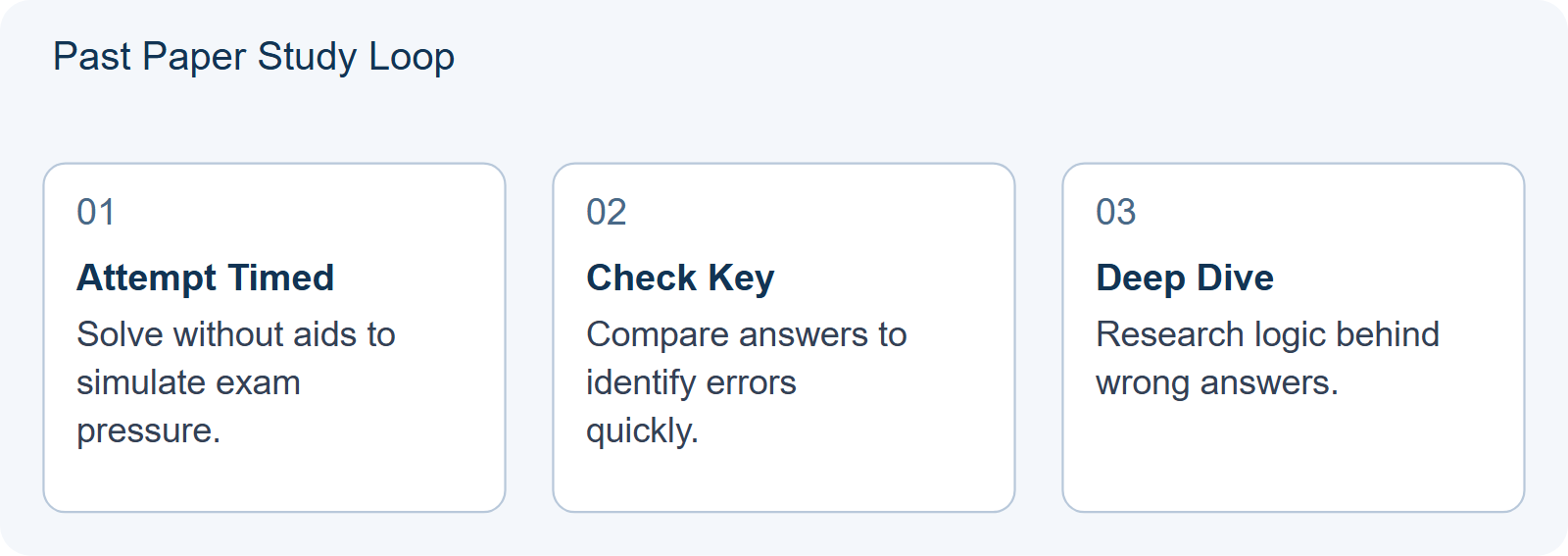
To maximize the utility of USNCO past papers, adopt a tiered study approach. Start by attempting problems under timed conditions without looking at any solutions. This simulates the pressure of the actual exam. Afterward, review your answers against the key. If you were incorrect, do not immediately look for a full written solution. Instead, try to re-solve the problem using your textbook or lecture notes. Only consult detailed explanations when you are truly stuck or when your independent derivation conflicts with the accepted answer.
Internal links such as An Answer Key Is Not a Mark Scheme provide further guidance on self-marking techniques. Similarly, topics like Where ΔH Actually Comes From offer deep dives into specific chemical concepts that frequently appear in past papers, serving as the “explanation layer” that standard keys lack.
Eligibility and Participation Context
When discussing participation, clarity on rules is essential. The USNCO National Exam is restricted to US citizens or legal permanent residents. Students outside the US, including those in China, may participate in the Local Exam phase depending on their enrollment status and ACS International Chapter guidelines, but they generally cannot advance to the National Exam unless they meet the specific citizenship/residency requirements. Understanding this scope helps students focus their preparation efforts appropriately. Resources like USNCO for Chinese Students at US High Schools clarify the logistical pathways for eligible participants.
Conclusion
Treating USNCO past papers as mere quizzes with binary outcomes wastes their potential. They are diagnostic tools. By actively seeking explanations that bridge the gap between the question and the answer key—whether through coaching, community discussions, or specialized study guides—you transform static documents into dynamic learning engines. Focus on the reasoning process, not just the result, to build the chemical intuition required for olympiad success.
HYPOTHETICAL/ILLUSTRATIVE: The “Redox Ambiguity” Decision
To demonstrate how to apply the advice of seeking explanations beyond an answer key, consider a hypothetical scenario involving a USNCO Local Exam question on redox titration. Imagine a student encounters a problem requiring the calculation of the concentration of an unknown oxidizing agent using potassium permanganate ($KMnO_4$). The student calculates a result that differs slightly from the official answer key provided in their resource package. This discrepancy triggers a critical decision point: should they accept the key as absolute truth, or investigate further?
Two plausible choices emerge here. Choice A is passive acceptance. The student assumes they made a simple arithmetic error, corrects their final number to match the key, and moves on without understanding why their initial logic failed. Choice B is active reconstruction. The student pauses to analyze the specific conditions given in the prompt—such as pH levels or temperature—and compares them against standard reduction potentials found in their textbook. They realize that while the stoichiometry was correct, the reaction pathway assumed acidic conditions, whereas the prompt implied neutral conditions where manganese dioxide ($MnO_2$) forms instead of $Mn^{2+}$. This changes the electron transfer count entirely.
The decision shifts based on the nature of the error. If the difference is within rounding tolerance (e.g., 0.1%), Choice A might be acceptable for speed. However, if the discrepancy suggests a fundamental misunderstanding of the reaction mechanism, Choice B is mandatory. In this illustrative case, choosing B reveals that the “answer key” only provided the final numerical value for the acidic condition variant, but did not explain the conditional dependency. By consulting a detailed explanation or deriving the half-reactions independently, the student learns that context dictates the product, a nuance often tested in National Exams.
| Aspect | Choice A: Passive Acceptance | Choice B: Active Reconstruction |
|---|---|---|
| Action Taken | Adjust final number to match key; ignore process. | Analyze reaction conditions; derive half-reactions. |
| Learning Outcome | Memorizes one specific answer; no conceptual gain. | Understands how pH affects redox products. |
| Future Risk | Fails similar questions with different conditions. | Can adapt to novel variations of the same concept. |
| Time Cost | Low immediate cost; high long-term remediation cost. | High immediate cost; low long-term remediation cost. |
This example highlights that the gap between a wrong answer and the right answer is rarely just about math; it is about chemical intuition. When you encounter a mismatch, do not simply overwrite your work. Instead, use the following reusable self-check to guide your preparation:
- Identify the Variable: What specific condition (concentration, temperature, phase) changed my expected outcome?
- Trace the Logic: Did I skip a step in determining the limiting reagent or the oxidation state change?
- Validate Against Principles: Does my derived path align with fundamental laws (like conservation of charge), even if it conflicts with a simplified key?
By treating every discrepancy as a diagnostic clue rather than a failure, students transform static past papers into dynamic tools for mastering complex reasoning. This approach ensures that when faced with ambiguous or multi-step problems in future exams, the student relies on robust conceptual frameworks rather than fragile memorized answers.
Frequently Asked Questions
Are official solutions available for all USNCO years?
No. Official releases often include only answer keys. Detailed explanations for all years are typically provided by third-party educators or coaching services, not always by ACS directly.
Can Chinese students take the USNCO National Exam?
Generally no. The National Exam requires US citizenship or legal permanent residency. Chinese students may participate in the Local Exam if eligible via international chapters, but cannot advance to the National stage without meeting US residency rules.
Is an answer key enough for preparation?
No. An answer key shows the correct result but not the method. To improve, you need to understand the logical steps, common pitfalls, and alternative approaches, which requires seeking additional explanations.