
A key gives you the final answer. It does not tell you whether an examiner would have awarded the steps, and the official point allocation is set by ACS rather than published for you to score against. So a student who checks final numbers is auditing the least diagnostic part of their work. Here is a protocol that judges the route instead.
The gap between a key and a scheme
On a written chemistry paper the marks sit along the route: setting up the right relationship, substituting correctly, carrying units, arriving at a defensible number. That is why a partly finished question is still worth writing out. It is also why the answer at the bottom of the page is a poor proxy for the quality of the page.
Two things follow, and most self-study students act on neither. First, a matching final number can hide a broken route: an error that cancels, an assumption that happened to be harmless in this particular case, a formula recalled correctly but applied for the wrong reason. Second, a mismatched final number tells you almost nothing about where the loss occurred, which is the only thing you actually need to know.
There is a practical layer to this as well. Our gathered pack of past papers runs from 1999 to 2025, and worked solutions exist for some years and not others, so for part of what you practise on there is no route to compare against at all. Even where a solution does exist, it shows one way of reaching the answer, not the point allocation the examiners used. The official scheme and its allocations are set by ACS each year and should be confirmed on acs.org; nothing in this article is that scheme, and you should not treat any self-built version as authoritative.
What you can build is a repeatable way to interrogate your own working. Done properly it is among the highest-value hours in a study week, because it is one of the few that changes behaviour rather than adding exposure.
The three things you genuinely cannot mark yourself
Start by being honest about the limits, because a method that pretends there are none will quietly reinforce your errors.
- Whether your reasoning is valid or merely lucky. You cannot easily see that you reached the right number through a wrong route, because you already believe the route. The partial substitute is back-substitution and limiting cases, covered below.
- Whether your working is legible to someone who is not you. You know what the unlabelled 0.0500 in the margin referred to. A marker does not. Nobody can assess their own clarity, because the missing context is supplied automatically by their own memory.
- The internally consistent misconception. If you believe something wrong, and reason correctly from it, every check you run will pass. This is the genuine unknown unknown, and it is the one thing self-marking cannot reach at all.
Naming these is not a counsel of despair. It tells you exactly what a second reader is for, and stops you buying help for the parts you could do alone.
Write the scheme before you look at the answer
This is the core of the method and it takes about four minutes per question. When you have finished a question, and before you look at any solution, split what you wrote into three layers and predict where the points would fall. Then compare.
The prediction step matters more than the comparison. Guessing where the marks sit forces you to look at your page the way a stranger would, which is precisely the perspective you lack.
| Layer | What a marker can actually see | The question to ask yourself | The self-deception to watch for |
|---|---|---|---|
| Setup | The relationship you chose and the balanced equation you chose it for | Is the correct relationship written down explicitly, before any numbers? | “I knew which equation it was” – but it never appears on the page |
| Substitution | Numbers going into that relationship, with units attached | Could a reader match every number to a quantity in the question? | Unlabelled values in the margin that only you can decode |
| Execution | One operation per line, signs and powers of ten visible | Are two steps collapsed anywhere, so the logic is invisible? | Mental arithmetic that was right this time |
| Result | A number, a unit, a sensible precision | Does it answer the quantity actually asked for, per mole or otherwise? | Stopping at joules when the question wanted kJ per mole |
| Justification | Any assumption you invoked, stated as an assumption | Did I use an approximation without declaring it was legal? | Silent use of a simplification that needed a condition |
The two-colour, four-pass protocol
The single most useful trick in self-assessment costs nothing: a second pen. Work the paper twice, in two colours, before you look at anything.
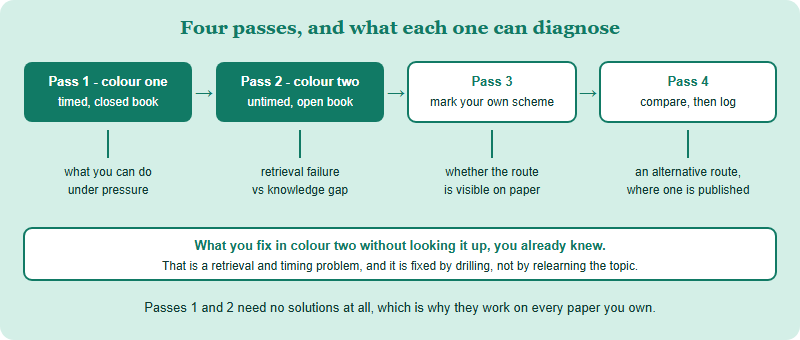
The reason the two-colour pass matters so much is that the two commonest failures look identical on a marked script and require opposite responses. If you could not do it in either colour, you have a knowledge gap and you need to go back to the topic. If you fixed it once the clock stopped, without needing to look anything up, you knew the chemistry and lost it to time, pressure or retrieval, and going back over the topic will not help. Students who skip this step reread textbooks to solve problems that were never about the textbook.
Checking an answer when no worked solution exists
For any paper without a published route, four checks catch most wrong answers without needing anyone else. Run them in this order, because they get more expensive as you go.
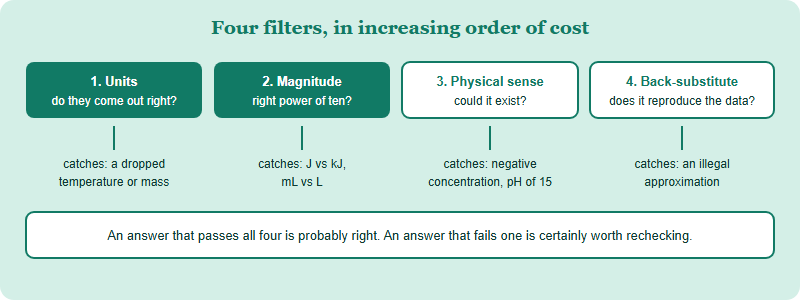
In practice the third and fourth do most of the work. Physical sense is unforgiving in chemistry: a weak acid solution cannot have a pH above seven, a concentration cannot be negative, an equilibrium constant of enormous size cannot describe a reaction the question calls barely favourable, and a yield cannot exceed what the limiting reagent permits. Each of those is a contradiction you can spot alone.
Back-substitution is the strongest check of all and the most neglected. If you solved an equilibrium problem by assuming a change was small, put your answer back into the original expression and confirm it reproduces the starting concentrations. If the assumption was not legal, this is where it shows. Cross-checking between parts of the same question works the same way: if one part gives a strongly negative free-energy change and a later part gives an equilibrium constant below one, the two parts contradict each other and at least one is wrong, which you know before you have marked either.
What an outside reader adds, and how to check one is any good
Everything above is what you can do alone, and it is most of the available gain. A second reader exists to cover the three things listed earlier: valid-versus-lucky reasoning, legibility to a stranger, and the misconception you cannot see past. That is a narrow brief, and it is worth judging any help against it.
Some questions that separate real feedback from decoration. Does the reader write on your working rather than handing you the correct solution? Can they say which step lost the mark, not merely that the answer was wrong? Do they distinguish a knowledge gap from a timing problem, and prescribe different things for each? Will they show you a piece of your own writing and explain what was ambiguous about it? Do they decline to guarantee results, and say plainly when a rule or format is set by ACS and should be confirmed on acs.org rather than asserted?
The corresponding warning signs are just as plain: guaranteed outcomes or promised placements; claims of secret or exclusive question banks; marking that returns only a score; an unwillingness to be specific about which years of material actually come with worked solutions. This site is operated by Hanlin Education, which also runs chemistry teaching, so apply that checklist to us on the same terms as to anyone else – a checklist that exempts its author is not a checklist.
Two practical notes to close. Work from real papers rather than invented exercises, because the phrasing and the density are part of what you are training against; how to use the past-paper pack sets out the sequencing, and our gathered pack spans 1999 to 2025 with worked solutions for some years and not others. If you are new to how the written paper sits alongside the other components, start from what the USNCO is and how the exam is built, confirming any format detail on acs.org. And because whether you can sit the exam depends on passport and enrolment rather than ability, with three distinct cases rather than one rule, it is worth reading the eligibility position, honestly before you plan a year around a paper. The marking discipline in this article is worth building either way: it is how you improve at written chemistry when nobody is standing over the page.
Frequently asked questions
Is an answer key enough to mark my own work?
No. A key gives the final answer; marks are awarded for the route, and the official point allocation is set by ACS each year.
How do I tell a knowledge gap from a retrieval failure?
Redo the paper in a second colour, open book and untimed. Whatever you fix in colour two you knew but could not retrieve.
How can I check an answer when no worked solution exists?
Audit the units, the magnitude and the physical sense, then back-substitute. Most wrong answers fail one of those four checks.
What can another reader see that I cannot?
Whether your reasoning is valid rather than lucky, whether your working is legible, and any misconception that is internally consistent.
This is the USNCO information desk, synchronising official ACS information for chemistry students in China, operated by Hanlin Education. The USNCO is run by the American Chemical Society (ACS), which sets all official rules, marking and eligibility; always confirm current details on acs.org. Anything we get wrong here is corrected within 7 working days of being reported.