
Equilibrium is six of the sixty multiple-choice marks, and it is the one block that leaks into all the others: a titration in the laboratory questions, an equilibrium constant behind the thermodynamics questions, a concentration ratio inside electrochemistry. This is the aqueous machinery in the order the exam actually uses it — set-up discipline first, then titration curves, then buffers and solubility.
Six marks in the block, and a share of several others
The published past papers group the sixty multiple-choice questions into ten content areas of six questions each, in a stable order, with Equilibrium sitting at questions 31 to 36 in recent years. On paper that makes it exactly as valuable as kinetics or organic chemistry: six marks, no more. Confirm the current blueprint on acs.org, and see our overview of how the USNCO is structured if the tiers and papers are new to you.
The reason equilibrium repays more than six marks of work is that the chemistry does not stay inside its numbered block. Four connections are worth naming, because each is a place where an equilibrium habit earns marks in a question labelled something else:
- Thermodynamics. The relationship between standard free-energy change and the equilibrium constant means a thermodynamics question can end by asking which way a reaction lies, and an equilibrium question can end by asking whether a process is spontaneous. They are two views of one quantity.
- Electrochemistry. Cell potential depends on the reaction quotient, so any question that changes a concentration — including changing pH — is an equilibrium question wearing a different hat.
- Descriptive and laboratory chemistry. Titration, indicator choice and precipitation are laboratory topics whose numbers come from Ka and Ksp.
- Organic chemistry. Ranking four compounds by acidity is an equilibrium statement about conjugate-base stability, not a memorised list.
None of this changes how many equilibrium questions appear on the paper. It changes what a mark of equilibrium fluency is worth, which is considerably more than one-tenth of the exam.
Set-up discipline: the part that decides the mark before you calculate
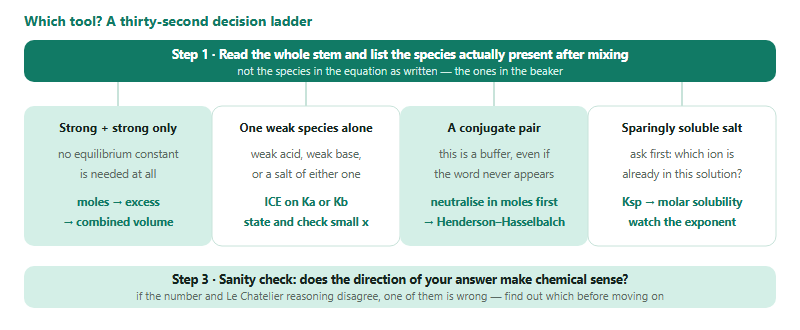
Almost every lost equilibrium mark is lost in the first thirty seconds, before any arithmetic. Three habits prevent most of it.
List the species that are actually present. Not the species in the equation as written — the ones in the beaker after mixing. A question that says “25.0 mL of 0.10 M acetic acid is treated with 10.0 mL of 0.10 M sodium hydroxide” does not contain a weak-acid problem. It contains a neutralisation followed by a buffer. A student who writes an ICE table on acetic acid has already lost the question, and the answer will look entirely plausible.
Do stoichiometry before equilibrium, always in that order. Whenever a strong acid or strong base is added to anything, the strong reagent is consumed completely first. Work in moles for that step, not concentrations — the volumes change — then convert back to concentrations in the combined volume, and only then reach for Ka. Merging the two steps is the single most productive error in this topic.
State the approximation, then check it. Dropping x from a denominator is legitimate when x is genuinely small next to the initial concentration; the common convention is to accept it when the neglected term is under about five per cent of that concentration, and to solve the quadratic when it is not. The dangerous cases are dilute solutions and acids that are not especially weak — exactly the cases an examiner chooses. Writing “assume x is small next to 0.10, check later” on the page costs two seconds and converts a silent error into a visible one.
One more piece of bookkeeping is worth learning as a route rather than a value: the conjugate relationship, which converts any Ka into the corresponding Kb through the ion-product of water. Questions that hand you a Ka and then ask about the salt of that acid are testing whether you recognise that you already have everything you need.
The titration curve in four regions
A titration curve is not one problem. It is four problems joined end to end, each with a different dominant species and therefore a different tool. Once you can name which region a question is asking about, the calculation is short. The table below is for the commonest case on this exam, a weak monoprotic acid titrated with a strong base.
| Region | What has been added | Dominant species | The tool | What the curve does |
|---|---|---|---|---|
| Start | No titrant yet | Weak acid only | ICE table on Ka | Starts well above the pH of a strong acid at the same concentration |
| Buffer region | Some base, less than the equivalence amount | Weak acid plus its conjugate base | Neutralisation in moles, then the Henderson–Hasselbalch relationship | The flattest part of the curve; at half-equivalence the pH equals the pKa |
| Equivalence | Exactly enough base to consume the acid | Conjugate base only, in the combined volume | Kb obtained from Ka and the ion-product of water | The steep vertical section; the pH here is above 7, not equal to it |
| After equivalence | Excess strong base | Excess hydroxide | Dilution arithmetic on the excess strong base alone | Levels off, approaching the pH of the titrant |
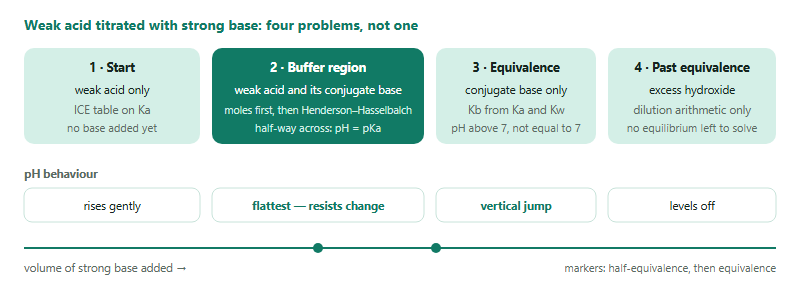
Two extensions turn up often enough to prepare for. A diprotic acid has two of everything, and the pH at the first equivalence point is approximately the average of the two pKa values — a result that looks like a trick until you notice that the species sitting there is amphoteric. And indicator choice is not decoration: the useful indicator is the one whose colour change falls inside the vertical section, which is why weak-acid and strong-acid titrations need different indicators.
Buffers and solubility: the two places arithmetic hides
A buffer question is usually recognisable at a glance: a weak acid together with its conjugate base, or a weak base with its conjugate acid, in the same solution. Reaching for the Henderson–Hasselbalch relationship should then be automatic. Three refinements separate a fast, correct answer from a slow, wrong one.
First, when strong acid or strong base is added to a buffer, do the neutralisation in moles and update both members of the pair — one goes up, the other goes down. Students who change only one produce answers that are close but not right. Second, because the relationship depends on a ratio, diluting a buffer with water barely moves its pH, a counter-intuitive result that examiners like. Third, buffer capacity is greatest when the two members are present in equal amounts, that is when the pH equals the pKa, and a buffer is genuinely useful only within roughly one pH unit either side of that. A question asking you to choose a buffer for pH 4.8 is asking which acid has a pKa near 4.8.
Solubility questions hide their difficulty in the conversion between Ksp and molar solubility, because the exponent depends on the formula. The relationships are short enough to derive on the spot and worth being able to write down in five seconds:
| Salt type | Ion ratio | Ksp in terms of molar solubility s | The trap |
|---|---|---|---|
| AB | 1 : 1 | Ksp = s squared | None — this is the case students assume applies to everything |
| AB2 or A2B | 1 : 2 | Ksp = 4 s cubed | Losing either the factor of 2 inside the bracket or the power |
| A2B3 | 2 : 3 | Ksp = 108 s to the fifth | Comparing this Ksp directly against an AB salt and concluding it is less soluble |
Beyond the conversion, three questions cover most of what is asked. Does adding a shared ion change the solubility? Yes, it suppresses it, and the question is engineered to catch anyone who does not ask “which of these ions is already in the solution?” before starting. Will a precipitate form when two solutions are mixed? Compute the reaction quotient in the combined volume and compare it with Ksp — remembering that mixing dilutes both solutions before anything reacts. Can two ions be separated? Yes, if their Ksp values differ enough that one is essentially fully precipitated before the other begins, which is the arithmetic underneath qualitative analysis in the descriptive and laboratory block.
A four-week rotation, and who can sit the papers
This topic responds to short, frequent, mixed practice rather than one long block, because the failure mode is misclassification rather than ignorance. A workable rotation is thirty minutes twice a week for four weeks. Week one: six multiple-choice questions taken from the equilibrium positions of past papers, timed, classifying each by branch before checking answers. Week two: titration regions only, five questions, each answered by naming the region in writing first. Week three: buffers, including at least one “strong acid is added to this buffer” question done entirely in moles. Week four: solubility, with one common-ion problem and one precipitate-or-not problem.
The most useful single exercise costs nothing. Take ten stems and, without solving any of them, write only which branch each belongs to and which species are present. Students in our coaching routinely find their classification accuracy is well below their calculation accuracy, which tells them exactly where the marks are going. Our own compiled past-paper pack is the natural source of stems, because it lets you pull the same question positions across many years; worked solutions exist for some years rather than all, so treat the archive as practice material first. Our guide to how to use the past papers sets out that method in more detail.
On access, the honest position is three positions rather than one. A student who is not a US citizen or permanent resident but attends a US high school may sit the Local Exam, and ACS states that such students cannot be nominated to sit for the National Exam. A US citizen or permanent resident studying at an accredited American-curriculum school abroad, including inside mainland China, for at least a year and under 20, can run the full route — Local Exam, National Exam, Study Camp and Team USA selection — entering through an ACS International Chemical Sciences Chapter. A student on a Chinese passport at a mainland-China school has no ACS entry route; our eligibility guide sets out all three cases. For that third group the chemistry above loses none of its value: aqueous equilibrium is the part of general chemistry that first-year university courses assume most confidently.
Frequently asked questions
How many equilibrium questions are on the USNCO multiple-choice paper?
Recent past papers place Equilibrium as one of ten content areas, at questions 31 to 36. Confirm the current blueprint on acs.org.
Is the pH at the equivalence point always 7?
No. Only for a strong acid with a strong base. A weak acid titrated with a strong base finishes above 7, because the conjugate base remains.
When can I drop x from the denominator?
When the neglected amount is under about five per cent of the initial concentration. State the assumption, then check it.
Can I rank two salts by solubility from their Ksp values?
Only if they release ions in the same ratio. Different ion ratios give different exponents, so a direct comparison is meaningless.
This is the USNCO information desk, synchronising official ACS information for chemistry students in China, operated by Hanlin Education. The USNCO is run by the American Chemical Society (ACS), which sets all official rules and eligibility. Always confirm current details on acs.org. Errors are corrected within 7 working days of notice.