Most parents ask whether a chemistry olympiad is worth it. The more useful questions are narrower: is this route even open to my child, how many hours a week does it take, and how would I know at month three whether it is working? This guide answers those three, in that order, with the parts that are set by ACS separated from the parts that are our own planning judgement.
First: which route is open, and it depends on the passport
This is the question to settle before spending anything, and it is the one most commonly answered wrongly in conversation, because families assume the rule follows geography. It does not. It follows citizenship or permanent residency, and then the school. There are three distinct cases, and flattening them into one sentence is how households end up planning for something that was never available.
| Status | Where enrolled | What the ACS route allows | What this means for planning |
|---|---|---|---|
| US citizen or permanent resident | An accredited American-curriculum school abroad — including inside mainland China — attended for at least a year, student under 20 | The full route: Local Exam, National Exam, Study Camp and Team USA selection, entering through an ACS International Chemical Sciences Chapter | The whole ladder is genuinely in play. Plan against the season calendar and confirm current requirements on acs.org |
| Not a US citizen or permanent resident | A US high school | The Local Exam only. ACS states that such students can participate in the Local Exam without the possibility of being nominated to sit for the National Exam | A real exam experience and a real benchmark, but the ladder stops there. Plan for the Local Exam as the destination, not a step |
| Chinese passport | A mainland-China school | No ACS entry route | The value is the syllabus, the past papers and understanding how the system works — which is a legitimate reason to do the chemistry, but not a competition entry |
Two administrative details follow from that table and are worth knowing before you plan a calendar. Entry runs through an ACS Local Section rather than directly to ACS, and a student takes part in the competition of the section in which their high school is located — so the practical first question for a family in case one or case two is which section covers the school. Our eligibility guide works through all three cases in detail, and if the competition itself is new to you, our overview of what the USNCO is is the shorter starting point.
What the ladder actually narrows to, and what the awards are called
Parents are usually shown the top of the ladder and left to infer the shape of the rest. The published shape is worth having in front of you before any conversation about goals. Roughly 10,000 students sit the Local Exam; more than 1,000 go on to the National Exam; the top 20 are invited to a Study Camp at the University of Maryland; four students go on to represent the United States at the International Chemistry Olympiad. In the 2026 season the Local Exam ran from 27 February to 16 March, the National Exam from 10 to 19 April, the Study Camp from 31 May to 13 June, and the IChO from 10 to 19 July. Dates move each year, so confirm the current season on acs.org.
One correction saves a great deal of confusion later. The recognition levels at this competition are High Honors and Honors — the top 50 and the next 100 nationally. The gold, silver and bronze language that circulates in Chinese-language summaries is host-organisation framing from elsewhere; it is not how these awards are named. If a programme describes outcomes in medals, ask which competition and which organising body those medals belong to. Confirm the current award structure on acs.org.
Read that shape honestly and it sets the right expectation: this is a ladder where the interesting outcome for almost every family is not the top rung. It is the chemistry a student ends up knowing, the exam temperament they build, and — in cases one and two — a national benchmark of where they actually stand. No competition result causes a university offer, and any programme that suggests otherwise is selling something other than chemistry.
The hours: a planning range, not a rule
The numbers below are our own planning ranges from coaching, not ACS guidance and not a prescription; different students converge at very different rates and results vary. They exist to give a household something concrete to weigh against everything else in the week.
| Year group | Weekly hours (our planning range) | What that buys in a year | What it must not displace |
|---|---|---|---|
| Grade 9 | 2–3 | School chemistry made genuinely solid; first contact with olympiad phrasing | Anything. At this stage school chemistry is the investment |
| Grade 10 | 3–5 | One full pass through the syllabus; first timed multiple-choice papers | Core academic subjects and sleep |
| Grade 11 | 5–7 in term time, more in holidays | Weekly timed papers; written-answer practice; a working error log | The AP, IB or A-level examination months |
| Grade 12 | Tapering | Consolidation only — this is not the year to start | Applications, final coursework and examinations |
Two practical notes. Frequency beats duration in this subject: four sessions of forty-five minutes will outperform one three-hour block, because the skill being built is retrieval under time pressure rather than exposure. And the holidays do the heavy lifting — a student who uses two summer weeks well can cover ground that would take a term of evenings, which is why the honest planning conversation happens in the spring, before the summer is committed elsewhere.
Checkpoints: how to tell at month 3, 6 and 12
The hardest part of supporting an olympiad track is that progress is invisible for a long time, and then arrives all at once. Without checkpoints, families end up judging by how hard the student appears to be working, which is the one signal that carries no information at all. Four checkpoints, each compared against the same student earlier rather than against anyone else's child, are enough.
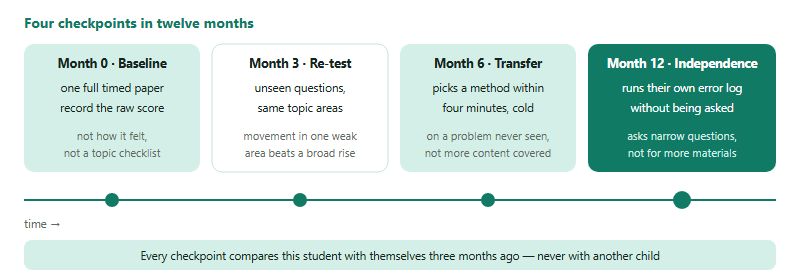
A note on the month-three re-test, because it is easy to run badly. It must use questions the student has not seen. Re-sitting a paper they have already worked through measures memory of that paper and nothing else, and it reliably produces an encouraging number that means very little. Our own compiled past-paper pack is useful here precisely because it lets a family pull equivalent questions from different years; worked solutions exist for some years rather than all, so treat it as practice material first. Our guide to using the past papers properly explains how to set up a clean re-test.
Signals worth trusting, and four questions to ask a coach
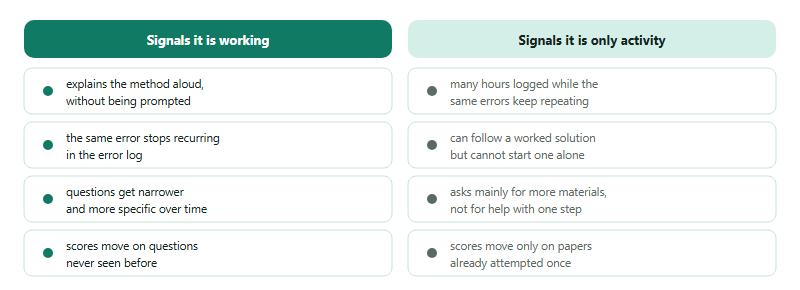
In our own teaching, the difference between a student who is progressing and a student who is merely busy shows up in how they talk about problems long before it shows up in a score. That is our observation from coaching rather than a measured statistic, and individual results vary — but the pattern is consistent enough to use as an early warning.
If you are evaluating any programme, school club or private arrangement, four questions separate substance from packaging. Which route is my child eligible for, by status? — an answer that does not distinguish the three cases above is a warning sign in itself. What will you measure at month three, and on what unseen material? What proportion of contact time is my child working rather than watching? And what does this displace? A coach who cannot say what a chemistry olympiad year costs elsewhere in the week has not planned the year.
The last point is the one worth ending on. For a family in case three, where no ACS entry route exists, the honest framing is that the chemistry is the return: a student who works through this syllabus properly arrives at university with the general-chemistry core already solid, and with the habit of unfamiliar problems being interesting rather than alarming. That is a real outcome. It is simply not a competition result, and a household deciding on this basis should know which one it is buying.
Frequently asked questions
Can my child enter the USNCO from a school in mainland China?
Only if they hold US citizenship or permanent residency and attend an accredited American-curriculum school there. Confirm the conditions on acs.org.
How many hours a week does this really take?
Our planning range is 2 to 3 hours in Grade 9, rising to 5 to 7 in Grade 11 term time. These are our figures, not ACS guidance.
Are the awards gold, silver and bronze?
No. The recognition levels are High Honors and Honors. Medal language comes from host-organisation framing elsewhere. Confirm on acs.org.
Will a good result get my child into a university?
No competition result causes an offer. Treat the chemistry learned and the benchmark obtained as the return, not admission.
This is the USNCO information desk, synchronising official ACS information for chemistry students in China, operated by Hanlin Education. The USNCO is run by the American Chemical Society (ACS), which sets all official rules and eligibility. Always confirm current details on acs.org. Errors are corrected within 7 working days of notice.