Across the USNCO past papers, three areas separate strong students from the pack more than any others: thermodynamics, chemical equilibrium, and the organic block. They are hard not because the facts are obscure but because they demand chained reasoning under time pressure. This guide decodes why each is difficult and how a China-based self-studier can build genuine command of them using the publicly available papers.
Why these three, and how to use this guide
The USNCO, run by the American Chemical Society (ACS), publishes past exams from 1999–2025 with answer keys, and its syllabus spans the standard advanced high-school and introductory-college range: atomic and molecular structure, stoichiometry, states of matter, kinetics, thermodynamics, equilibrium (acid–base, solubility, redox/electrochemistry), descriptive and organic chemistry. Every year is different, but the same handful of topics reliably produce the questions students find hardest. We are anchoring to topic areas the syllabus covers; for the exact weighting and format of any given paper, confirm on acs.org and see our What Is the USNCO? overview.
| Topic block | Why it is hard | The skill it really tests |
|---|---|---|
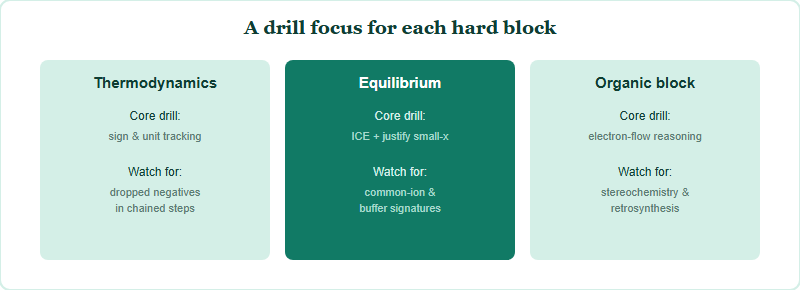
| Thermodynamics | Multiple state functions (ΔH, ΔS, ΔG) interlock; sign conventions and temperature dependence trip people up | Choosing the right relationship and tracking signs across a multi-step calculation |
| Chemical equilibrium | ICE tables, coupled equilibria, buffers and Ksp layer quickly; small-x approximations must be justified | Setting up a system correctly, then knowing which simplification is safe |
| Organic block | Mechanisms, stereochemistry and multi-step synthesis reward pattern recognition, not memorised lists | Reasoning about electron flow and structure, not recall alone |
Thermodynamics: master the sign, then the chain
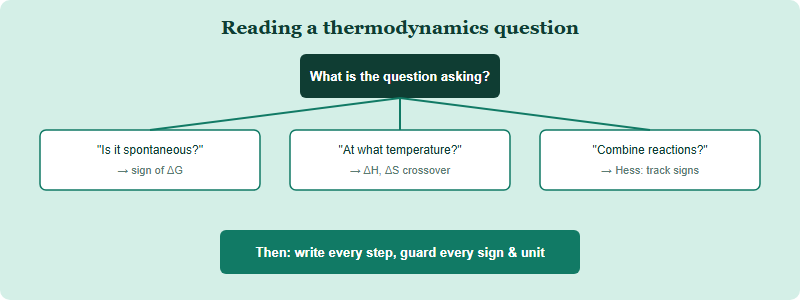
Thermodynamics questions rarely test a single formula. They test whether you can move between enthalpy, entropy and free energy without losing a sign or a unit along the way. The classic failure is not “I did not know the equation” — it is “I dropped a negative in step three.”
- Anchor everything to spontaneity. The relationship linking ΔG to ΔH, ΔS and temperature is the spine of the topic. Build the instinct that a question about “will this happen / at what temperature” is really a ΔG question in disguise.
- Drill sign conventions until they are automatic. Exothermic versus endothermic, entropy increase versus decrease, and what a positive versus negative ΔG means — these should never cost you thinking time. Wrong signs are the single most common avoidable loss here.
- Practise the temperature crossover. Questions that ask at what temperature a process becomes spontaneous combine two state functions and a threshold. Do enough of them that the setup is reflexive.
- Carry units through Hess-style problems. When combining reaction steps, unit and sign bookkeeping is where marks quietly disappear. Write every step; do not do it in your head.
Diagnose thermodynamics by where you lose points. If you lose them on setup, you have a concept gap; if you lose them on arithmetic and signs, you have an execution gap — and the fix for those two is completely different.
Equilibrium: set it up right, simplify only when it is safe
Equilibrium is where careful students still stumble, because a small setup error compounds. The topic layers fast: a simple Kc problem becomes a weak-acid problem, then a buffer, then a solubility (Ksp) problem with a common ion, then a coupled equilibrium — and each layer adds a place to go wrong.
- Live in the ICE table. Initial–Change–Equilibrium bookkeeping is the universal tool. Write it out even when you think you can skip it; the questions that punish shortcuts are exactly the ones that look skippable.
- Justify the small-x approximation, do not assume it. Dropping x from a denominator is fine only when it is genuinely small relative to the initial concentration. Strong students state the assumption and, when in doubt, check it — a habit that prevents a whole class of wrong answers.
- Recognise the buffer signature. A weak acid with its conjugate base is a buffer, and reaching for the Henderson–Hasselbalch relationship should be automatic when you see that pairing.
- Watch the common-ion effect in Ksp. Solubility questions that add a shared ion are designed to catch students who forget the shift. Ask “what ion is already here?” before you compute.
- Use Le Chatelier as a sanity check, not a crutch. After a calculation, ask whether the direction of the shift makes qualitative sense. If your number and the principle disagree, one of them is wrong.
Equilibrium rewards students who read the whole stem before writing anything, because the last clause (“…in a solution already 0.10 M in chloride”) often changes the entire approach.
The organic block: reason about electrons, do not memorise lists
Organic chemistry frightens students who try to memorise every reaction. On the USNCO it rewards the opposite: understanding why electrons move, so you can reason through a mechanism or a synthesis you have never seen before.
- Think in nucleophiles and electrophiles. Almost every mechanism is electron-rich meeting electron-poor. Once you see reactions as electron flow, families collapse into a few patterns instead of dozens of facts.
- Take stereochemistry seriously. Chirality, R/S, and cis/trans distinctions appear precisely because they separate students who visualise molecules in three dimensions from those who do not. Build model-kit or sketching habits early.
- Work synthesis backwards. Multi-step synthesis problems yield to retrosynthetic thinking — start from the target and ask what could have made it. This turns an intimidating forward maze into a sequence of small choices.
- Learn functional-group behaviour, not reaction names. Knowing how an alcohol, a carbonyl or an aromatic ring behaves lets you predict; memorised named reactions do not transfer to unfamiliar substrates.
Because the organic block is pattern-based, it is also the area where volume of quality practice pays off fastest. Every mechanism you reason through (rather than look up) widens the set of unfamiliar problems you can handle.
The self-study trap that keeps these topics hard
There is one habit that quietly stops self-studiers from ever mastering these three blocks, and it is worth naming because it feels like progress while it happens. It is practising recognition instead of reasoning — doing a problem, checking the answer, nodding along to the worked solution, and moving on. You come away feeling you “get it,” but you have only recognised someone else's reasoning, not generated your own.
Recognition is fragile. In thermodynamics it collapses the moment a sign convention is reversed from the version you saw; in equilibrium it fails when the stem hides a common ion; in organic it evaporates in front of an unfamiliar substrate. The exam is built precisely to defeat recognition, which is why students who “understood everything” in review still lose marks under conditions.
- Close the solution before you look. Attempt the full problem cold, commit an answer, and only then open the key. The struggle before the answer is where the learning is; skipping it is the trap.
- Re-derive, do not re-read. When you get one wrong, cover the solution and reconstruct the correct chain yourself. If you cannot rebuild it unaided, you have not learned it yet — you have only recognised it.
- Explain it out loud. Teaching a step to an imaginary peer forces reasoning into the open and exposes the gaps that silent nodding hides.
- Revisit after a gap. Come back to a “mastered” problem a week later and redo it blind. Genuine command survives the delay; recognition does not.
This discipline is also what makes the USNCO past papers so valuable for a China-based student who — as we cover in Can International Students Take the USNCO? — is generally using them to build chemistry rather than to sit the exam. The point of the archive is not to have “seen” the questions; it is to have reasoned through them until the reasoning is yours.
Turning this into a study rotation
Knowing why these topics are hard is only useful if it changes how you practise. The mistake is to grind one topic to exhaustion and neglect the others; the exam interleaves them, so your practice should too.
- Rotate, do not silo. In a study week, touch all three blocks rather than spending a fortnight only on organic. Interleaving builds the retrieval strength the exam actually demands.
- Mine the past papers by topic. Pull thermodynamics, equilibrium and organic questions across several years and work them in clusters, so you see how the same idea is dressed differently. Our past-paper guide shows how to run this rotation.
- Keep an error log per block. Write down every lost mark and label it: concept, setup, or slip. After a month, the pattern tells you exactly where the next hour of study should go.
- Confirm exam specifics separately. How these topics are weighted or examined in any given paper can change; verify the current format on acs.org rather than assuming last year’s shape.
Done this way, the “hardest” topics become the most rewarding: they are where a self-studier in China, working only from public papers, can build the kind of chemical reasoning that transfers well beyond any single exam.
FAQ
Which USNCO topic do students find hardest?
Thermodynamics, chemical equilibrium and the organic block most often separate strong students. Each rewards chained reasoning rather than recall. Confirm weighting on acs.org.
Do I need to memorise every organic reaction?
No. Reasoning about electron flow, functional-group behaviour and retrosynthesis transfers to unfamiliar problems; memorised reaction lists do not.
Why do I lose marks on equilibrium even when I know the theory?
Usually setup: skipping the ICE table or applying the small-x approximation when it is not valid. Justify simplifications rather than assuming them.
How should I practise these topics from China?
Use the 1999–2025 past papers, cluster questions by topic across years, and keep an error log labelling each loss as concept, setup or slip.
This is the USNCO information desk synchronising official ACS information for chemistry students in China, operated by Hanlin Education. The USNCO is run by the American Chemical Society (ACS), which sets all official rules, syllabus and eligibility. Topic weighting and exam format can change year to year; always confirm current details on acs.org. Any error will be corrected within 7 working days.