
If your practice scores have stopped moving, the problem is almost never how many problems you do. It is that you are not diagnosing them. Working a paper, checking the answers and moving on is exposure, not learning. This is the method that converts exposure into improvement: a five-way mistake taxonomy, a ninety-second log entry, and a re-test ladder.
Practice without diagnosis is just exposure
Here is the pattern we see constantly when we go through students' scripts. A student has worked fifteen past papers. They can tell you their scores. They cannot tell you which three topics produced most of their lost marks, whether those losses were knowledge gaps or execution slips, or whether the questions they got wrong in paper three would still be wrong today. The practice happened; the diagnosis never did.
The consequence is a plateau that feels inexplicable from the inside. Effort is high, hours are real, and the score sits still, because the same small slice of the syllabus keeps costing marks while the part you already own gets rehearsed again and again. More papers do not fix that. They just produce more evidence of the same untreated problem.
Two things break the plateau. The first is classifying every lost mark, because I got equilibrium wrong is not actionable while I applied the small-x approximation without testing it is. The second is scheduling a re-test, because a mistake you understood once and never met again is a mistake you will make again under pressure. Almost everything else in this article is machinery for those two ideas. For the exam this preparation points at, see our overview of what the USNCO is; the format and rules are set by ACS, so confirm current details on acs.org.
The five-way taxonomy
Every lost mark falls into one of five categories, and the category determines the treatment. This is the part students skip, and it is the part that does the work — because four of the five categories are not fixed by studying more chemistry, and a student who treats every error as a knowledge gap will re-read textbooks forever while the real leak continues.
| Type | How you recognise it | What it means | The correct treatment | Re-test at |
|---|---|---|---|---|
| 1. Concept gap | Even after reading the solution you cannot explain why it is right | You do not know this chemistry | Go back to the book, then a fresh set of problems on that topic. Not the same problem again | 3, 10 and 30 days |
| 2. Retrieval failure | The instant you see the answer you think “of course” | You know it but cannot summon it under load | Active recall, not re-reading. Self-test from a blank page | 2 days, then weekly |
| 3. Procedural slip | Right method, wrong number: algebra, units, transcription, rounding | Your execution habits are leaky | Change the process, not the content. Write units, box answers, work vertically | Same week, under time |
| 4. Reading error | You solved a question the paper did not ask | You are missing conditions and qualifiers | A mark-up routine before you start writing | Any question with the same trap shape |
| 5. Timing or strategy error | You could do it, but ran out of time or over-invested in one item | Content is fine; allocation is not | Section-length timed runs with a skip-and-return rule | Whole-section reps, weekly |
A few notes on classifying honestly, because self-deception here is the whole failure mode. The distinction between type one and type two is decided in the first two seconds after you see the solution — instant recognition means retrieval, genuine puzzlement means concept. Do not let type three absorb everything; careless mistake is the label students reach for because it is comfortable, and if more than about a third of your errors are landing in that box you are almost certainly misclassifying retrieval failures as slips. Type four has a specific signature worth knowing: the qualifiers that catch people are negations, standard-state conditions, limiting-reagent phrasing, and units that differ between the data and the answer.
The ninety-second entry
An error log fails for exactly one reason: it becomes too expensive to maintain. Students start by copying whole solutions, redrawing diagrams and colour-coding, and abandon the thing in a fortnight. The entry below takes ninety seconds and is deliberately, almost insultingly, small.
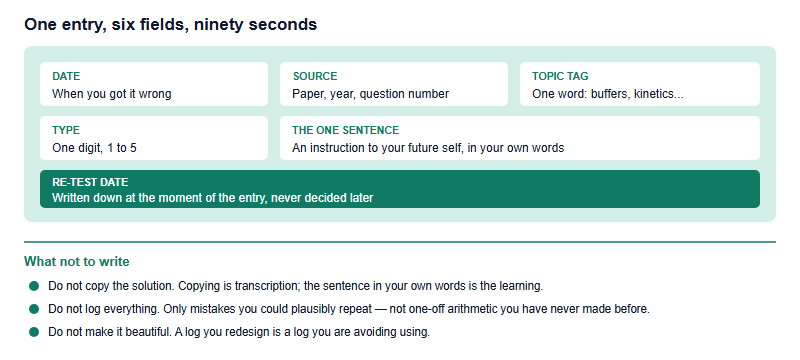
The one sentence is the whole method, so it is worth being precise about what makes it work. It must be phrased as an instruction to your future self, not as a description of the past. I forgot to check the second dissociation is a description and it changes nothing. When a polyprotic acid appears, decide whether the second dissociation matters before assuming it does not is an instruction, and it fires the next time you see one. The test is simple: could you hand the sentence to someone about to sit the paper and would it be useful to them? If not, rewrite it.
A plain spreadsheet is the right tool — six columns, sortable, filterable, and searchable by topic tag. Paper works too and has the advantage of being faster to write and harder to fiddle with. What does not work is a notebook of full solutions, which is the format almost every student defaults to and almost none can sustain.
The review loop and the re-test ladder
Logging without re-testing is just record-keeping. The loop below is twenty minutes a week, and it is the part that converts the log from an archive into an instrument.
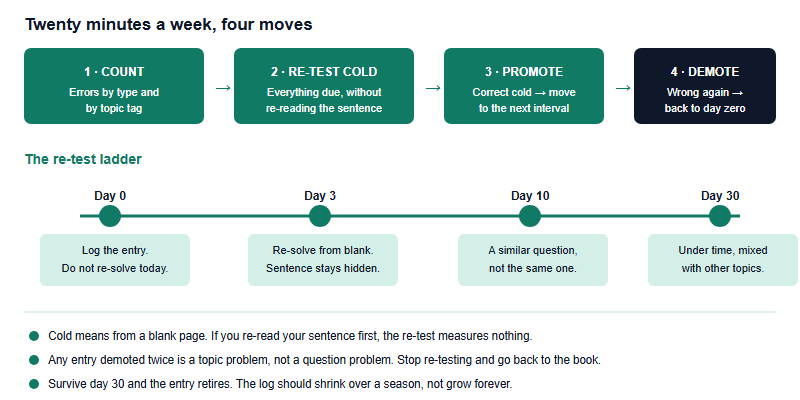
The detail that most affects whether this works is what you re-test with. At day three, re-solving the original question is fine, because at that distance you are testing whether the correction stuck. At day ten it is not, because you will half-remember the answer and reward yourself for recall you do not have. You need a different question that fails in the same way — which is precisely what a topic-sliced past-paper collection provides. Our gathered past-paper pack and the method for working through it is organised so you can pull, say, the buffer questions we have gathered across a range of years and usually have a fresh one to re-test with.
Reading your own data after four weeks
Four weeks in, you have something no score alone can give you: a distribution. Sort by type and count, and the shape of the counts tells you what to change. This is the payoff, and it is why the taxonomy is worth the discipline.
- Mostly type one, concept gaps. You have moved to problems too early. Go back to the book for the two or three worst topic tags and rebuild before spending more paper time.
- Mostly type two, retrieval failures. Your knowledge is real but not automatic. Shift hours from reading to active recall and from mixed practice to short, frequent, self-tested repetition.
- Mostly type three, procedural slips. Content is fine, execution leaks. Fix the habits themselves: units carried through every line, a guard digit until the final answer, the answer boxed and re-read against the question.
- Mostly type four, reading errors. You are rushing the first ten seconds of every question. Adopt a mark-up routine and apply it without exception, including on questions that look easy.
- Mostly type five, timing. This is the good problem. Your chemistry is competitive and what remains is allocation, which responds fast to whole-section timed runs and a firm skip-and-return rule.
The topic-tag column earns its keep at the same moment. Sort by tag and you usually find that two or three tags account for a disproportionate share of everything — and those tags, not the whole syllabus, are your revision plan for the next month. Students routinely discover their real weakness is not the topic they feared. A student convinced that organic chemistry is sinking them will often find, on counting, that equilibrium has quietly produced several times as many entries.
Watch one number over time as well: the demotion rate, meaning the share of due re-tests you get wrong again. A high rate early is normal. If it stays high after a month, your one-sentence entries are probably descriptions rather than instructions, and rewriting them is a better use of an evening than another paper.
Where it fits in a season, and the access rules
Start the log the day you start timed practice, not before. During a first content pass almost everything is a concept gap and the log adds nothing but overhead. The moment you begin working real questions cold, the classification starts carrying information and the method turns on.
Budget realistically. Logging costs about ninety seconds per entry, and a full practice paper might generate eight to fifteen worth keeping — so twenty minutes after a paper, plus twenty minutes of weekly review. Against several hours of practice, that is a small tax for the only mechanism that tells you what the practice was worth. In the final weeks the log inverts and becomes your revision plan: the surviving entries are, by definition, the mistakes you have proven you repeat.
Two closing honesty notes. First, this method makes no promises about outcomes, and any preparation approach that does should be treated with suspicion. What it reliably does is stop you spending a second month treating a retrieval problem as a knowledge problem. Second, keep the access rules straight. Per ACS, the National Exam requires United States citizenship or permanent residency; a non-US-national attending a high school in the United States may sit the Local Exam but cannot be nominated onward; a US citizen or green-card holder at an accredited American school abroad, including in China, enrolled at least a year and under twenty, competes through an ACS International Chemical Sciences Chapter; and a student who is neither a citizen nor a permanent resident at a school in mainland China has no ACS route, with no China region to register for. The full position is in our guide to who can and cannot enter the USNCO, and eligibility is ACS territory, so confirm current rules on acs.org.
The log is the least route-dependent thing you can build. It is a diagnostic habit, and it works identically on school examinations, on any competition you are eligible for, and on university problem sets. The chemistry it is applied to may change. The method does not.
Frequently asked questions
Should I log every mistake?
No. Log only mistakes you could plausibly repeat. One-off arithmetic errors you have never made before are noise.
What makes a good one-sentence entry?
An instruction to your future self, not a description of the past. If it would not help someone about to sit the paper, rewrite it.
How long before the log shows anything useful?
About four weeks of timed practice. Before that you have too few entries for the distribution to mean anything.
When should I start keeping one?
The day you start timed practice. During a first content pass nearly everything is a concept gap, so the log adds only overhead.
This is the USNCO information desk, synchronising official ACS information for chemistry students in China, operated by Hanlin Education. The USNCO is run by the American Chemical Society (ACS), which sets all official rules and eligibility. Always confirm current details on acs.org. Errors reported to us are corrected within 7 working days.