
Gas mixtures are a staple of the US National Chemistry Olympiad (USNCO) Local and National exams. While the underlying physics—Dalton’s Law of Partial Pressures—is straightforward, the application often trips students up because it requires simultaneous tracking of two distinct quantities: the total pressure of the system and the individual contribution of each component. The core challenge is not just knowing the formula Pi = XiPtotal, but maintaining the integrity of the mole balance when reactions occur or when gases are collected over water.
The Core Mechanism: Why Mole Fraction is the Bridge
In any ideal gas mixture, the partial pressure of a specific component is directly proportional to its mole fraction. This relationship acts as the bridge between the macroscopic observable (pressure) and the microscopic reality (number of moles). For USNCO preparation, understanding this bridge is critical because exam questions rarely give you the mole fraction directly. Instead, they provide mass, volume, or reaction stoichiometry, forcing you to derive the mole count first.
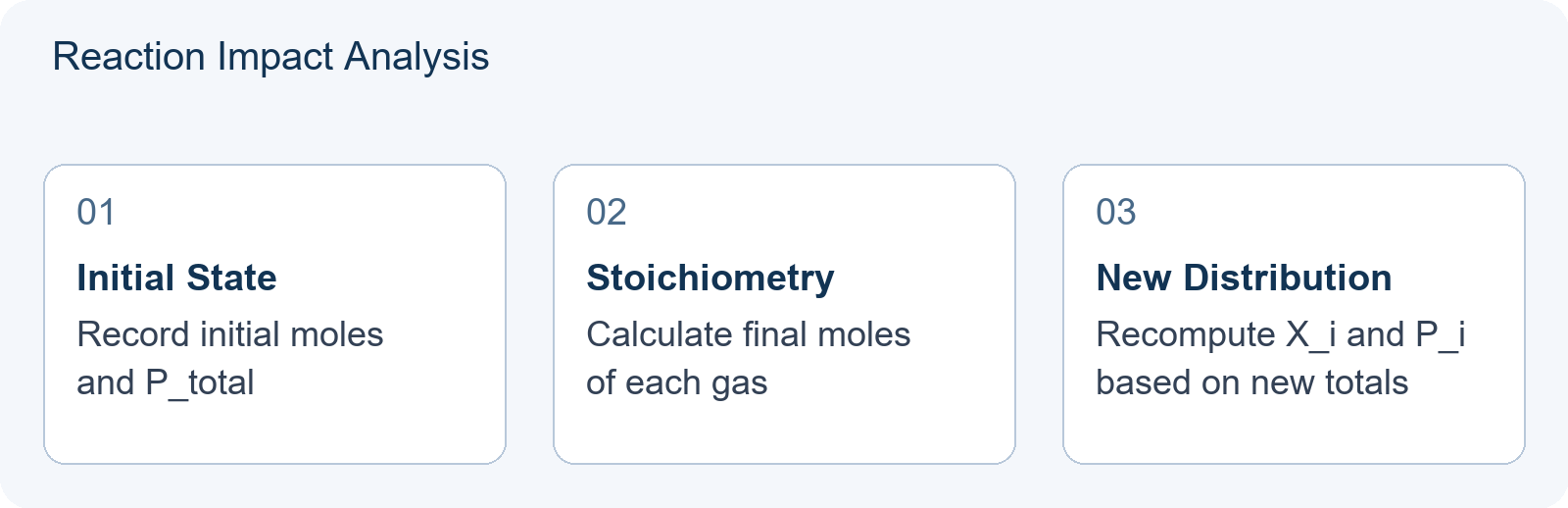
A common error in student solutions is treating partial pressures as additive constants that do not change during a reaction. However, if a reaction changes the total number of moles of gas, the mole fractions shift. In a fixed-volume container, a change in total moles changes the total pressure, which then redistributes the partial pressures. Tracking this dynamic requires a disciplined approach to the mole balance.
Step-by-Step Logic for Static Mixtures
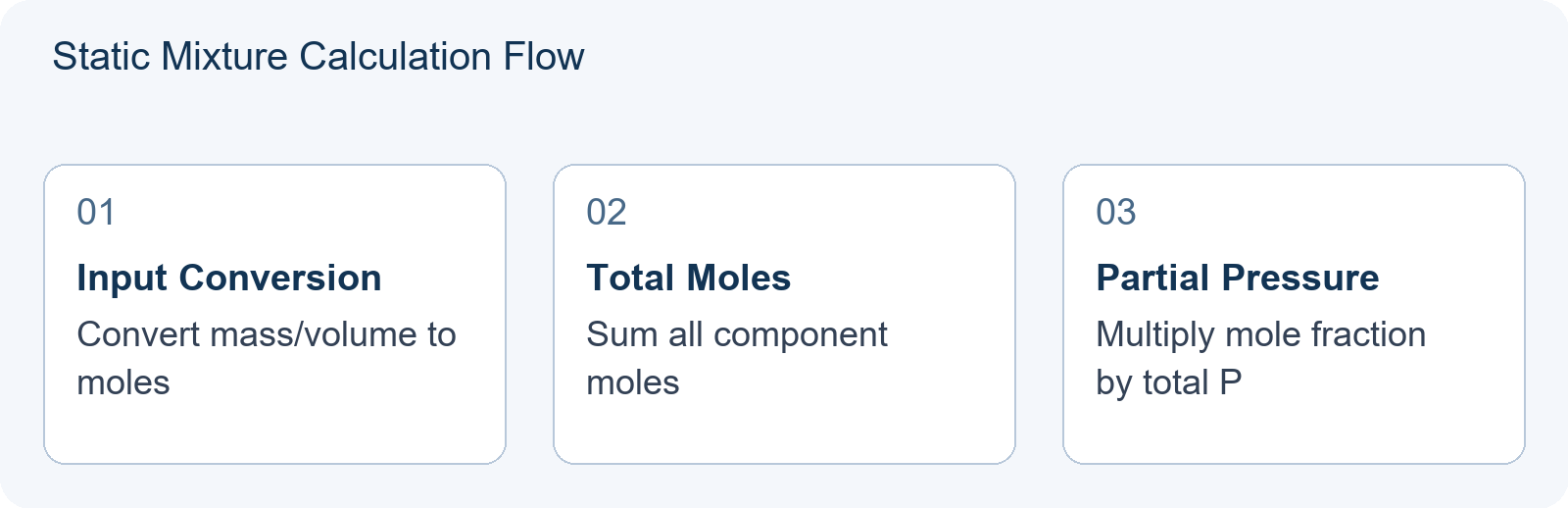
For non-reactive mixtures, the process is linear:
- Convert all inputs to moles: Whether given in grams, liters at STP, or particle counts, everything must become moles (n).
- Calculate Total Moles: Sum the moles of all components (ntotal = Σni).
- Determine Mole Fractions: Divide each component’s moles by the total (Xi = ni / ntotal).
- Apply Dalton’s Law: Multiply the mole fraction by the total pressure (Pi = XiPtotal).
This sequence seems simple, but under time pressure, students often skip the conversion step or mishandle inert gases. A critical distinction: if an inert gas is added to a rigid container at fixed temperature, the partial pressures of reactive species do not change, because Pi = niRT/V depends only on their own mole count. The inert gas raises the total pressure, not the reactive partial pressures. Conversely, if the container has a movable piston at fixed total pressure, adding inert gas expands the volume, and then the partial pressures of the gases already present decrease because their amounts occupy a larger volume.
Teaching Illustration 1: Fixed-Volume Reaction with Conserved Total Moles
Note: This is a hypothetical teaching illustration designed to show stoichiometric logic, not an actual contest problem.
Consider a rigid 10.0 L vessel containing 0.50 mol of Hydrogen gas (H₂) and 0.50 mol of Chlorine gas (Cl₂) at 298 K. The initial total pressure is calculated using the Ideal Gas Law (PV = nRT):
Pinitial = (1.00 mol) × (0.08206 L atm/mol K) × (298 K) / 10.0 L = 2.445 atm.
Initially, since the moles are equal, the mole fraction of each is 0.500. Thus, PH₂ = 1.223 atm and PCl₂ = 1.223 atm.
Now, assume the mixture reacts completely to form Hydrogen Chloride (HCl) according to the equation: H₂(g) + Cl₂(g) → 2HCl(g).
Many students incorrectly assume the partial pressures remain unchanged because the temperature and volume are constant. Let’s check the mole balance:
- Reactants consumed: 0.50 mol H₂ and 0.50 mol Cl₂ disappear.
- Products formed: According to stoichiometry, 1 mol H₂ produces 2 mol HCl. So, 0.50 mol H₂ produces 1.00 mol HCl.
- New Total Moles: We started with 1.00 mol of gas. We ended with 1.00 mol of gas (HCl). The total number of moles did not change.
Because ntotal remained 1.00 mol, the total pressure remains 2.445 atm. However, the composition changed entirely. Now, there is only one type of gas molecule. The mole fraction of HCl is 1.000. Therefore, the new partial pressure of HCl is 2.445 atm. The partial pressures of H₂ and Cl₂ drop to zero.
Key nuance: This reaction is a special case where Δngas = 0 (1 + 1 = 2). The total pressure stayed constant not because partial pressures are immutable, but because the stoichiometry happened to conserve total moles. Do not generalize this to reactions where Δngas ≠ 0.
Teaching Illustration 2: Fixed-Volume Reaction with Decreasing Total Moles
Note: This is a hypothetical teaching illustration using abstract species to isolate the mole-balance principle.
Consider a rigid 30.0 L vessel at 298 K containing 2.00 mol of gas A and 1.00 mol of gas B. The reaction is: 2A(g) + B(g) → 2C(g). This is assumed complete, with all gases behaving ideally.
Initial total pressure:
Pinitial = (3.00 mol)(0.08206 L atm/mol K)(298 K) / 30.0 L = 2.445388 atm.
Initial mole fractions: XA = 0.667, XB = 0.333. Initial partial pressures: PA = 1.630259 atm, PB = 0.815130 atm.
Mole balance check:
- A consumed: 2.00 mol; B consumed: 1.00 mol.
- C formed: 2.00 mol (from stoichiometry: 2 mol A produces 2 mol C).
- New total moles: 2.00 mol (down from 3.00 mol).
New total pressure at constant V and T:
Pnew = (2.00 mol)(0.08206)(298) / 30.0 L = 1.630259 atm.
The total pressure dropped by exactly one-third. The product C now has mole fraction 1.000, so PC = 1.630259 atm. If you had assumed the original partial pressures carried over, you would have calculated PC = 2.445388 atm—an error of 50%.
Teaching Illustration 3: Gas Collected Over Water
Note: This is a hypothetical teaching illustration. The water vapor pressure value used is a standard physical constant, not a sourced competition fact.
A superficial approach also fails when students apply Dalton’s Law to gases collected over water without adjusting for vapor pressure. Consider a classic scenario: Oxygen gas is generated by thermal decomposition of a solid and collected over water at 25°C. The total atmospheric pressure is 760 mmHg. The volume of gas collected is 500 mL.
If a student uses Ptotal = 760 mmHg in the Ideal Gas Law to find moles of O₂, they will calculate an incorrect value. Why? Because the gas inside the collection tube is a mixture of O₂ and water vapor (H₂O). At 25°C, the vapor pressure of water is approximately 23.8 mmHg.
According to Dalton’s Law:
Ptotal = PO₂ + PH₂O
760 mmHg = PO₂ + 23.8 mmHg
PO₂ = 736.2 mmHg
The correct calculation for moles of oxygen must use 736.2 mmHg, not 760 mmHg. Using the wrong pressure leads to an overestimation of the yield by about 3.23%. This error propagates into any subsequent stoichiometric calculation that uses the incorrect amount. The key takeaway is that “collected over water” is a signal to subtract the vapor pressure of water at the experimental temperature before proceeding with any mole calculations.
Diagnostic Application: Testing Your Understanding
To assess your readiness, consider this diagnostic problem. A flask contains a mixture of Nitrogen (N₂), Helium (He), and Methane (CH₄). The partial pressures are measured as follows: PN₂ = 2.0 atm, PHe = 1.0 atm, and PCH₄ = 3.0 atm. The total volume is 5.0 L at 300 K.
Question 1: What is the total pressure?
Answer: Ptotal = 2.0 + 1.0 + 3.0 = 6.0 atm. This is direct application of Dalton’s Law.
Question 2: What is the mole fraction of Methane?
Answer: XCH₄ = PCH₄ / Ptotal = 3.0 / 6.0 = 0.50. Note that we didn’t need volume or temperature to find the mole fraction; pressure ratios suffice for ideal gases.
Question 3: How many moles of Helium are present?
Answer: Use the Ideal Gas Law for the partial pressure of Helium. nHe = (PHeV) / (RT). nHe = (1.0 atm × 5.0 L) / (0.08206 × 300 K) ≈ 0.203103 mol.
Analysis: If you struggled with Question 3, it indicates a gap in connecting partial pressure to the amount of substance. Many students try to calculate total moles first, then multiply by mole fraction. Both methods work, but calculating directly from partial pressure is faster and less prone to rounding errors in multi-step problems.
Implications for Next Learning Tasks
Mastering gas mixtures is not an isolated skill; it is foundational for Chemical Equilibrium and Electrochemistry. In equilibrium problems involving gases (e.g., N₂O₄ ⇌ 2NO₂), the equilibrium constant Kp is defined in terms of partial pressures. If you cannot accurately determine the partial pressure of each species at equilibrium, you cannot solve for Kp or predict shifts in equilibrium position.
Furthermore, in electrochemical cells involving gaseous electrodes (like the Standard Hydrogen Electrode), the potential depends on the partial pressure of hydrogen gas via the Nernst Equation. An error in tracking partial pressure here leads to incorrect cell potentials.
Therefore, after reviewing these concepts, your next task should be to practice problems connecting partial pressures to equilibrium expressions and electrochemical potentials. Ensure you understand how changes in total pressure or volume affect each species’ contribution to the overall system.
Preparation Strategy for USNCO Candidates
The ACS has published that registration for the 2026–27 cycle opens November 1, 2026, with the Local Exam scheduled February 28–March 2, 2027, and the National Exam April 16–18. These dates are subject to change; verify with official sources.
When preparing for gas mixture questions, focus on three areas:
- Vapor Pressure Corrections: Memorize or know how to look up water vapor pressure tables. Practice problems where gas is collected over water.
- Stoichiometric Changes: Work through problems where reactions change the total number of moles. Calculate the new total pressure and new mole fractions explicitly.
- Unit Consistency: Ensure pressure units match the gas constant R used. Mixing atm and bar, or kPa and torr, is a frequent source of error.
It is also beneficial to review related topics such as USNCO Equilibrium Approximations: Knowing When the Small-Change Shortcut Fails, where small-change shortcuts rely on accurate initial concentration (or pressure) values. Similarly, understanding Stoichiometry, Solutions and Gases: The USNCO Topics You Think You Have Already Mastered (2026) provides the broader context for how these calculations fit into the exam structure. For those weighing competition options, USNCO vs CCC: Which Chemistry Competition to Prepare for When You Cannot Do Both offers a framework for allocating preparation time.
Finally, remember that while online resources are helpful, working through physical problems with pen and paper builds the muscle memory needed for timed exams. Use past papers available through legitimate channels to test these skills under simulated conditions.
Frequently Asked Questions
Does adding an inert gas change the partial pressures of reactive species?
It depends on conditions. In a rigid container at fixed temperature, adding inert gas does not change partial pressures of other gases, because Pi = niRT/V depends only on each species’ own mole count. The inert gas raises total pressure, not the reactive partial pressures. However, if the system is at fixed total pressure with a movable piston, adding inert gas expands volume, and then the partial pressures of gases already present decrease because their amounts occupy more space.
How do I handle gases collected over water in USNCO problems?
Subtract the vapor pressure of water at the experimental temperature from the total measured pressure before using the Ideal Gas Law for the gas of interest. At 25°C, water vapor pressure is approximately 23.8 mmHg. Using the total pressure instead of the corrected partial pressure overestimates the gas amount by about 3.2% at room temperature.
What if the volume changes during the reaction?
If volume changes, you must use the Ideal Gas Law (PV=nRT) to find the new total pressure first, then apply Dalton’s Law. You cannot simply scale partial pressures by mole fraction if the total pressure itself has changed due to volume expansion or contraction. Track moles first, then recalculate all pressures from the new conditions.