
Electrochemistry and kinetics are the two physical-chemistry blocks that school courses touch but rarely train to olympiad depth. Both are unusually learnable: electrochemistry reduces to one triangle linking cell potential, free energy and the equilibrium constant, and kinetics reduces to choosing the right integrated rate law and reading the graph. This guide builds both, with the traps that cost most marks.
Why this pair is under-trained
Thermodynamics and equilibrium get drilled because students expect them to be hard. Organic gets drilled because students fear it. Electrochemistry and kinetics fall between: they appear late in most school syllabuses, they are often the last units before final examinations, and they are taught as formula sheets rather than as reasoning systems. The result is a predictable pattern — students can recite the Nernst equation but cannot say which species goes in the numerator of the reaction quotient, and can recite three integrated rate laws but cannot tell which one a data table is asking for.
There is a second reason to prioritise them. Both blocks are heavily quantitative and self-checking: a sign error or a wrong order produces an answer that is obviously absurd once you know what to look for. That makes them the fastest blocks to convert from shaky to reliable, usually inside three weeks. If you are still orienting yourself around the competition structure, our overview of what the USNCO is and how its stages work is the place to start; the topic list itself is published by ACS, so confirm the current scope on acs.org. Our own breakdown of what the syllabus covers maps the physical-chemistry sections topic by topic.
Electrochemistry: one triangle, three quantities
Almost every electrochemistry question is asking you to move between three quantities: the standard cell potential, the standard free-energy change, and the equilibrium constant. If you can travel any edge of that triangle in either direction, you can answer the question.
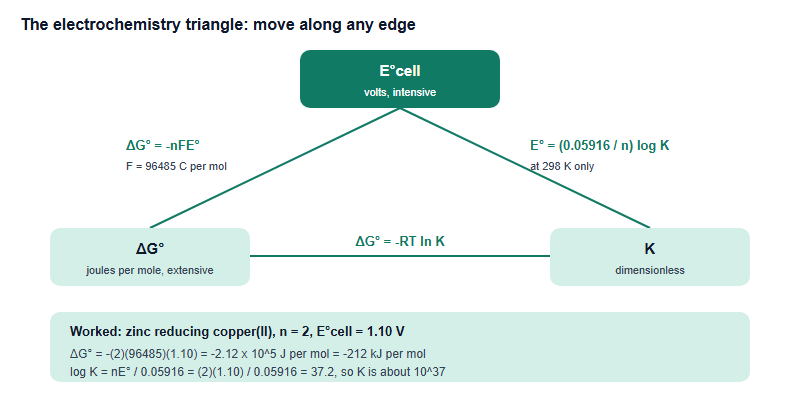
Two extensions complete the block. The Nernst equation handles non-standard conditions: at 298 K, the cell potential falls by 0.05916/n volts for every factor of ten by which the reaction quotient rises. Take the same zinc-copper cell with the copper(II) concentration dropped to 0.010 M while the zinc(II) stays at 1.0 M: the quotient becomes 100, log Q is 2, and the potential falls to 1.10 minus 0.0592, that is 1.04 V. Notice how small the shift is — for a two-electron cell a hundredfold concentration change moves the potential by under 60 millivolts, and by about 118 mV when only one electron is transferred, which is why concentration cells produce such modest voltages.
The other extension is electrolysis arithmetic, which is pure bookkeeping through the Faraday constant. Charge equals current multiplied by time; moles of electrons equals charge divided by 96485; moles of product follows from the half-equation. A current of 2.00 A for 30.0 minutes delivers 3600 coulombs, which is 0.0373 mol of electrons, which deposits half that in moles of copper from a copper(II) solution — about 1.19 g. Every electrolysis question is that chain, in one order or the other.
Kinetics: choose the law, then read the graph
Kinetics questions almost always start with the same hidden instruction: work out the order first. Order is an experimental property, not something you can read off the balanced equation, unless the step is elementary. Once you have the order, the integrated law, the half-life behaviour and even the units of the rate constant all follow.
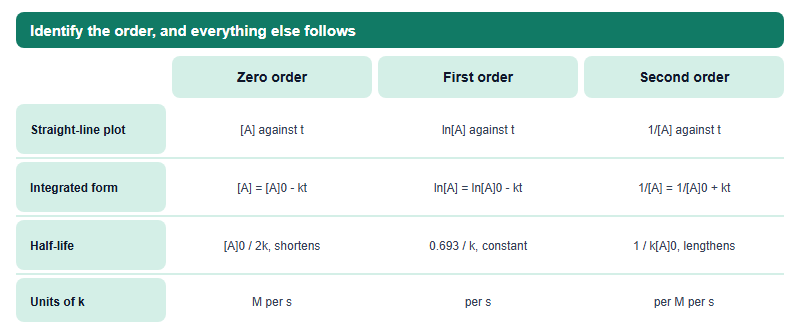
The half-life row deserves a sentence of its own. Only a first-order reaction has a half-life independent of concentration, which is why radioactive decay and many drug-clearance problems are first order and why a data table showing equal successive halving times is a first-order fingerprint. A zero-order half-life shortens as the reaction proceeds; a second-order half-life lengthens.
Temperature dependence is the last piece. The Arrhenius relationship says the rate constant rises exponentially as activation energy falls or temperature rises, and in its two-point form it lets you extract an activation energy from two rate constants at two temperatures. A useful sanity habit: activation energies for ordinary solution reactions typically land in the tens of kilojoules per mole, so an answer of 4 kJ or 4000 kJ per mole is telling you to check your algebra rather than your chemistry.
Eight traps that cost more marks than the chemistry
| Block | The trap | What to do instead |
|---|---|---|
| Electrochemistry | Multiplying the cell potential when you scale the equation | Potential is intensive, so it never scales. Free energy is extensive, so it does. Scale one, not the other. |
| Electrochemistry | Assuming the anode is always negative | Oxidation is always at the anode, but the anode is negative in a galvanic cell and positive in an electrolytic one. |
| Electrochemistry | Building the cell potential from mixed conventions | Take both values as reduction potentials and use cathode minus anode. Never flip a sign twice. |
| Electrochemistry | Putting solids or pure liquids into the reaction quotient | Only species with meaningful activities appear. A metal electrode does not. |
| Kinetics | Reading the order off the balanced equation | Order is experimental. Use initial-rate data, or the graph that comes out linear, unless you are told the step is elementary. |
| Kinetics | Confusing rate of reaction with rate of change of one species | Divide each species rate by its stoichiometric coefficient before comparing. |
| Kinetics | Claiming a catalyst shifts the equilibrium | A catalyst lowers the activation energy of both directions equally. It changes how fast, never how far. |
| Kinetics | Leaving an intermediate in the rate law | Eliminate it using the fast pre-equilibrium before the rate-determining step, then simplify. |
The mechanism trap is worth expanding, because it is the one that separates strong candidates. A proposed mechanism must satisfy two conditions: the elementary steps must add to the overall balanced equation, and the predicted rate law must match the experimental one. When the rate-determining step contains an intermediate, you cannot leave it there — you express it through the equilibrium of the fast step that produced it. Practise that substitution on paper five or six times and the whole family of mechanism questions stops being intimidating.
A three-week drill, and who can actually sit the exam
Before committing time, keep the access rules straight, because they are frequently misreported. Per ACS, the National Exam requires US citizenship or permanent residency. A student who is not a US national but attends a high school in the United States may sit the Local Exam, yet can never be nominated onward. A US citizen or green-card holder enrolled for at least a year at an accredited American school abroad — including in China — and under 20 competes through an ACS International Chemical Sciences Chapter, and that route does reach the National Exam and Team USA. A student who is neither a citizen nor a permanent resident, at a school in mainland China, has no ACS route at all; there is no USNCO China region to register for. The detail sits in our guide to who can and cannot enter the USNCO.
For a China-based self-studier, these two blocks are among the best-value chemistry you can learn regardless, because they carry straight into school examinations, other competitions and first-year university courses. For where these three weeks sit in a full season, see our study roadmap. A workable three-week structure:
- Week 1 — the triangle. Derive each edge once from the definitions rather than memorising three formulas. Then do twenty conversions between cell potential, free energy and equilibrium constant until direction and sign are automatic.
- Week 2 — Nernst and electrolysis. Ten non-standard cells, five concentration cells, ten electrolysis calculations. Write the reaction quotient explicitly every time, even when it feels obvious.
- Week 3 — kinetics. Twelve data tables where you must determine the order before anything else, then six mechanism questions requiring an intermediate to be eliminated, then two activation-energy extractions.
Then move to real questions. Slice the electrochemistry and kinetics items out of several years and work them in one block, which exposes how the same handful of ideas recur across cycles. Our gathered past-paper pack and the method for working through it is set up for that topic-sliced approach, with worked solutions available for some years rather than all of them. Log every miss as a rule you failed to apply rather than a question you got wrong, and you will usually find three rules explain most of the damage.
Frequently asked questions
Is the 0.05916 factor always valid?
Only near 298 K. It comes from RT/F multiplied by the natural log of ten, so a different temperature needs the full Nernst form.
How do I tell the order from a data table quickly?
Check which plot is linear: concentration for zero order, its natural log for first, its reciprocal for second. Equal half-lives mean first order.
Does a catalyst change the equilibrium constant?
No. It lowers the activation energy of both directions equally, so the reaction reaches the same position faster.
Are these topics definitely on the syllabus?
Physical chemistry sits inside the published scope, but ACS sets the official topic list – confirm the current version on acs.org.
This is the USNCO information desk, synchronising official ACS information for chemistry students in China, operated by Hanlin Education. The USNCO is run by the American Chemical Society (ACS), which sets all official rules and eligibility. Always confirm current details on acs.org. Any error here is corrected within 7 working days.