
Most of the time students lose on chemistry olympiad problems is not chemistry time — it is arithmetic time. Taking logarithms, deciding whether an approximation is legal, checking units and rounding correctly are the four operations that appear in almost every quantitative question. This guide builds the toolkit: the numbers worth memorising, the approximation rule, and the rounding conventions.
Why the maths is where the minutes go
Watch a well-prepared student work a buffer question and you will see the chemistry decided in about fifteen seconds — this is a weak acid with its conjugate base, so Henderson-Hasselbalch applies — followed by ninety seconds of hunting for a logarithm, second-guessing whether to solve a quadratic, and wondering how many decimal places the answer wants. The chemistry was never the bottleneck.
That matters more than it sounds, because the multiple-choice section of the National Exam gives 60 questions in 90 minutes, an average of ninety seconds each across every topic. Arithmetic that takes ninety seconds by itself is arithmetic that cannot be afforded. The good news is that this toolkit is small and finite: perhaps a dozen number facts, one decision rule, and four rounding conventions. Unlike chemistry content, it does not keep growing. Build it once and it pays out on every quantitative question you ever meet, whether or not you sit this particular exam. (For the structure of the competition itself, see our overview of what the USNCO is; official format details are set by ACS, so confirm current rules on acs.org.)
The number facts worth memorising
These are the values that let you finish a calculation in your head, or at least sanity-check the number your calculator produced. Learning them is an evening of work and it changes how fast the rest feels.
| Value | Number | What it unlocks |
|---|---|---|
| log 2 | 0.301 | Any pH involving a leading 2, and every factor-of-two comparison |
| log 3 | 0.477 | Leading 3 values, and log 6 as 0.301 plus 0.477 |
| log 5 | 0.699 | Follows from 1 minus log 2, a useful check that your memory is consistent |
| log 7 | 0.845 | Completes the single-digit set, so any leading digit is reachable |
| ln 10 | 2.303 | Converting between natural and base-ten logs in Nernst, Arrhenius and free-energy work |
| ln 2 | 0.693 | First-order half-life, immediately |
| Gas constant R | 8.314 J per mol per K, or 0.08206 L atm per mol per K | Choosing the right R for the units in the question |
| RT at 298 K | about 2.48 kJ per mol | Judging whether a free-energy value is large or small |
| Faraday constant | 96485 C per mol | All electrolysis and free-energy-from-potential arithmetic |
| Avogadro constant | 6.022 x 10 to the 23 | Particle counting and unit-cell density work |
Two worked lines show what they buy you. A strong acid at 2.0 x 10 to the minus 3 molar has pH equal to 3 minus log 2, which is 2.70, with no calculator. Going the other way, a pH of 4.7 means the hydrogen ion concentration is 10 to the minus 4.7, which you split into 10 to the 0.3 times 10 to the minus 5 — and since 10 to the 0.3 is 2, the answer is 2 x 10 to the minus 5 molar. Students who cannot do that split lose the ability to check any acid-base answer for plausibility.
The same trick converts an acid dissociation constant into a pKa on sight. A Ka of 1.8 x 10 to the minus 5 gives a pKa of 5 minus log 1.8, and since log 1.8 is about 0.26, the pKa is about 4.74 — the value you then drop straight into Henderson-Hasselbalch.
When the x-is-small shortcut is legal
The single most common source of silently wrong answers in equilibrium work is applying the small-x approximation where it does not hold. The decision is not a matter of taste; it has a test, and the test takes five seconds.
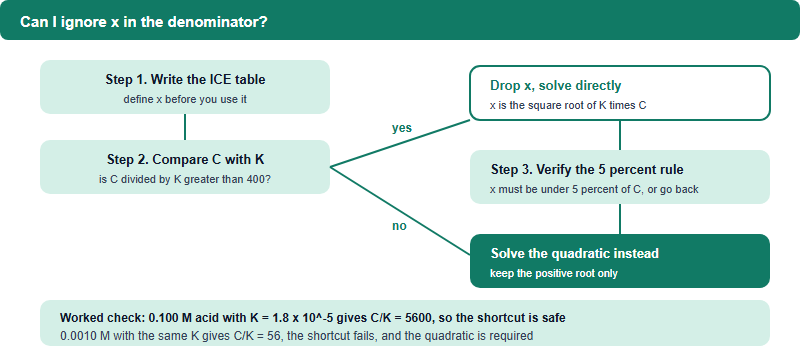
It is worth seeing the size of the error, because students often assume it is negligible in every case. For a 0.100 molar weak acid with a dissociation constant of 1.8 x 10 to the minus 5, the shortcut gives a hydrogen ion concentration of 1.34 x 10 to the minus 3 and a pH of 2.87, and the exact treatment agrees to the digits that matter. Drop the concentration to 0.0010 molar and the shortcut still returns 1.34 x 10 to the minus 4, while the quadratic gives 1.25 x 10 to the minus 4 — an overestimate of roughly seven percent, and a pH of 3.87 instead of 3.90. In a multiple-choice question where the distractors are built from exactly that mistake, seven percent is the whole question.
Two related pieces of algebra belong in the same drawer. Solubility products collapse into powers of the solubility: a one-to-one salt gives the product as solubility squared, a one-to-two salt gives four times solubility cubed, and a one-to-three salt gives twenty-seven times solubility to the fourth. And gas-phase equilibria convert between concentration and pressure constants by multiplying by the gas constant times temperature raised to the change in moles of gas. Neither is hard; both are slow if you derive them under time pressure.
Unit algebra and the four rounding rules
Units are not decoration — they are the cheapest error detector available. Carry them through every substitution and a wrong gas constant announces itself immediately, because litre-atmospheres will not reduce to joules. The habit costs nothing and catches the class of error that is otherwise invisible: an answer that is numerically wrong but chemically plausible.
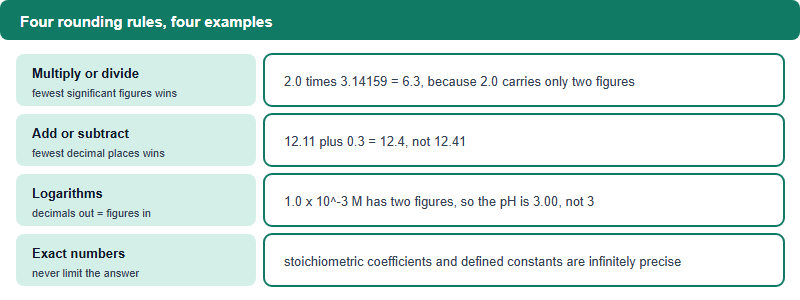
Three habits make these rules practical rather than theoretical. Carry one or two guard digits through the middle of a calculation and round only at the final line, because rounding at every step compounds error. When a question gives data to differing precision, find the least precise value first and write it down, so the final rounding decision is made before you are tired. And in a multiple-choice setting, round early and roughly on purpose — if you only need to distinguish four options that differ by an order of magnitude, an estimate to one figure answers the question in a fifth of the time.
A ten-minute daily drill, and who can sit the exam
Keep the access rules straight before you plan a term around this. Per ACS, the National Exam requires US citizenship or permanent residency. A student who is not a US national but attends a high school in the United States may sit the Local Exam, yet can never be nominated onward. A US citizen or green-card holder enrolled for at least a year at an accredited American school abroad — including in China — and under 20 competes through an ACS International Chemical Sciences Chapter, and that route does reach the National Exam and Team USA. A student who is neither a citizen nor a permanent resident, at a school in mainland China, has no ACS route at all, and there is no USNCO China region to register for. The full position is set out in our guide to who can and cannot enter the USNCO.
This particular toolkit is the least route-dependent thing on the site. Logarithms, approximation control and rounding discipline carry into school examinations, into any chemistry competition you can enter, and into first-year university problem sets. Ten minutes a day for a fortnight is usually enough:
- Minutes 1 to 3 — logs both ways. Five concentrations to pH, five pH values back to concentration, no calculator.
- Minutes 4 to 6 — the approximation test. Three equilibrium set-ups where you state the ratio, predict whether the shortcut holds, then confirm with the five percent check.
- Minutes 7 to 8 — unit algebra. Two substitutions where you cancel units explicitly and confirm the result lands in the unit the question asked for.
- Minutes 9 to 10 — rounding. Take yesterday's answers and re-round them from the raw data, checking the logarithm rule specifically.
Then apply it where it counts. Rather than working whole papers, pull only the calculation-heavy items from several years and run them back to back, which trains the arithmetic pathway rather than the reading pathway. Our gathered past-paper pack and the method for working through it supports that kind of slicing, with worked solutions for some of the years rather than every one. Track two numbers as you go: how many questions you finished inside ninety seconds, and how many errors were arithmetic rather than chemistry. When the second number falls below one in ten, this toolkit has done its job.
Frequently asked questions
When is the x-is-small approximation safe?
When the initial concentration divided by the equilibrium constant exceeds about 400, and x then proves to be under five percent of that concentration.
How many significant figures does a pH have?
Only the digits after the decimal point count. A concentration with two significant figures gives a pH quoted to two decimal places.
Which value of the gas constant should I use?
Match it to your units: 8.314 joules per mole per kelvin for energy work, 0.08206 litre-atmospheres per mole per kelvin for gas laws in atmospheres.
Are calculators allowed in the exam?
Equipment rules are set by ACS and can differ by stage – confirm the current policy on acs.org before assuming either way.
This is the USNCO information desk, synchronising official ACS information for chemistry students in China, operated by Hanlin Education. The USNCO is run by the American Chemical Society (ACS), which sets all official rules and eligibility. Always confirm current details on acs.org. Any error here is corrected within 7 working days.