The U.S. National Chemistry Olympiad (USNCO) draws on the full span of introductory-through-advanced chemistry: general and physical chemistry (stoichiometry, thermodynamics, equilibrium, kinetics, electrochemistry), organic chemistry (structure, functional groups, mechanisms), inorganic chemistry (periodicity, bonding, descriptive chemistry) and analytical chemistry (titration, measurement, lab technique). It is broad rather than narrow, and it rewards genuine understanding over memorised facts. The exact current scope is set by the American Chemical Society (ACS) — confirm it on acs.org.
The shape of the syllabus, not a fixed checklist
A first, honest point. The USNCO does not publish a single short “tick-box” syllabus the way some school exams do; the most reliable way to know exactly what is examinable in a given year is the official ACS Chemistry Olympiad materials and the past papers (1999–2025), which together define the scope far better than any list. This article describes the shape of that scope — the subject areas the exam draws on and how deep it tends to go — so you can map your study. For the precise, current syllabus, always confirm on acs.org; treat what follows as a tour, not a definitive specification.
What is consistent year to year is the breadth. The USNCO behaves like the chemistry equivalent of a strong first-year university curriculum compressed into a high-school competition: it expects fluency across the standard pillars below, and at the National level it pushes the difficulty of questions well past a typical school course. For how those pillars fit into the wider competition, see What Is the USNCO.
The four broad areas it draws on
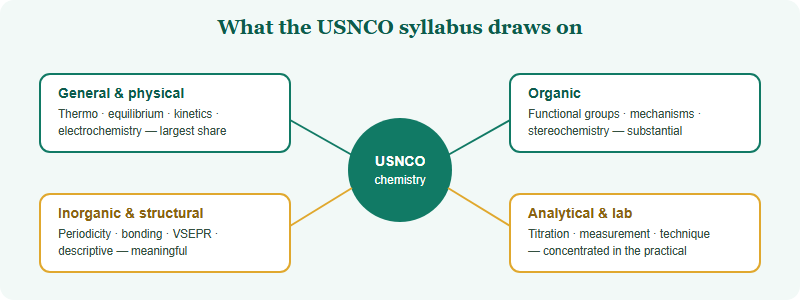
Chemistry is conventionally divided into a handful of branches, and the USNCO touches all of them. The weighting leans heavily toward general and physical chemistry, with substantial organic and meaningful inorganic and analytical content. Here is the territory, with the kinds of topics each area tends to involve.
| Area | Representative topics it tends to involve | Rough emphasis |
| General & physical | Stoichiometry and the mole; gas laws; thermodynamics (enthalpy, entropy, free energy, Hess’s law); chemical equilibrium (Kc/Kp, Le Chatelier, solubility products); acids, bases and buffers; reaction kinetics and rate laws; electrochemistry and the Nernst equation | Largest share |
| Organic | Functional groups and nomenclature; isomerism and stereochemistry; characteristic reactions and reaction mechanisms; structure–reactivity reasoning | Substantial |
| Inorganic & structural | Atomic structure and periodicity; bonding and molecular geometry (VSEPR); descriptive chemistry of the elements; coordination and transition-metal ideas | Meaningful |
| Analytical & laboratory | Quantitative analysis; titration (acid–base, redox); gravimetric technique; measurement, significant figures and error; safe, accurate bench procedure | Concentrated in the practical |
This is an orientation to the subject areas, not an official specification. The exact topics, depth and weighting are set by ACS and can change year to year — confirm the current syllabus on acs.org before you plan around it.
How that scope maps onto the three exam parts
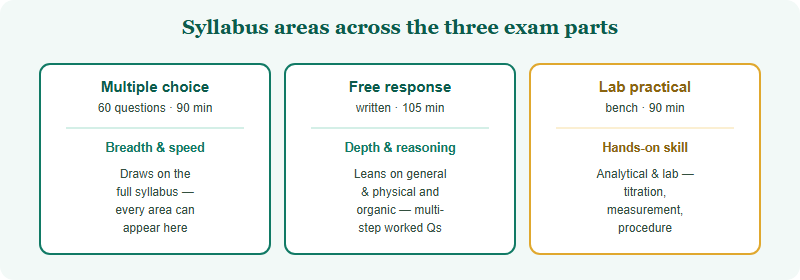
The syllabus does not sit in a vacuum — it is delivered through the three parts of the National Exam, and each part tests the same chemistry in a different way. Understanding that mapping is the practical point of knowing the syllabus at all: it tells you not just what to learn, but how each topic will be examined.
- Multiple choice (60 questions, 90 minutes) — breadth and speed across the whole syllabus. Every area above can appear here, with an emphasis on recall, quick calculation and recognition.
- Free response (written, 105 minutes) — depth and reasoning. This is where multi-step problems, full worked thermodynamics or equilibrium calculations, and organic mechanisms are set, with marks awarded for the reasoning shown.
- Laboratory practical (90 minutes) — the analytical and hands-on core. This is where titration, gravimetric technique, measurement and careful procedure are tested on the bench, not on paper.
That third part is what makes the USNCO distinctive among chemistry competitions: it examines real lab skill directly. We cover it in detail in The USNCO Lab Practical: The Hands-On Component, Explained.
How broad, and how deep, does it really go?
Two questions matter when you size up any syllabus: how wide is it, and how far down does it dig. For the USNCO, the honest answer is “wide, and deeper than school.”
On breadth: the exam expects you to be comfortable everywhere in the table above. You cannot reliably skip a pillar — a student strong in organic but shaky on electrochemistry will lose marks the syllabus puts within easy reach of a balanced candidate. The multiple-choice paper, in particular, samples the whole map, so gaps are exposed quickly.
On depth: the National Exam routinely goes beyond a standard high-school course into early-undergraduate territory — multi-step thermodynamics, quantitative equilibrium with several simultaneous effects, mechanism-level organic reasoning, and lab work judged on real technique. This is why roughly 10,000 students sit the Local Exam each year but only the top 20 reach the Study Camp: the difficulty climbs sharply at each tier. The progression from breadth to depth is exactly what the Study Camp, and how Team USA is chosen, is built around — and it is why a thorough syllabus map is the foundation of any serious preparation.
The most reliable way to read the syllabus: the past papers
Because there is no short official checklist that captures every nuance, the single best way to understand the true scope and depth is to study the past papers, 1999–2025, with answer keys. They are, in effect, the syllabus made concrete: every topic that has been examined, at the exact depth it was examined, year after year. Reading a decade of papers tells you more about what “covered” means than any prose description — including this one.
Use them to read the syllabus, not just to drill it: as you work through papers, note which subject areas recur, how multi-step the questions get, and where the examiners like to combine topics (equilibrium with thermodynamics, say, or organic structure with spectroscopy-style reasoning). Do not reproduce or memorise specific questions — the papers are copyrighted by ACS, and rote recall does not transfer; the value is in recognising the pattern and reach of what is asked. This matters for any chemistry student anywhere: the USNCO syllabus and its paper library are among the best competition-chemistry resources in the world, and you can study them to build real depth even if you never sit the exam.
Who this matters to — an eligibility note
It is worth being precise, because it is easy to assume otherwise. The USNCO is for U.S. high-school students, who enter through an ACS Local Section — there is no individual sign-up from abroad, and eligibility is set entirely by ACS. If you are a student in China, do not assume you can register for or compete in the USNCO directly; confirm any participation question on the official ACS channels. What is genuinely valuable to you is the chemistry itself: the public syllabus and the 1999–2025 past papers are a world-class way to build competition-grade chemistry depth, whatever exam you ultimately sit. To see how the whole system fits together first, start with What Is the USNCO.
Frequently asked questions
What subjects does the USNCO syllabus cover?
It spans general and physical chemistry (thermodynamics, equilibrium, kinetics, electrochemistry), organic chemistry, inorganic and structural chemistry, and analytical and laboratory work — confirm the exact scope on acs.org.
Is there an official USNCO syllabus list?
ACS publishes Chemistry Olympiad materials, but the truest guide to scope and depth is the public past papers (1999–2025). Always confirm the current official syllabus on acs.org.
How hard is the USNCO compared with a school course?
Deeper. The National Exam reaches into early-undergraduate territory — multi-step problems and real lab technique — which is why only the top 20 of about 10,000 reach the Study Camp.
How does the syllabus map to the exam parts?
Multiple choice samples the whole syllabus for breadth; free response tests depth in physical and organic chemistry; the lab practical tests analytical and bench skills. Confirm current formats on acs.org.
This is the U.S. National Chemistry Olympiad (USNCO) information desk, synchronising the official competition information — dates, rules, the syllabus, past papers and results — for chemistry students in China, operated by Hanlin Education. The USNCO is run by the American Chemical Society (ACS), which sets all official rules and eligibility; the information here is synced from official ACS sources. Always confirm current details on acs.org. Confirmed errors are corrected within 7 working days.