The USNCO laboratory practical is the third part of the U.S. National Chemistry Olympiad National Exam: a real, 90-minute bench session judged on hands-on technique, not multiple-choice answers. Students perform actual wet-chemistry tasks — measuring, titrating, observing, recording — under timed conditions. It is the component most competitors under-prepare for, because pen-and-paper study does not build laboratory hands.
Where the lab practical sits in the USNCO structure
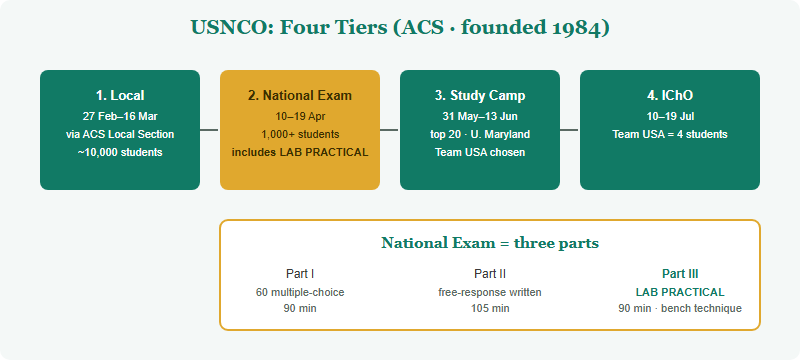
The USNCO, founded in 1984 by the American Chemical Society (ACS), is a four-tier competition. Each tier filters a smaller, stronger group toward the International Chemistry Olympiad (IChO). The laboratory practical appears only at the second tier — the National Exam — alongside two written parts. Understanding that placement explains why it matters so much: by the time a student reaches the National Exam, the written rounds alone no longer separate the field, and bench skill becomes a genuine differentiator.
If you are new to how the tiers fit together, our overview of what the USNCO is walks through the full ladder, and our breakdown of the Local Chemistry Olympiad first tier covers the entry round that precedes it.
What the three parts of the National Exam actually look like
The USNCO National Exam is built from three distinct components, each testing a different kind of competence. The first two are written; the third is physical. A strong score requires all three, which is precisely why under-preparing for the lab is so costly — a student can be excellent on paper and still lose ground at the bench.
| Part | Format | Time | What it really tests |
|---|---|---|---|
| Part I | 60 multiple-choice questions | 90 minutes | Breadth and speed across the syllabus; recall and quick reasoning |
| Part II | Free-response written paper | 105 minutes | Depth: multi-step problem solving, mechanisms, full worked derivations |
| Part III | Laboratory practical | 90 minutes | Hands-on technique: measurement, observation, accuracy, lab discipline |
Part III is the only component where the answer depends on what your hands produce. You cannot guess a titration endpoint or back-calculate a glassware error you never made. The lab practical rewards students who have spent real time on the bench, and it quietly penalises those who treated chemistry as a purely theoretical subject.
What kinds of tasks the lab practical involves
The exact tasks change each year and are set by ACS, so the only authoritative source is acs.org. That said, the practical draws on the standard repertoire of quantitative and qualitative wet chemistry that any well-equipped school laboratory can support. Based on the discipline the syllabus covers, students should expect to be assessed on skills such as:
- Volumetric analysis (titration): preparing solutions, reading a burette to the correct precision, and identifying an endpoint cleanly — a classic accuracy-under-time task.
- Quantitative measurement: using a balance, volumetric flask, and pipette correctly; recording data to an appropriate number of significant figures.
- Qualitative observation: noting colour changes, precipitate formation, gas evolution, and temperature shifts, then interpreting them.
- Data handling under pressure: tabulating results in real time and carrying them into a calculation without losing accuracy.
- Laboratory discipline: working safely, managing reagents, and finishing within the 90-minute window.
The specific reactions, reagents and grading rubric for any given year are official details — always confirm them on acs.org rather than assuming they match a previous paper.
Why hands-on skill matters more than students expect
Three structural facts make the practical decisive. First, recognition is tight: the top 50 scorers earn High Honors and the next 100 earn Honors, so small margins separate outcomes — and a weak lab score is exactly the kind of small margin that decides them. Second, the practical is impossible to cram. Reading a burette consistently to within a fraction of a millilitre, or judging an endpoint without overshooting, is muscle memory built over many sessions. Third, the skills transfer: the same bench discipline is exactly what the experimental round at the International Chemistry Olympiad demands, where Team USA’s four students compete. A student who builds lab readiness early is preparing for far more than one 90-minute window.
For students in China: how to engage with this honestly
A clear word on eligibility, because it matters. Entry is arranged by an ACS Local Section — or, for eligible students abroad, by an ACS International Chemical Sciences Chapter — so there is no individual sign-up from abroad, and eligibility is set entirely by ACS. For most students at schools in mainland China the practical answer is still no: ACS restricts the National Exam, and therefore the lab practical, to U.S. citizens and permanent residents, and its provision for students abroad additionally requires at least one year at an accredited American school. Students who do meet those conditions can and do compete from China through an ACS International Chemical Sciences Chapter — we set out the three cases in full in who can actually enter the USNCO. If you want to confirm your own status, the only reliable route is the official ACS channels.
So what is the genuine value here? It is twofold. First, understanding the system — the four tiers, the National Exam structure, and what the lab practical demands — sharpens how you think about chemistry as an experimental science, not just a set of equations. Second, and most usefully, the public USNCO past papers from 1999 to 2025, released with answer keys, plus the official syllabus, are a serious, free resource for building real chemistry depth. You cannot reproduce the lab practical at home from a paper, but the written rounds and syllabus map exactly the knowledge that underpins it.
- Use the syllabus as your spine: it defines the topic coverage that every part of the exam, including the lab, draws on.
- Work the written past papers for depth: the free-response questions train the multi-step reasoning that good lab work also requires.
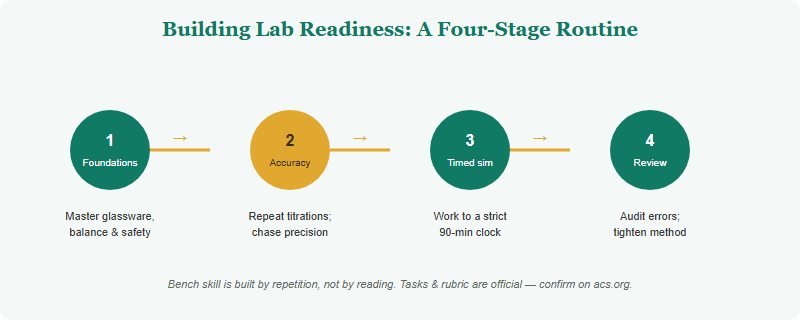
- Translate theory into bench practice where you can: if you have access to a school laboratory, run the standard quantitative techniques the practical assesses — titration above all.
- Do not paste or redistribute the papers: they are copyrighted ACS material; use them to learn, not to republish.
The payoff of this approach is visible at the top of the ladder: Team USA won four gold medals at IChO 2025 in Dubai, a result built on exactly the depth this system cultivates. Our look at what Team USA results signal puts that performance in context.
Frequently asked questions
How long is the USNCO lab practical?
The laboratory practical runs for 90 minutes. It is Part III of the National Exam, alongside the 60-question multiple-choice paper and the free-response written paper.
What does the lab practical test?
Real bench technique — measurement, titration, observation, accuracy and lab discipline under a timed clock. The exact tasks are set by ACS each year; confirm on acs.org.
Can students in China take the USNCO lab practical?
It depends on the student. The lab practical is part of the National Exam, which ACS restricts to U.S. citizens and permanent residents, so a U.S. citizen or green-card holder who has spent at least a year at an accredited American school in China can reach it through an ACS International Chemical Sciences Chapter, while a student who is not a U.S. citizen or permanent resident has no ACS route from a school in mainland China. Eligibility is set by ACS; confirm on the official ACS channels.
How can I prepare for the lab component without sitting the exam?
Use the public 1999–2025 past papers and the official syllabus to build chemistry depth, and practise standard quantitative techniques in a school laboratory where possible.
This is the U.S. National Chemistry Olympiad (USNCO) information desk, synchronising the official competition information — dates, rules, the syllabus, past papers and results — for chemistry students in China, operated by Hanlin Education. The USNCO is run by the American Chemical Society (ACS), which sets all official rules and eligibility; the information here is synced from official ACS sources. Always confirm current details on acs.org. Confirmed errors are corrected within 7 working days.