Inorganic and descriptive chemistry is the quietest gap in most USNCO preparation. Thermodynamics gets drilled and organic gets feared, but periodic-trend exceptions, coordination complexes, lattice arithmetic and descriptive reactions are where students trained on AP or IB lose marks fastest, because their school course simply never asked those questions. This guide maps the five blocks and shows the reasoning each one wants.
Why inorganic is the gap nobody plans for
Ask a student preparing for a US chemistry olympiad what they are worried about and you will hear thermodynamics, equilibrium and organic mechanisms. Those are real difficulties, and they are well-trodden. Inorganic chemistry is different: students are not afraid of it, so they never schedule it, and then they meet a question asking why the first ionisation energy of oxygen is lower than that of nitrogen and discover they have only ever learned the trend, never the exception.
The scope is not a secret. Our own sync of the published scope shows the syllabus spanning general and physical, organic, inorganic and analytical chemistry, and ACS publishes the authoritative topic list — always confirm the current version on acs.org, because emphasis and wording change between cycles. Our own breakdown of what the syllabus actually covers maps it topic by topic. What is worth saying plainly is that “inorganic” on a US olympiad syllabus is much wider than the handful of d-block facts most international-school courses carry.
Three structural reasons make this block expensive to ignore:
- It is highly compressible. Inorganic questions often reduce to one rule plus one exception. That makes them fast marks for a prepared student and near-guesses for an unprepared one.
- It hides inside other topics. A question that looks like equilibrium may turn on whether a hydroxide is amphoteric; a question that looks like thermochemistry may turn on lattice-energy trends.
- School courses trimmed it. Descriptive chemistry has been progressively reduced in many school syllabuses, so a student can hold a top school grade and still have never predicted the products of a main-group reaction.
If you are new to the competition structure itself, start with what the USNCO actually is and how its stages fit together, then come back to content blocks like this one.
Five blocks where school chemistry stops
The table below is the map we use when a student says “my chemistry is fine, I just need practice”. Each row is a place where school treatment and olympiad-level expectation diverge, with the first drill that closes it.
| Block | Typical school treatment | What olympiad-level questions expect | First drill |
|---|---|---|---|
| Periodic trends | Direction of radius, ionisation energy and electronegativity across a period and down a group | Explaining the exceptions, ranking isoelectronic species, comparing ions with parent atoms, linking trend to reactivity | Write the period-2 first-ionisation-energy order from memory and justify both dips |
| Main-group descriptive chemistry | A short list of named reactions, mostly memorised | Predicting products, oxide acid-base character across a period, oxyacid strength ordering, amphoterism, net ionic equations | Rebuild the period-3 oxide chart blank, then predict six main-group products |
| Transition metals and coordination compounds | Often just “d-block ions are coloured and have variable oxidation states” | Oxidation state from complex charge, d-electron count, geometry, field strength, high or low spin, unpaired electrons, isomerism | Take ten complexes and give oxidation state, d-count and spin state for each |
| Solid state and lattices | Named as a topic, rarely made quantitative | Atoms per unit cell, coordination number, packing efficiency, density from cell edge, lattice-energy trends | Derive atoms per cell for simple cubic, body-centred and face-centred cells without looking |
| Analytical chemistry | Straightforward acid-base titration arithmetic | Indicator choice from equivalence pH, back-titration, gravimetric analysis, redox titration stoichiometry, separation logic | Set up three redox titrations and balance each in acidic solution |
Coordination chemistry: reading a complex in four steps
Coordination chemistry is the single highest-yield block here, because almost every question about a complex can be opened with the same four-step routine. Learn the routine and a whole family of questions becomes mechanical.
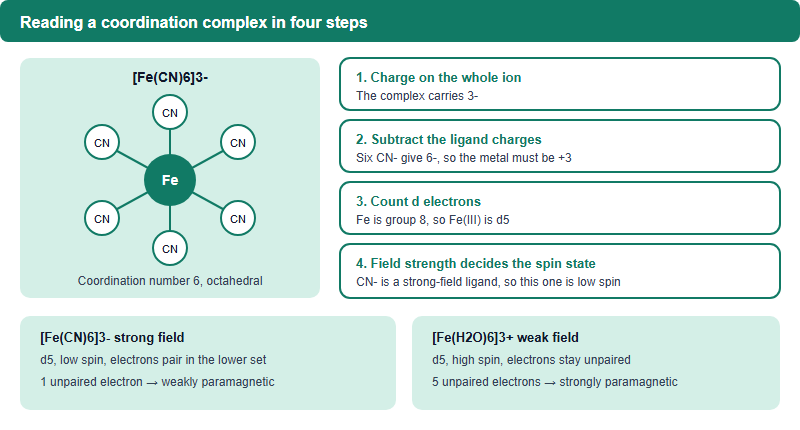
Once the four steps are automatic, the rest of the block is a short list of consequences you should be able to state without hesitation:
- Colour comes from d-to-d transitions across the splitting gap, so a bigger gap absorbs shorter wavelengths. A complex with no d electrons, or a full d shell, has no such transition available.
- Magnetism follows the count of unpaired electrons, which is exactly what the high-spin or low-spin decision determines.
- Ligand ordering matters: iodide and bromide sit at the weak-field end, water and ammonia in the middle, cyanide and carbon monoxide at the strong-field end.
- Tetrahedral complexes have a much smaller splitting than octahedral ones, which is why they are effectively always high spin.
- The chelate effect is an entropy argument: one bidentate ligand replacing two monodentate ones increases the number of free particles, so the complex is more stable.
- Isomerism is examinable in its own right — geometric isomers in square-planar and octahedral complexes, and optical isomers where a complex has no improper symmetry.
Descriptive chemistry: trends you should be able to rebuild blank
Descriptive chemistry rewards a student who has built the chart once by hand rather than read it ten times. The clearest example is oxide character across a period: it moves from strongly basic through amphoteric to strongly acidic, and that single pattern answers a surprising number of questions about reactions with acid and alkali.
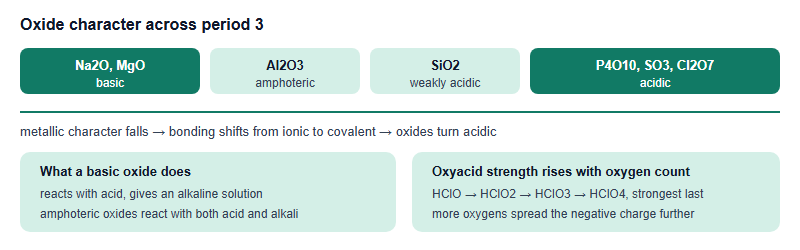
Two more descriptive habits pay for themselves. First, learn solubility rules well enough to write net ionic equations without hesitation — US-style questions lean on them heavily, and a spectator ion left in an equation is a needless loss. Second, treat periodic-trend exceptions as the actual content: the small dip in first ionisation energy at boron reflects an electron entering a higher-energy subshell, and the dip at oxygen reflects the repulsion of the first paired electron in a 2p orbital. A question that asks you to rank four elements is really asking whether you know those two stories.
A four-week plan, and who this block matters for
Before you invest a term in this, keep the access rules straight. Per ACS, the National Exam requires US citizenship or permanent residency. A student who is not a US national but attends a high school in the United States may sit the Local Exam, yet can never be nominated onward. A US citizen or green-card holder enrolled for at least a year at an accredited American school abroad — including in China — and under 20 competes through an ACS International Chemical Sciences Chapter, and that route does reach the National Exam and Team USA. A student who is neither a citizen nor a permanent resident, at a school in mainland China, has no ACS route at all; there is no USNCO China region to register for, and the value is in the syllabus and the training material. The full breakdown is in our guide to who can and cannot enter the USNCO.
For everyone in that last group, inorganic chemistry is arguably the best-value block to train anyway: it transfers directly to school examinations, to other chemistry competitions and to first-year university courses, and it is short enough to close in about a month. For where a block like this sits in a full season, see our study roadmap.
- Week 1 — periodic reasoning. Rebuild the trend charts blank, then write one-sentence explanations of the ionisation-energy exceptions, ionic versus atomic radius, and isoelectronic ranking.
- Week 2 — descriptive main group. Oxide character chart, oxyacid ordering, amphoterism, solubility rules, twenty net ionic equations.
- Week 3 — coordination chemistry. The four-step routine on ten complexes a day, then geometry, isomerism, colour and magnetism.
- Week 4 — lattices and analysis. Unit-cell counting and density arithmetic, then redox titration stoichiometry and indicator choice.
Then test the block the only way that counts: on real questions under time. Pull the inorganic items out of several years of papers and work them in one sitting, so you see how the same three ideas recur across cycles. Our gathered past-paper pack and the method for working through it is built for exactly this kind of topic-sliced practice, with worked solutions for some of the years rather than all of them. Keep a one-line error log — not what you got wrong, but which rule you failed to apply — and you will find the same four rules explain most of your losses.
Frequently asked questions
Is coordination chemistry really examined at this level?
Inorganic chemistry sits inside the published scope, but ACS sets and updates the official topic list — confirm the current syllabus on acs.org.
Do I need university-level inorganic chemistry?
No. You need first-year depth on a short list of blocks: trends, descriptive main group, coordination, lattices and analysis.
Can a student in mainland China register to sit the exam?
Only through a US route. A US citizen or green-card holder who has been enrolled for at least a year at an accredited American school in China and is under 20 competes through an ACS International Chemical Sciences Chapter, and that route does reach the National Exam. A student who is neither a citizen nor a permanent resident has no ACS route, because there is no USNCO China region, and uses the syllabus and papers as training material.
How long does closing the inorganic gap take?
About four focused weeks at three sessions a week for most students, then short maintenance drills to keep the charts retrievable.
This is the USNCO information desk, synchronising official ACS information for chemistry students in China, operated by Hanlin Education. The USNCO is run by the American Chemical Society (ACS), which sets all official rules and eligibility. Always confirm current details on acs.org. Any error here is corrected within 7 working days.