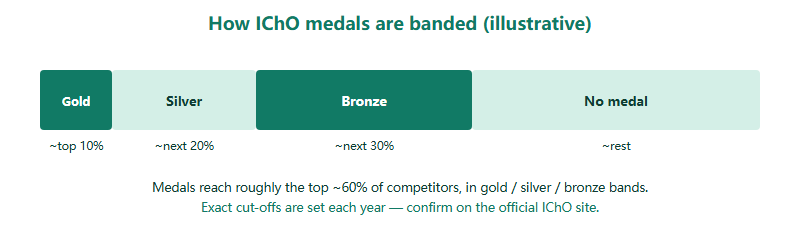
The International Chemistry Olympiad (IChO) 2026 was held in Tashkent, Uzbekistan, gathering national teams of up to four students each from more than eighty countries and regions. It is the summit that the USNCO, the UKChO and every other national chemistry olympiad feed into. For a student in China, understanding how this world championship works — and who is actually eligible to compete in it — is more useful than it first appears.
IChO 2026: the world championship of chemistry
The IChO has run annually since 1968 and is the most prestigious pre-university chemistry competition in the world. Each participating country selects a team of up to four secondary-school students through its own national process — the USNCO for the United States, the UK Chemistry Olympiad for Britain, and so on — and sends them to a single host city each July. In 2026 that city was Tashkent, Uzbekistan.
The competition itself is built on two long examinations: a theoretical paper and a hands-on laboratory practical, held on separate days and each lasting several hours. Confirm the current format and exact dates on the official IChO site, but the shape has been stable for years — and it is why national programmes like the USNCO build a wet-lab practical into their own selection. At the international level, you cannot medal on theory alone.
How IChO medals work
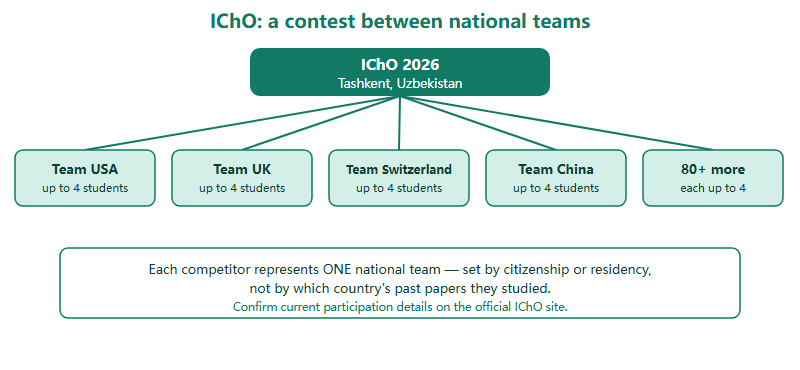
The IChO does not have a single winner; it ranks individual competitors by combined score and awards medals in bands. Gold goes to roughly the top tenth of competitors, silver to the next band, and bronze to the band below that, with medals reaching about the top 60% overall. The exact cut-offs are recalculated every year from that year's score distribution, so treat any percentage as approximate and confirm the official bands on the IChO site.
| Recognition | Roughly who | Notes |
|---|---|---|
| Gold medal | About the top ~10% of competitors | Highest tier; cut-off set each year |
| Silver medal | Roughly the next ~20% | Awarded by combined theory + practical score |
| Bronze medal | Roughly the next ~30% | Medals in total reach about the top ~60% |
| Honourable mention | Below the bronze cut-off | Recognises strong non-medal performances (confirm on official site) |
A contest of national teams: this year's results
Because the IChO is fought between national teams, the same competition can produce very different stories depending on which country a student represents. Here is some first-party context, reported by Hanlin Education and de-identified — and shared with the honest caveat that results vary from year to year and student to student, and that no programme can promise an outcome.
At IChO 2026, students we supported competed for teams other than the United States. One earned Team UK's only gold medal this year. Another earned a bronze for Team Switzerland — reported as that team's best-ever IChO result and its first ethnically-Chinese medallist. We share these not as guarantees but to make one point concrete: each of those students competed for the national team they were eligible to join, through that country's own selection process. Neither route was “taking the USNCO from China,” and neither could have been Team USA without US citizenship or permanent residency.
That is the quiet lesson of every IChO. Ability gets you to the level; eligibility decides which flag you can carry. If you are curious about who is and is not allowed onto the US team, our explainer on whether international students can take the USNCO spells it out, and the same country-by-country logic applies everywhere.
What this means for a student in China
If you are at an international school in China and dream of the IChO, the practical implications are clear and, honestly, encouraging:
- Your route is your eligibility, not your prep. Investigate the national selection where you actually hold citizenship or residency. That — not the USNCO — is your possible path to an IChO team.
- Build to the international bar: theory plus practical. The IChO always tests both. Any serious preparation has to include real laboratory technique, not just calculation. This is exactly why USNCO material, with its built-in practical, is such good training.
- Benchmark against national-exam level. The gap between a strong school student and an IChO competitor is large. Measuring yourself against USNCO National and UKChO papers tells you honestly where you stand.
To turn that into a plan, start with our overview of what the USNCO is to understand the US system, then use our guide on how to use USNCO past papers to train with the right material at the right level. Our team keeps a curated, organised pack of USNCO papers with worked notes for selected years, added to over time. You may not be able to march behind Team USA at the IChO — but you can absolutely build chemistry that would hold its own there.
Frequently asked questions
Where was IChO 2026 held?
The 2026 International Chemistry Olympiad was held in Tashkent, Uzbekistan, in July. Confirm exact dates and the current host on the official IChO site.
How big is each country's IChO team?
Up to four students, selected through that country's national olympiad — the USNCO for the USA, the UKChO for Britain, and so on. Confirm details officially.
Can a China-based student compete at the IChO?
Only through a national team they are eligible to join by citizenship or residency — not by taking the USNCO from China. Investigate the rules where you are eligible.
How are IChO medals decided?
By combined theory and practical score, in gold, silver and bronze bands reaching roughly the top ~60%. Cut-offs are set each year; confirm on the official site.
This is the USNCO information desk synchronising official ACS information for chemistry students in China, operated by Hanlin Education. The USNCO is run by the American Chemical Society (ACS), which sets all official rules and eligibility; the International Chemistry Olympiad is organised separately, and first-party student results are de-identified and vary year to year. Always confirm current details on acs.org and the official IChO site. Any errors are corrected within 7 working days.