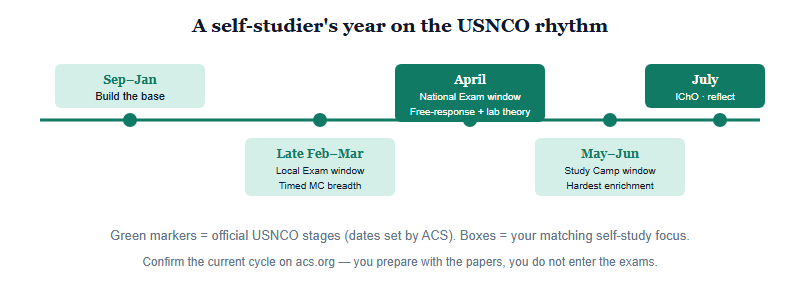
The USNCO runs on a predictable yearly cycle — Local Exam in late February to mid-March, National Exam in April, Study Camp in June, and the IChO in July. For most students in mainland China — who have no ACS entry route and use the public papers instead — that calendar is a ready-made study spine; for the smaller group who are eligible through an ACS International Chemical Sciences Chapter, it is the season itself. This article lays out the season month by month and pairs each phase with what a China-based self-studier should actually be doing. All official dates are set by ACS — confirm the current cycle on acs.org.
Why the US calendar is useful even if you do not compete
First, the honest framing. The USNCO is the American Chemical Society (ACS) competition, and entry always runs through an ACS Local Section — or, for eligible students abroad, an ACS International Chemical Sciences Chapter. There is no individual sign-up from abroad, but that describes the mechanism, not a closed door. A student who is a U.S. citizen or legal permanent resident, enrolled for at least a year at an accredited American school in China and under 20, can compete through such a chapter — and follows this calendar for real, not as a study aid. A student who is neither a citizen nor a green-card holder, at a school in mainland China, has no ACS route; for them the public papers, not the exam hall, are the point. (A third case: a non-U.S.-national at a high school inside the United States may sit the Local Exam but cannot be nominated to the National Exam, whatever the score.) Eligibility is set by ACS — for the full picture see whether international students can take the USNCO, and confirm on acs.org. So for most readers here this is not a registration calendar. It is a training calendar: the US season gives you natural deadlines to organise self-study around, and each official stage corresponds to a different kind of practice you can borrow from the public papers. Structure beats motivation, and a fixed external rhythm is structure you do not have to invent.
The four official stages — Local, National, Study Camp, IChO — form one ladder. We explain that ladder as a structure in What Is the USNCO; this piece turns it into a time axis for a self-studier's year.
The official cycle at a glance
The table below lists the four stages with the indicative 2026 timing synced from official ACS information, alongside the self-study focus a China-based student can run in parallel. Treat the dates as orientation — ACS sets and can move them each year, so confirm on acs.org before planning around any specific week.
| Stage (official) | Indicative 2026 timing | Your parallel self-study focus |
| Local Chemistry Olympiad | 27 February – 16 March | Broad multiple-choice fluency; the whole syllabus, fast |
| National Exam | 10 – 19 April | Free-response depth + lab-theory understanding |
| Study Camp (U Maryland) | Early–mid June | Hardest enrichment; revisit your weakest topics |
| IChO (international final) | July | See the global standard; consolidate and reflect |
Dates are indicative and set by ACS (and, for the IChO, its own organisation). Confirm the current cycle on acs.org before relying on any week.
Autumn (September–January): build the base
The US season is quiet here, which makes it the most valuable window for a self-studier — no exam to chase, just time to build. This is when your school chemistry course is also moving fastest, so the efficient play is to let the curriculum lead and use USNCO material to deepen each topic as it comes up. Finished kinetics in class in November? Pull kinetics questions from a couple of past papers that week. The aim by January is a secure, broad command of general chemistry — the foundation everything later depends on.
- Sep–Oct: Quantitative core — stoichiometry, solutions, gas laws, atomic structure. Get fast and accurate; these are “inside” your course and the highest-frequency USNCO content.
- Nov–Dec: Energy and equilibrium — thermochemistry, Hess's law, equilibrium, acid–base. This is where school chemistry and competition chemistry start to diverge, so spend real time here.
- Jan: First full timed multiple-choice paper. Not to “pass” anything — to set a baseline and find your weakest cluster before the busy term.
Late February–March: the Local-Exam window
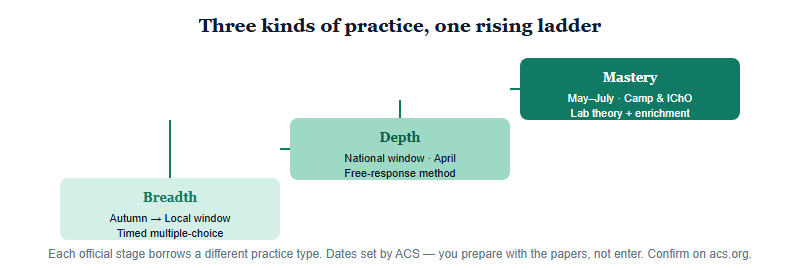
In the US, the Local Chemistry Olympiad runs 27 February–16 March in 2026 — the breadth filter that nominates students to the national round. For your parallel study, this is the cue to switch from topic-by-topic learning to full timed multiple-choice papers. The Local round is essentially a wide multiple-choice test, so the public papers are an exact match for what you should be drilling now — full timed multiple-choice breadth, two-pass pacing, weakest-cluster logging (confirm the current Local format on acs.org). For the tactics of that paper specifically, see our breakdown of the Local Chemistry Olympiad as the first tier. Aim to sit one full timed paper a week through this window and watch your weakest cluster shrink.
April: the National-Exam window
The National Exam sits between 10 and 19 April in 2026 — the three-part assessment (60 multiple-choice + free-response + lab practical) that decides who reaches the Study Camp. For your study, April is the moment to move beyond multiple choice into depth. The free-response paper rewards extended, written problem-solving — showing method, not just the answer — and the lab practical rewards understanding of technique. You cannot replicate the practical at a desk, but you can study its theory: stoichiometry of titrations, sources of error, what each procedure is measuring. This is the month your preparation stops looking like exam prep and starts looking like real chemistry.
May–July: Study Camp, the IChO, and reflection
The top performers attend the residential Study Camp at the University of Maryland in early-to-mid June, where the four-member Team USA is selected; the team then competes at the IChO in July. For a self-studier these months are about altitude and perspective. May and June are when you reach for the hardest enrichment — the “beyond” topics, your most stubborn weak areas — because your base is now solid enough to support it. July, when the IChO runs, is for consolidation and honest reflection: review your gap log from the whole year, and look at what the international standard actually demands. We cover those final stages in inside the USNCO Study Camp and the road from the USNCO to the IChO.
Then the cycle restarts. The advantage of running your year on this rhythm is that nothing is wasted: each phase builds the foundation the next one needs, and by the time the new Local window comes round, you are starting from a much higher base than the previous September. For the study-content detail behind this calendar — what to actually practise in each phase — pair it with how to prepare for the USNCO and the method in USNCO past papers and how to use them.
A short FAQ
When does the USNCO season run?
Indicatively: Local 27 February–16 March, National 10–19 April, Study Camp in June, IChO in July (2026 timing). ACS sets the dates — confirm on acs.org.
Can a China-based student register for any of these stages?
It depends on your status. A U.S. citizen or legal permanent resident who has been enrolled for at least a year at an accredited American school and is under 20 can compete through an ACS International Chemical Sciences Chapter — the same calendar, for real. A student who is neither a citizen nor a green-card holder, at a school in mainland China, has no ACS route, and the calendar is a study spine only. Either way entry is arranged through a section or chapter, never an individual sign-up form. See whether international students can take the USNCO, and confirm on acs.org.
When should I start self-study for the cycle?
The September–January base-building window is ideal because the US season is quiet and your school course is moving fast. Build broad fluency first.
Do the dates change each year?
Yes. ACS publishes the cycle annually and timing can shift. Always confirm the current dates on acs.org before planning.
This is the USNCO information desk synchronising official ACS information for chemistry students in China, operated by Hanlin Education. The USNCO is run by the American Chemical Society (ACS), which sets all official dates, rules and eligibility; the calendar here is indicative orientation for self-study, not a registration schedule. Always confirm current details on acs.org. Any error will be corrected within 7 working days.