On the U.S. National Chemistry Olympiad (USNCO), the top 50 students nationally on the National Exam earn High Honors and the next 100 earn Honors — so roughly 150 of the ~1,000+ National Exam sitters are formally recognised each year. This piece unpacks what those tiers signal, why they sit where they do in the funnel, and how a China-based self-studier can benchmark against them without ever sitting the exam.
Where High Honors and Honors sit in the funnel
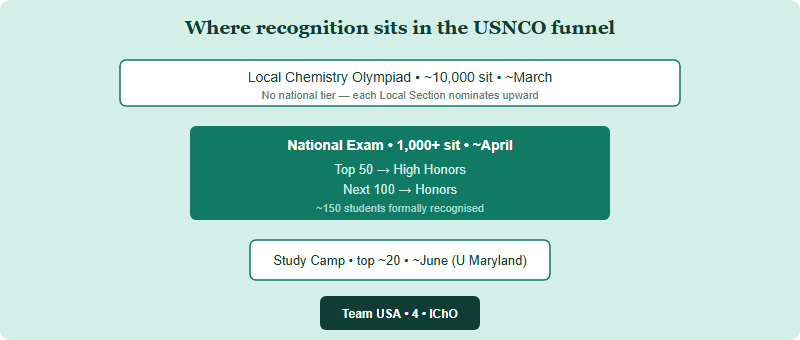
The USNCO, run by the American Chemical Society (ACS) since 1984, is a four-tier competition. Recognition is layered on top of the funnel, not handed out at every stage. Understanding the shape of that funnel is the fastest way to see what a tier is worth.
- Local Chemistry Olympiad (~March) — administered by ACS Local Sections; the entry point. Roughly 10,000 U.S. high-school students sit it. There is no national “High Honors” here; each Local Section decides how many students it nominates upward.
- National Exam (~April) — the 1,000+ nominees sit a three-part paper. This is where High Honors and Honors are awarded.
- Study Camp (~June, University of Maryland) — the top ~20 scorers are invited to a rigorous residential camp.
- Team USA & the IChO (~July) — four students are selected to represent the U.S. at the International Chemistry Olympiad.
So the two named recognition tiers — High Honors and Honors — are a National Exam distinction. They tell you a student was nominated by their Local Section and then finished among the strongest few hundred chemistry students in the country. For the full four-tier map, see our companion piece, What Is the USNCO? A 2026 Guide.
The tiers at a glance
| Tier | Who earns it | What it signals | Rough share of National Exam sitters |
|---|---|---|---|
| High Honors | Top 50 nationally on the National Exam | Among the very strongest U.S. high-school chemists in a given year | ~5% of the ~1,000+ who sit |
| Honors | The next 100 nationally | Nationally competitive; a clear step above a strong classroom student | ~10% of the ~1,000+ who sit |
| National Exam qualifier | Anyone nominated by a Local Section to sit the National Exam | Already selected out of ~10,000 local sitters | The full 1,000+ pool |
| Study Camp invitee | Top ~20 scorers | In contention for Team USA | ~2% of the pool |
Two things are worth stressing. First, these are national ranks converted into named bands — the cut-offs move year to year with the paper’s difficulty, so there is no fixed “score = High Honors” line to memorise; the ranks (top 50, next 100) are what stay stable. Second, the exact award names, counts, and any certificate or medal details are set by ACS and can change, so always verify the current year on acs.org before quoting them in an application or a school profile.
Why this matters for students in China — and the honest limit
Here is the part we will not blur. Both tiers are awarded on the National Exam, and ACS limits that exam to U.S. citizens and legal permanent residents; a student who does not meet that condition may sit the Local Exam but cannot be nominated upward, ACS says, “regardless of their performance (score).” What that means depends on which student you are. A U.S. citizen or green-card holder who has been enrolled for at least a year at an accredited American school abroad — including such schools in China — competes through an ACS International Chemical Sciences Chapter, so High Honors or Honors is a genuinely available goal. A student at a school in mainland China who is not a U.S. citizen or permanent resident has no ACS route at all, and for that reader the tiers are a benchmark rather than a target. Either way, entry is never an individual online sign-up: it runs through a Local Section or Chapter coordinator. And there is no China-region version of these awards — High Honors and Honors are the only ACS recognition tiers. We set the cases out in full in Can International Students Take the USNCO? Eligibility, Honestly, and eligibility should always be confirmed on acs.org.
So why should the tiers matter to a China-based chemistry student with no route to the exam? Because they are the best public yardstick for how hard the exam actually is. The USNCO past papers from 1999–2025 are publicly available with answer keys, and the recognition ranks tell you the level a paper was written to reward. That turns an abstract question (“how good is good?”) into a concrete, measurable target you can practise toward.
How to benchmark against the tiers without sitting the exam
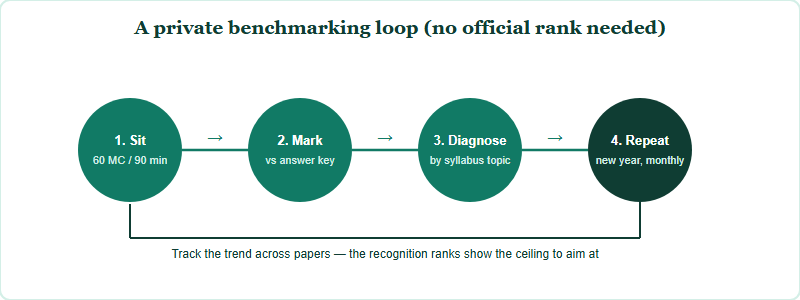
If the National Exam is not open to you, you cannot receive an official rank — but you can build a private benchmark that mirrors it. The idea is to reproduce exam conditions and track your raw performance over time, using the recognition ranks as a reference for what “nationally competitive” would demand.
- Fix the multiple-choice conditions. Sit a full past multiple-choice section — 60 questions in 90 minutes — with no calculator beyond what the paper allows and no notes. Record your raw score. Repeat monthly with a different year to see a trend, not a single data point.
- Score the free-response yourself against the key. The 105-minute free-response section is where depth shows. Mark honestly against the published answer key and note where you lost points — setup, units, a missed step — rather than only the total.
- Track the gap, not just the number. A student aiming at the level the top few hundred reach should see multiple-choice raw scores climbing steadily across papers and free-response solutions that lose points to slips rather than to not knowing the chemistry.
- Use the syllabus as your map. Pair every practice paper with the topic list so weak areas surface as patterns. Our guide USNCO Past Papers (1999–2025): The Pack and How to Use It lays out a full rotation.
Benchmarking this way is honest in both directions: you are not claiming a rank you cannot earn, and you are not pretending the exam is easier than it is. You are using a world-class question bank, and its known difficulty ceiling, to pull your own chemistry up.
Calibrating the tiers against a level you already know
Abstractly, “top 50 in the country” is hard to feel. It helps to place the recognition ranks against reference points a China-based student already understands, so the target stops being a number and becomes a level.
| Reference level | Roughly what it corresponds to | Distance from the recognition ranks |
|---|---|---|
| Strong school / AP-level chemistry | Confident with the core syllabus and standard problems | The starting line, not the finish; the National Exam sits well above this |
| National Exam qualifier | Nominated out of ~10,000 local sitters | Already a serious level — the ~1,000+ pool the tiers are drawn from |
| Honors (next 100) | Nationally competitive across the full syllabus at speed | Consistent, fast, near-complete papers with few conceptual gaps |
| High Honors (top 50) | Among the strongest in the country in a given year | Depth in the hardest topics plus reliability under time pressure |
The practical takeaway for self-study: being comfortable with AP-level or strong school chemistry is the entry condition, not the destination. The gap between “I can do my school syllabus” and “I would be nationally competitive” is exactly the gap the past papers are built to expose — particularly in the reasoning-heavy areas like thermodynamics, equilibrium and organic chemistry. Treating a strong classroom level as the floor and the recognition ranks as the ceiling gives you an honest sense of how much runway a serious chemistry goal actually needs. And it reinforces the eligibility point: a reader with no ACS route is using this to calibrate study rather than to chase a rank, while a U.S.-passport student at an American school abroad may be working toward the exam itself — see Can International Students Take the USNCO? for that boundary.
Reading the tiers on an application — carefully
If a student has legitimately earned High Honors or Honors (a U.S. citizen or permanent resident who sat the National Exam, whether through a Local Section in the U.S. or an ACS International Chemical Sciences Chapter abroad), the recognition is a strong, specific signal: a national rank in a rigorous subject olympiad, not a participation line. It is far more informative than “member of chemistry club.”
What it is not is a guarantee of anything downstream — not Study Camp, not Team USA, and certainly not any admission outcome. Each stage is a fresh, harder cut. Present the tier for exactly what it certifies: a national rank on one exam in one year. Overstating it is easy to check and easy to lose credibility over. Understating it wastes a genuinely rare distinction.
FAQ
How many students earn High Honors and Honors?
The top 50 nationally on the National Exam earn High Honors and the next 100 earn Honors — about 150 in total. Confirm current counts on acs.org.
Is there a fixed score that guarantees High Honors?
No. The tiers are national ranks (top 50, next 100), so the score cut-off shifts each year with the difficulty of that paper.
Can a student in China earn a USNCO recognition tier?
It depends on the student. The tiers are awarded on the National Exam, which ACS limits to U.S. citizens and green-card holders. A student who holds that status and has been enrolled for at least a year at an accredited American school in China can compete through an ACS International Chemical Sciences Chapter, so the tiers are genuinely reachable. A student who is not a U.S. citizen or permanent resident has no ACS route, and the tiers are best used as a difficulty benchmark. There is no separate China-region award scheme. Confirm eligibility on acs.org.
Does High Honors mean you make Team USA?
No. Only the top ~20 scorers reach Study Camp, and just four are chosen for Team USA. High Honors is a National Exam distinction, a separate and earlier cut.
This is the USNCO information desk synchronising official ACS information for chemistry students in China, operated by Hanlin Education. The USNCO is run by the American Chemical Society (ACS), which sets all official rules, recognition tiers, and eligibility. Figures here are approximate and can change year to year; always confirm current details on acs.org. Any error will be corrected within 7 working days.