The USNCO syllabus overlaps most of a strong school chemistry course — and then goes further in depth and pace. For a student in China taking AP, A-Level or IB chemistry, that overlap is the whole point: the public USNCO papers are a way to stretch the chemistry you are already studying, not a separate curriculum to learn from scratch. This article maps which USNCO topics sit inside your course, which sit just beyond it, and how to use the gap. Always confirm the official syllabus on acs.org.
First, the honest framing
The USNCO is the American Chemical Society (ACS) national competition, for U.S. high-school students nominated through an ACS Local Section. A student in China does not enter it — there is no individual sign-up from abroad. So this is not “prepare to compete.” It is the more useful thing for our readers: the USNCO syllabus and its public papers are a free, high-quality benchmark for how far real competition chemistry sits above a school course, and which exact topics carry that gap. For the eligibility detail in full, read whether international students can take the USNCO; for what the syllabus formally covers, see the USNCO syllabus explained.
Why this matters for an international-school student: your AP / A-Level / IB grade is the credential, but the chemistry depth you can demonstrate — in a supplementary essay, an interview, or simply in how confidently you handle a hard problem — is the differentiator. Working USNCO material against your own course is one of the cleanest ways to build that depth, because every topic you meet is one you can trace back to something already on your syllabus.
The topic map: inside, edge, beyond
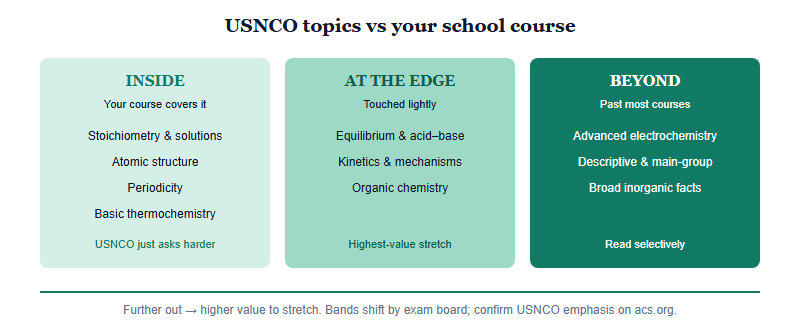
The grid below sorts the major USNCO content areas into three bands relative to a typical school course: inside (your course already covers it, the USNCO just asks harder questions), at the edge (your course touches it lightly, the USNCO goes deeper), and beyond (the USNCO commonly assumes more than most school courses teach). Bands are a general orientation across AP, A-Level and IB — the boundary shifts by syllabus and option, and the USNCO emphasis is set by ACS, so confirm specifics against your exam board and acs.org.
| USNCO area | Band vs school chemistry | What the USNCO adds |
| Stoichiometry & solutions | Inside | Multi-step, time-pressured set-ups; trickier limiting-reagent logic |
| Atomic structure & periodicity | Inside | Finer trend reasoning; less formula, more “why” |
| Thermochemistry & Hess's law | Inside / edge | Longer energy cycles; combined with equilibrium |
| Equilibrium & acid–base | Edge | Polyprotic systems, buffers, titration curves in depth |
| Kinetics & mechanisms | Edge | Rate-law derivation; mechanism reasoning beyond recall |
| Electrochemistry & redox | Edge / beyond | Cell potential calculation; non-standard conditions |
| Organic chemistry | Edge / beyond | Broader reactions and structure problems than many school courses |
| Descriptive & main-group | Beyond | Breadth of inorganic facts a typical course skims |
The pattern is consistent: the quantitative core is inside almost every school course, so the USNCO simply raises the difficulty of questions you can already attempt. The gap opens at equilibrium, kinetics, electrochemistry and descriptive chemistry — these are where competition chemistry pulls ahead, and therefore where the highest-value stretching happens. If you only have time to use the USNCO papers on a few areas, those four are the ones that turn a solid school grade into genuine depth.
How each course lines up
The three main international curricula meet the USNCO from slightly different starting points. None of them “is” the USNCO syllabus, but each shares a large enough core that the papers are usable straight away.
- AP Chemistry is the closest fit in scope and style — a broad, quantitative, single-year survey that overlaps the USNCO multiple-choice paper heavily. The main gap is depth in equilibrium, electrochemistry and descriptive chemistry, plus the USNCO's harder free-response demands. We compare the two directly in AP Chemistry vs the USNCO.
- A-Level Chemistry brings strong organic and physical chemistry over two years, so A-Level students often find the USNCO organic and energetics questions familiar, while the breadth of fast inorganic recall and the multiple-choice pace are the stretch.
- IB Chemistry (HL) rewards conceptual understanding and data analysis; HL students tend to be comfortable with the reasoning style, with the gap showing up in the sheer breadth of factual recall the USNCO can ask and the speed of Part I.
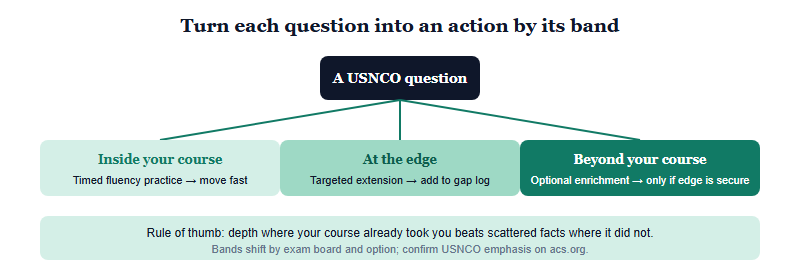
In every case the move is the same: identify which band a USNCO question sits in for your course, and treat “inside” questions as timed practice, “edge” questions as targeted extension, and “beyond” questions as optional enrichment you reach for only once the rest is secure.
A practical way to use the gap
Mapping is only useful if it changes what you do on a Tuesday evening. Here is a concrete routine for turning the overlap into depth, built around the free past-paper pack Hanlin has gathered (questions plus answer keys, with worked solutions for many — not all — of the years; coverage varies and is being added to, so use what the teachers send as the reference).
- Anchor each session to a school topic. Just finished equilibrium in class? Pull the equilibrium questions out of two or three USNCO papers and work only those. The classroom context makes the harder version learnable.
- Mark the band as you go. If a question felt “inside,” log it as fluency practice. If it felt “edge” or “beyond,” that is your extension list — the chemistry your course did not reach.
- Do not chase “beyond” too early. Descriptive main-group breadth is real but low-yield until your edge topics are solid. Depth where your course already took you beats scattered facts where it did not.
- Keep a one-line gap log. Over a term, the recurring “edge” topics are precisely the chemistry that makes you stand out — and exactly what you can speak to with confidence later.
For the full method of getting value from the archive — pacing, marking, building a study list — see USNCO past papers and how to use them. The mapping in this article tells you which questions to pull; that guide tells you how to work them.
A short FAQ
Does the USNCO syllabus match AP Chemistry?
It overlaps heavily — both are broad, quantitative surveys — but the USNCO goes deeper in equilibrium, electrochemistry and descriptive chemistry. Confirm the official syllabus on acs.org.
Can A-Level or IB students use USNCO papers?
Yes, as a stretch resource. The quantitative core overlaps your course; treat the edge and beyond topics as targeted extension.
Where does the USNCO go furthest beyond a school course?
Typically descriptive and main-group inorganic breadth, advanced electrochemistry, and the depth of equilibrium and kinetics. Confirm current emphasis on acs.org.
Does using USNCO papers let me enter the USNCO?
No. The USNCO is for U.S. high-school students via an ACS Local Section. Chinese students use the papers only to prepare and benchmark.
This is the USNCO information desk synchronising official ACS information for chemistry students in China, operated by Hanlin Education. The USNCO is run by the American Chemical Society (ACS), which sets all official rules, the syllabus and eligibility; curriculum comparisons here are general orientation, not an exam-board mapping. Always confirm current details on acs.org and with your own exam board. Any error will be corrected within 7 working days.