
Organic and biochemistry occupy questions 55 to 60 of the USNCO multiple-choice paper — six marks, exactly the same as every other topic area, sitting at the very end. That position is why the block gets lost twice over: reached last when the clock has gone, and revised last when the syllabus feels long. Here is what is actually in it, and how to make those six marks cheap.
Position is half the problem
ACS publishes the multiple-choice blueprint as ten topic areas of six questions each, in a fixed order by question number, with Organic / Biochemistry at questions 55 to 60. Confirm the current blueprint on acs.org, but if it holds for the paper in front of you, two things follow immediately.
The first is arithmetic. Part I allows 90 minutes for 60 questions, so the whole organic block is a nine-minute job at average pace. Students who work strictly in order and lose four minutes between them to two hard equilibrium questions arrive at question 55 with five minutes and six questions left. They then score two out of six and conclude that their organic chemistry is weak. Often it is not weak at all; it was never tested, because they never got there with time to think.
The second is that a block at a known address can be trained at that address. Questions 55 to 60 of every paper you own, pulled out and stacked together, make an organic problem set written by the people who write this exam. Ten papers gives you sixty organic questions at exactly the right calibration — better material than any textbook chapter, because textbook chapters are calibrated to the textbook. Our guide to using past papers properly covers how to ration your stock so you do not burn every paper on one topic; the pack we have compiled is available by scanning the QR code on this site, and some years come with worked solutions while others do not.
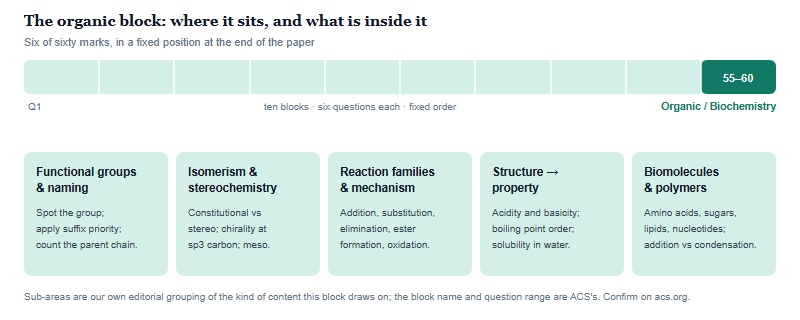
What the block asks, and the skills that answer it fastest
“Organic chemistry” frightens students who have met it as an endless list of named reactions. At multiple-choice speed it is nothing of the kind. With roughly ninety seconds per question there is no room for a long synthetic argument; what fits is recognition, one short inference, and a decision. The table below sets out the shapes these questions tend to take and the check that resolves each one quickly.
| Sub-area | What a question typically demands | The check that resolves it fast |
|---|---|---|
| Functional groups and naming | Identify a group from a structure, or match a name to a structure | Find the highest-priority group first; it fixes the suffix and the numbering direction |
| Isomerism | Count isomers, or decide whether two drawings are the same compound | Compare molecular formula, then connectivity, then spatial arrangement — in that order |
| Stereochemistry | Spot a chiral centre, count stereoisomers, recognise cis / trans | Look for an sp3 carbon with four different groups; check for an internal mirror plane |
| Reactions | Predict a product, or name the transformation type | Ask what was added, removed or swapped, and whether carbon changed oxidation level |
| Structure and property | Rank acidity, basicity, boiling point or solubility | Identify the strongest intermolecular force present, then the stabilisation of any charge formed |
| Biomolecules | Recognise a class, a linkage or a base pair | Name the linkage: amide, ester or glycosidic — the class usually follows |
Two capabilities inside that list are pure practice, and they repay time faster than almost anything else on the paper.
Suffix priority. When a molecule has more than one functional group, one of them becomes the suffix and the rest become prefixes. The descending order runs roughly: carboxylic acid, then ester, amide, nitrile, aldehyde, ketone, alcohol, amine, and finally the plain hydrocarbon skeleton with alkene and alkyne endings. Learn the order once and half the naming questions collapse, because the priority decides both the suffix and which end of the chain you number from. Number to give the principal group the lowest locant; only if that is tied do you go to the substituents.
Degrees of unsaturation. For a formula CcHhNnXx, the count is (2c + 2 + n − h − x) / 2, with oxygen ignored entirely. Each unit is one ring or one pi bond, and four units almost always signals a benzene ring — three double bonds plus the ring itself. This is a ten-second calculation that regularly eliminates two of four options before you have looked at any structure properly, and it is the single most transferable trick in the block.
Counting stereoisomers. With n stereocentres the maximum is 2n, but that is a ceiling, not an answer. Symmetry reduces it: a meso compound has stereocentres and an internal mirror plane, so it is achiral despite them, and tartaric acid's three stereoisomers rather than four is the classic case. Questions in this area are usually testing whether you check for symmetry or stop at the formula.
Ranking questions. Acidity and boiling point rankings appear constantly because they are fast to write and hard to guess. For acidity, the reliable order is carboxylic acid, then phenol, then water, then alcohol, then terminal alkyne, then amine — and within a family, electron-withdrawing groups near the acidic hydrogen strengthen the acid, which is why chloroacetic acid is a stronger acid than acetic acid. The reasoning is always about how well the anion left behind can spread its negative charge. For boiling points, rank by the strongest intermolecular force available: carboxylic acids, which pair up into hydrogen-bonded dimers, sit above alcohols and amines, which sit above aldehydes, ketones and esters with dipole–dipole attraction, which sit above alkanes with dispersion forces alone. Then use size within a family, and remember that branching lowers a boiling point by reducing contact area.
Reaction families, and the ladder that checks your answer
Rather than memorising a list of named reactions, hold a small number of families and one organising idea. The families that keep appearing are: addition to a carbon–carbon double bond, where the hydrogen tends to join the carbon that already has more hydrogens; substitution at a carbon bearing a halogen or similar group; elimination, which removes a small molecule and creates a double bond; ester formation from a carboxylic acid and an alcohol, and its reverse, hydrolysis; and oxidation or reduction of alcohols and carbonyls.
The organising idea is the oxidation level of carbon. Almost every organic redox question is a step along one ladder, and the ladder gives you a way to check an answer arithmetically rather than by recall.
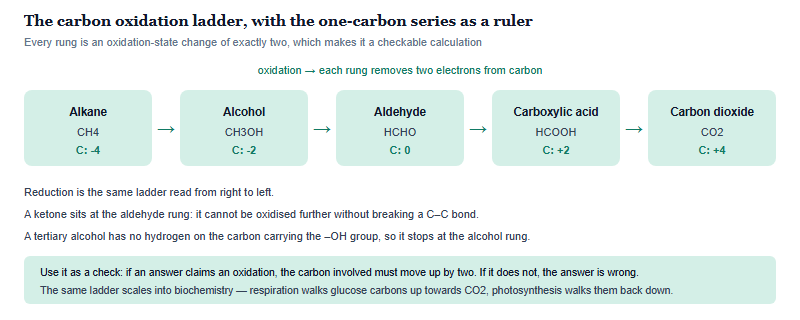
Two practical consequences. A primary alcohol can be oxidised to an aldehyde and onwards to a carboxylic acid; a secondary alcohol gives a ketone and stops; a tertiary alcohol has no hydrogen on the carbon bearing the hydroxyl group, so it does not climb at all. And when a question asks you to classify a transformation you have never seen, count the oxidation state of the carbon before and after. If it rose, it was an oxidation, whatever the reagent was called.
The biochemistry half nobody revises
The block is named Organic / Biochemistry, and students routinely prepare only the first word. The biochemistry that belongs at this level is not a molecular biology course; it is the chemistry of four families of molecule, and it is mostly recognition.
- Amino acids and proteins. An amino group and a carboxyl group on the same carbon, existing as a zwitterion at intermediate pH and therefore behaving as an acid or a base depending on conditions. The isoelectric point is the pH at which the net charge is zero. Twenty standard amino acids join through a peptide bond, which is chemically an amide. Structure runs in four levels: sequence, local folding patterns, overall three-dimensional shape, and the assembly of multiple chains.
- Carbohydrates. Polyhydroxy aldehydes or ketones, so an aldose or a ketose. Glucose, C6H12O6, cyclises and the ring form has two possible orientations at the new centre. Sugars join through glycosidic linkages, and the difference between starch and cellulose is the orientation of that linkage, which is the reason one is food and the other is not.
- Lipids. A triglyceride is glycerol esterified with three fatty acids — note that this is just ester chemistry again. Saturated chains pack tightly and melt higher; unsaturated chains with cis double bonds kink, pack badly and melt lower, which is why one is solid at room temperature and the other is oil.
- Nucleic acids. A nucleotide is a phosphate, a sugar and a nitrogenous base. Adenine pairs with thymine through two hydrogen bonds; guanine pairs with cytosine through three, which is why sequences rich in G and C need more energy to separate. DNA carries deoxyribose and thymine, RNA carries ribose and uracil.
Polymers usually sit alongside. The distinction that matters is mechanistic: addition polymerisation joins monomers with double bonds and loses nothing, while condensation polymerisation expels a small molecule at each join and produces the ester and amide linkages found in polyesters and nylons — the same linkages as in fats and proteins. Seeing that the synthetic and the biological cases are one piece of chemistry is exactly the connection this block rewards.
A twenty-minute weekly routine, and who can sit the papers
Because the block is recall-led, it responds to frequency rather than duration. A workable pattern is twenty minutes a week in three parts: six past-paper questions from the 55 to 60 range at ninety seconds each; five minutes drawing structures from names and names from structures, alternating direction; and five minutes on one ranking exercise, ordering four compounds by acidity or boiling point and writing the reason in a single sentence. The written reason is the part that transfers to the free-response paper, where an unexplained ranking earns little.
Two cautions. First, do not let this become vocabulary revision. The questions test whether you can apply a small number of ideas to an unfamiliar structure, so practice must involve structures you have not seen. Second, resist over-investing. It is six marks, the same as thermodynamics and the same as kinetics; a student who spends two months on organic chemistry because it is enjoyable has usually paid for it elsewhere on the paper.
On access, the honest position is three positions. A student who is not a US citizen or permanent resident but attends a US high school may sit the Local Exam, and ACS states that such students cannot be nominated for the National Exam. A US citizen or permanent resident studying abroad, including inside mainland China, at an accredited American-curriculum school for at least a year and under 20, can run the full route through an ACS International Chemical Sciences Chapter. A student on a Chinese passport at a mainland Chinese school has no ACS entry route; our eligibility guide covers all three cases. For that third group the chemistry above is still worth every hour, because it is the organic core any strong first-year university course assumes — and if you are new to the competition itself, start with what the USNCO is and how it is structured.
Frequently asked questions
How much of the USNCO is organic chemistry?
ACS publishes Organic / Biochemistry as one of ten multiple-choice areas, at questions 55 to 60. Confirm the current blueprint on acs.org.
Do I need reaction mechanisms with curly arrows?
At multiple-choice speed the demand is recognition and short inference. Mechanistic reasoning helps most on the written paper, not on the clock.
Is the biochemistry part really tested?
The block is named Organic / Biochemistry. Treat biomolecule recognition and linkage types as examinable, and confirm current coverage on acs.org.
What is the fastest single thing to learn here?
Degrees of unsaturation, then functional-group suffix priority. Both take an evening and both eliminate wrong options in seconds.
This is the USNCO information desk, synchronising official ACS information for chemistry students in China, operated by Hanlin Education. The USNCO is run by the American Chemical Society (ACS), which sets all official rules and eligibility. Always confirm current details on acs.org. Errors are corrected within 7 working days of notice.