Coordination chemistry is one of the places where USNCO candidates lose marks they can clearly see afterwards. The question is rarely about exotic synthesis or advanced spectroscopy; it is usually a rapid test of whether you can enumerate the distinct arrangements of a complex without confusing ligand charge, coordination number, geometry and symmetry labels. Before diving into the chemistry, here is a quick orientation for the current cycle: according to the ACS 2026-2027 Olympiad calendar as compiled in Hanlin’s competition-news update of 22 October 2026, student registration opens on 1 November 2026, with the Local Exam scheduled for late February/early March 2027 and the National Exam for mid-April 2027. Administrative details belong in registration guides; this article stays focused on the specific skill of isomer counting.
The core skill is not memorising a catalogue of complexes. It is applying a repeatable diagnostic that separates genuine isomers from rotated copies of the same structure. This article isolates that problem with two standard teaching illustrations: an octahedral MA4B2 case and an octahedral MA3B3 case. Both are labelled teaching illustrations, not official ACS USNCO questions, and they demonstrate the counting method rather than any particular syllabus item.
A terminology warning first, because it causes real confusion. In this clinic, “isomer counting” means counting the distinct stereoisomers of a single complex ion or molecule – geometric arrangements and, where relevant, optical isomers. It is not the classical coordination isomerism, in which ligands are redistributed between a cationic and an anionic complex centre, as in comparing [Co(NH3)6][Cr(CN)6] with [Cr(NH3)6][Co(CN)6]. Both ideas appear at the top of the USNCO syllabus, but they are different questions and use different bookkeeping.
The Three-Check Diagnostic
Before drawing anything, run three checks in this order. Skipping the order is the single most common cause of a lost mark.
- Check 1: Ligand charge and metal oxidation state. Classify every ligand as neutral (NH3, H2O, CO, en) or anionic (Cl-, CN-, OH-, ox2-). Use the overall charge of the species given to solve for the metal oxidation state. For geometric counting, the state mainly matters because it tells you which geometry is plausible – d8 metals with strong-field ligands, for example, are commonly square planar – but the ionic bookkeeping must still balance or the whole answer collapses.
- Check 2: Coordination number and geometry. Count donor atoms attached to the metal. USNCO-level items are usually 6 (octahedral) or 4 (tetrahedral or square planar). Do not assume octahedral because the formula ‘looks familiar’; a CN of 4 opens two different geometries with different counting rules, and that alone changes the answer.
- Check 3: Symmetry and labelling. Decide what kind of isomerism the question is asking for. Geometric isomerism (cis/trans, fac/mer) depends on relative positions. Optical isomerism depends on chirality. Neither includes resonance structures or freely rotating conformers, which are not separate isomers.
Teaching Illustration 1: The Octahedral MA4B2 Case
Consider the hypothetical complex ion [Co(NH3)4Cl2]+. This is a textbook teaching illustration for geometric isomerism in an octahedral complex; it is not reproduced from a contest paper.
Step 1 – verify. NH3 is neutral and Cl- is -1, so the metal must be Co(III) to give the overall +1 charge. The coordination number is 6 (four NH3 plus two Cl-), confirming octahedral geometry. Call NH3 the A ligand and Cl- the B ligand.
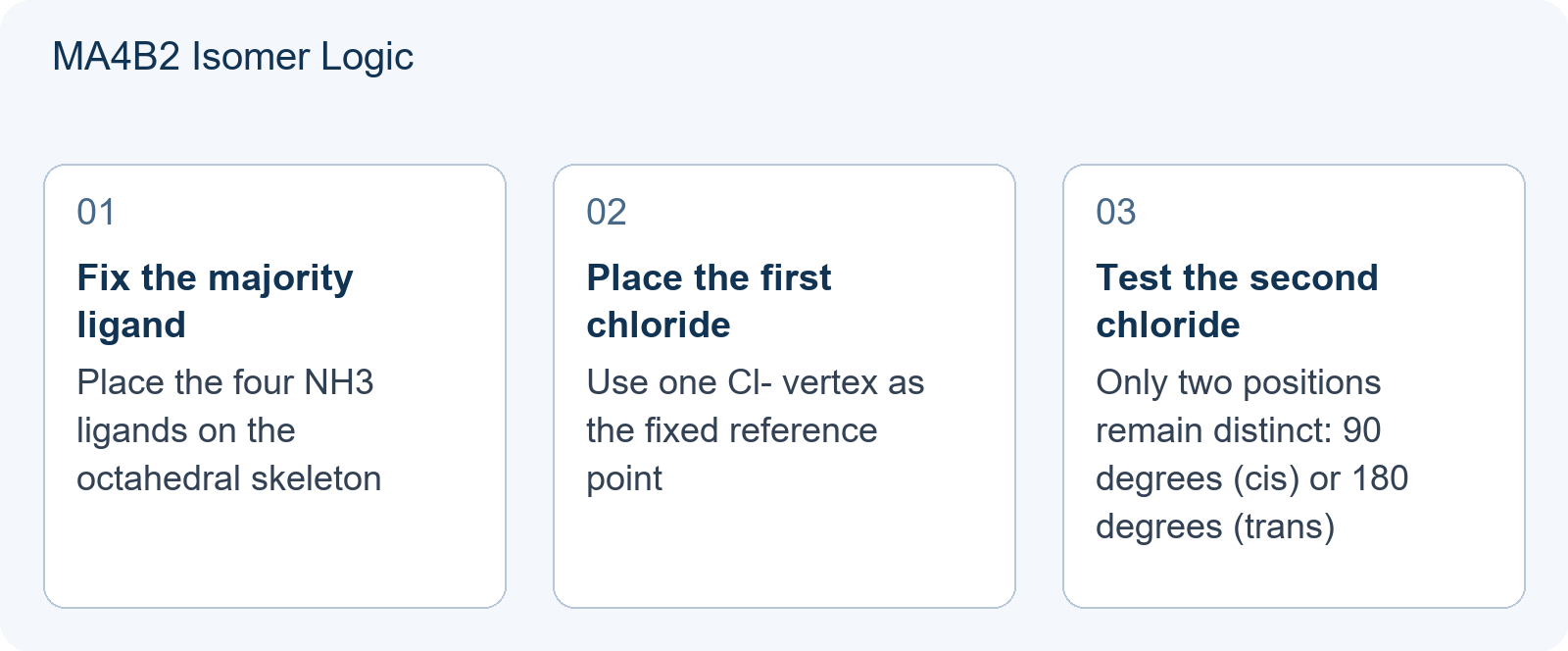
Step 2 – count arrangements. Choose one Cl- and fix it as a reference. The second Cl- has only two distinct positions relative to it.
- Cis: the two chlorides are 90 degrees apart, on adjacent vertices. Every drawing you can produce with them adjacent is superimposable on this one by rotation, so there is exactly one cis form.
- Trans: the two chlorides are 180 degrees apart, on opposite vertices. Again every drawing reduces to one structure by rotation, so there is exactly one trans form.
Step 3 – check for chirality. The trans form has a centre of inversion and mirror planes and is clearly achiral. The cis form has a C2 axis and two mirror planes; it is also achiral. So the geometric count (2) equals the stereoisomer count (2).
The error students make here is subtle: they draw one chloride axial and one equatorial, then redraw it with both equatorial, and treat the drawings as different isomers. In a regular octahedron all six vertices are equivalent before the first ligand is placed, so only the relationship between the two chlorides matters.
Teaching Illustration 2: The Octahedral MA3B3 Case
Now take the neutral complex [Co(NH3)3Cl3]. Again this is a teaching illustration, not a past paper question. Coordination number 6, octahedral geometry, three NH3 ligands and three Cl- ligands.
Ask how the three NH3 ligands can sit relative to one another. Because the octahedron is highly symmetric, there are only two distinct answers.
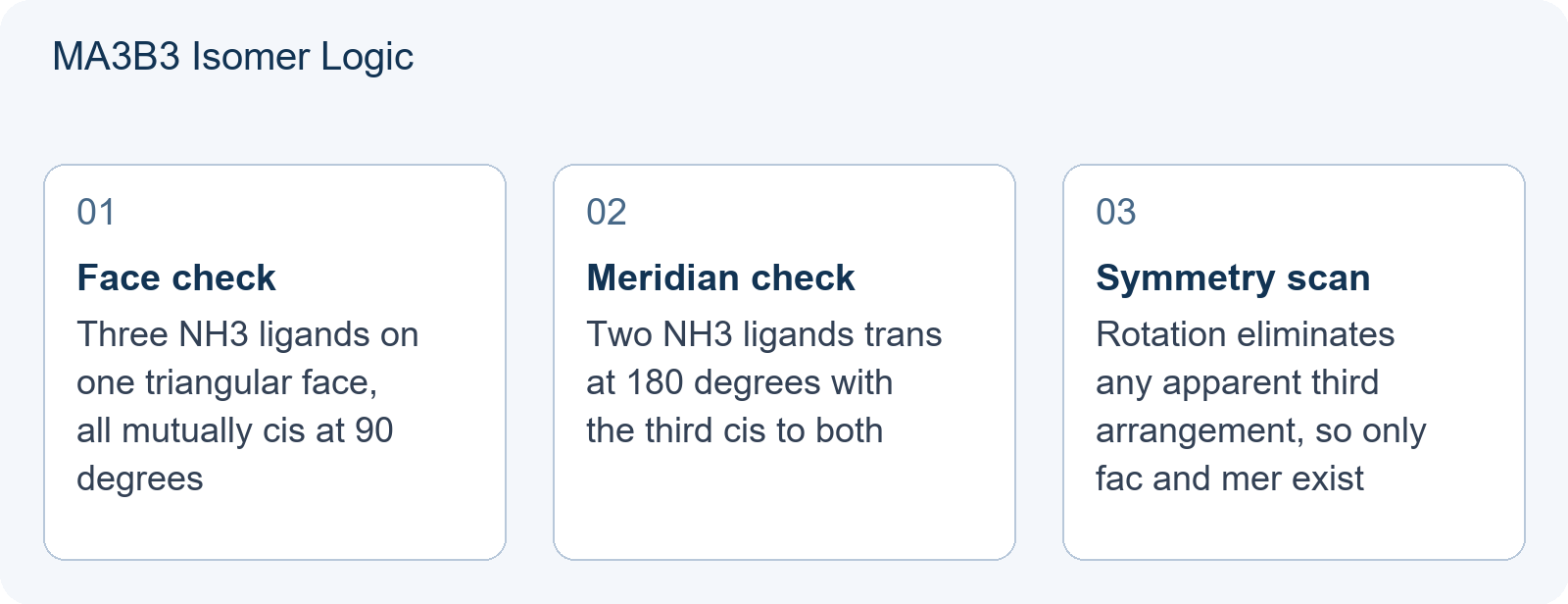
- Facial (fac): the three NH3 ligands occupy the three vertices of one triangular face, so every pair of NH3 ligands is mutually cis at 90 degrees.
- Meridional (mer): two NH3 ligands are trans to each other at 180 degrees across the metal, and the third NH3 is cis to both of them. The three nitrogens lie in a plane containing the metal centre, giving the meridian arrangement.
Both arrangements are achiral for this ligand set, so the stereoisomer count is again 2. The common error is to invent a third structure by placing the NH3 ligands in a scattered pattern; every such pattern rotates into a fac or a mer arrangement, because the octahedron has no lower-symmetry option for three identical ligands.
Why Optical Isomerism Changes the Count
Monodentate, symmetric ligands such as NH3 and Cl- do not on their own create chirality. Bidentate chelating ligands do, because they lock parts of the coordination sphere into a helical arrangement. The test is precise: a complex is chiral if it has no improper rotation axis – that means no mirror plane, no centre of inversion and no S_n axis of any order. Students sometimes state the test as ‘no plane and no centre’, which over-counts, because an S4 or S6 can also make a structure achiral.
Two standard examples show the effect.
[Co(en)3]3+, formed from three ethylenediamine ligands and Co(III), has only one geometric arrangement – all three chelate rings simply wrap around the metal – but it exists as a pair of non-superimposable mirror images, the left- and right-handed helices conventionally labelled Lambda and Delta. Stereoisomer count: 2.
[Co(en)2Cl2]+ is more interesting. With two chelates and two chlorides, the chlorides can be trans (one structure, achiral) or cis (one geometric structure that is chiral), giving three stereoisomers in total: trans, cis-Lambda and cis-Delta. Nothing about the charge logic has changed; the extra complexity comes entirely from chelation and chirality.
Two Extra Traps: CN = 4 and Formula-Matching
The first trap is coordination number 4. An MA2B2 formula with CN = 4 has a geometry-dependent answer. In a tetrahedral complex, every vertex is equivalent and the two B ligands are always at the same angle, so there is only one arrangement – no cis/trans isomerism at all. In a square planar complex, the two B ligands can be adjacent (cis) or opposite (trans), giving two geometric isomers. The classic teaching case is square planar [Pt(NH3)2Cl2], which has cis and trans forms with very different biological behaviour. If a question gives only the formula and CN = 4, geometry is part of what you must determine, usually from the metal and ligand set; do not silently assume square planar.
The second trap is charge bookkeeping at the end. Always re-total the charges of the structure you have just drawn. If the given overall charge does not match, you have miscounted ligands or misassigned a ligand’s charge, and the isomer count is invalid regardless of how many drawings you produced.
The Five-Minute Practice Protocol
Use this routine on any past-paper style item until it becomes automatic. It is deliberately slow at first so that it becomes fast later.
- Write the three checks in the margin. Charge, coordination number, geometry. One word each is enough.
- Fix the most numerous ligand. Placing the four NH3 ligands in MA4B2, for example, removes most duplicate drawings before you start.
- Move the rarer ligand only. Test all distinct positions for the minority ligand relative to the fixed skeleton, using rotation to discard duplicates.
- Label and chirality-scan. Name each structure (cis, trans, fac, mer) and then ask whether any improper rotation axis exists.
- Re-check the charge and the question’s actual demand. Confirm whether the question wants geometric isomers only, stereoisomers overall, or a specific named form.
Readers who want additional topic-specific sets can build them from the practice structure described in USNCO Quizzes: Build Topic-Specific Practice Sets From Past Papers (2026), though that page covers practice organisation rather than coordination chemistry itself.
Error Logging for Coordination Chemistry
Isomer-counting mistakes repeat, which makes them easy to fix once they are recorded. The general template in Why You Keep Losing the Same Marks: A Chemistry Error Log That Actually Works (2026) transfers directly. For coordination chemistry, log five fields.
| Error type | Typical description | Correction move |
|---|---|---|
| Geometry assumption | Treated CN = 4 as octahedral or as square planar without evidence | Compute CN first, then decide geometry from the metal and ligands |
| Symmetry oversight | Counted a rotated structure as a new isomer | Fix one ligand as a reference before placing the others |
| Chirality miss | Forgot to split enantiomers of a cis-chelate form | After the geometric count, check every structure for improper rotation axes |
| Ligand charge | Called an anionic ligand neutral or the reverse | Maintain a short memorised list of common ligand charges |
| Question scope | Answered a ‘geometric only’ question with the full stereoisomer count | Re-read the requested count before writing the final number |
Reviewing the log before a mock exam turns diffuse anxiety into a short, specific checklist. For a reader whose log shows mostly chirality misses, the next two weeks should be spent on chelated complexes; for a reader whose log shows mostly geometry assumptions, the priority is VSEPR and coordination-number reasoning, which is developed in USNCO Molecular Geometry: Separate Electron Domains From Molecular Shape.
Where This Fits in the Wider Inorganic Picture
Isomer counting is one segment of a much broader inorganic and structural syllabus. The wider context – bonding models, periodic trends, and the standard structural questions that appear repeatedly – is set out in Structure, Bonding and Periodic Trends: The USNCO Marks You Should Never Lose (2026). Treat this clinic as a drill you can run in ten minutes, not as a substitute for that broader revision.
Scope Note: Teaching Illustrations, Not Official Problems
The examples used here – [Co(NH3)4Cl2]+, [Co(NH3)3Cl3], [Co(en)3]3+, [Co(en)2Cl2]+ and square planar [Pt(NH3)2Cl2] – are standard textbook illustrations chosen to clarify the counting method. They are not reproduced from official ACS USNCO papers and they do not represent specific scoring guidance. Actual contest items may involve more complex ligand sets, higher coordination numbers, or an explicit requirement to justify a structural argument. Always treat the official ACS materials for the season as the reference point for syllabus and administrative rules.
For China-based students in US high schools, participation routes depend on school registration and chapter arrangements, not on the chemistry in this article; that is a separate question and is documented elsewhere on this site. The chemistry itself – charge, coordination number, geometry, symmetry – is the same wherever the paper is taken.
General event background is available at Event background.
This is an independent preparation guide, not affiliated with, endorsed by, or sponsored by the American Chemical Society.
Frequently Asked Questions
Do I need to memorise all possible coordination isomers?
No. Memorisation fails as soon as the ligand set changes. What you need is the systematic counting method for the common geometries – octahedral, tetrahedral and square planar – applied through the three checks of ligand charge, coordination number and symmetry.
How do I know whether a complex is optically active?
Check for any improper rotation axis: a mirror plane, a centre of inversion, or an S_n axis of any order. If none exists, the complex is chiral and exists as a pair of enantiomers. Monodentate symmetric complexes such as [Co(NH3)4Cl2]+ and [Co(NH3)3Cl3] are achiral, while chelated cis forms such as cis-[Co(en)2Cl2]+ are chiral.
Are these examples from actual USNCO papers?
No. They are teaching illustrations built from standard coordination chemistry. They demonstrate the diagnostic method but are not reproduced contest questions, and the official ACS materials for the season remain the reference point for syllabus and scoring.