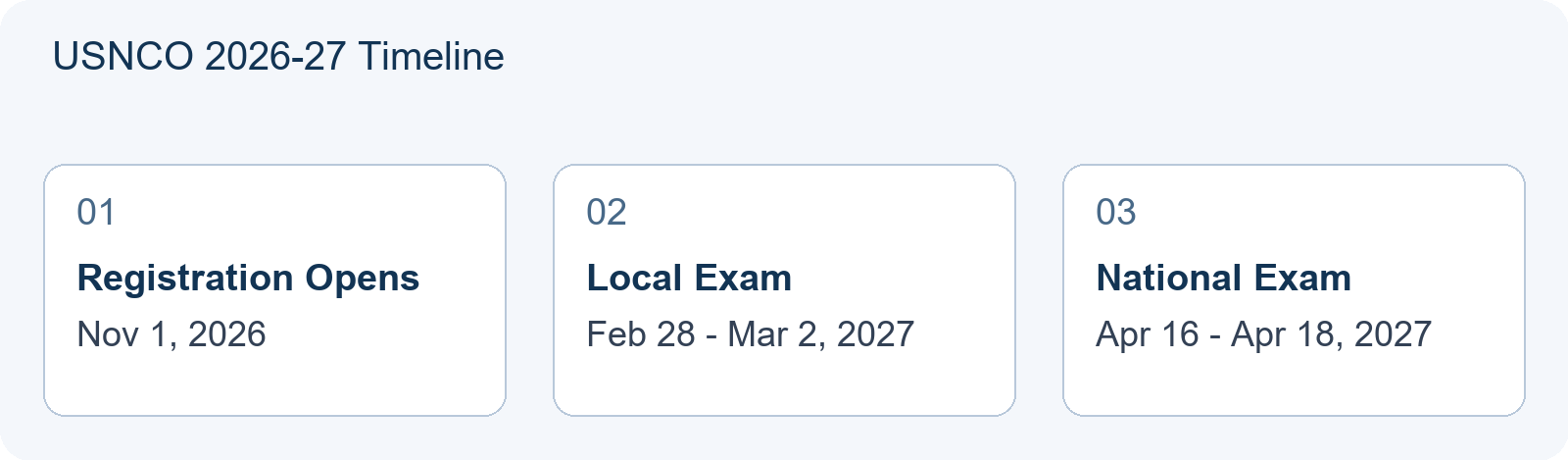
For China-based chemistry students weighing USNCO vs CCO in the 2026-27 planning season, the answer starts with eligibility, not prestige. CCO’s 2026 award change removes national awards and evaluates entrants against global Gold/Silver/Bronze/Merit lines. USNCO remains the ACS national pathway: 2026-27 student registration opens on 2026-11-01, the Local Exam runs 2027-02-28 to 03-02, and the National Exam runs 2027-04-16 to 04-18. If you have a confirmed ACS-eligible route, USNCO is the benchmark for lab-data and inorganic breadth. If you can register through a CCO/CCC regional route and prefer written proof depth, CCO is the stronger fit—but its 2026 recognition is entirely global.
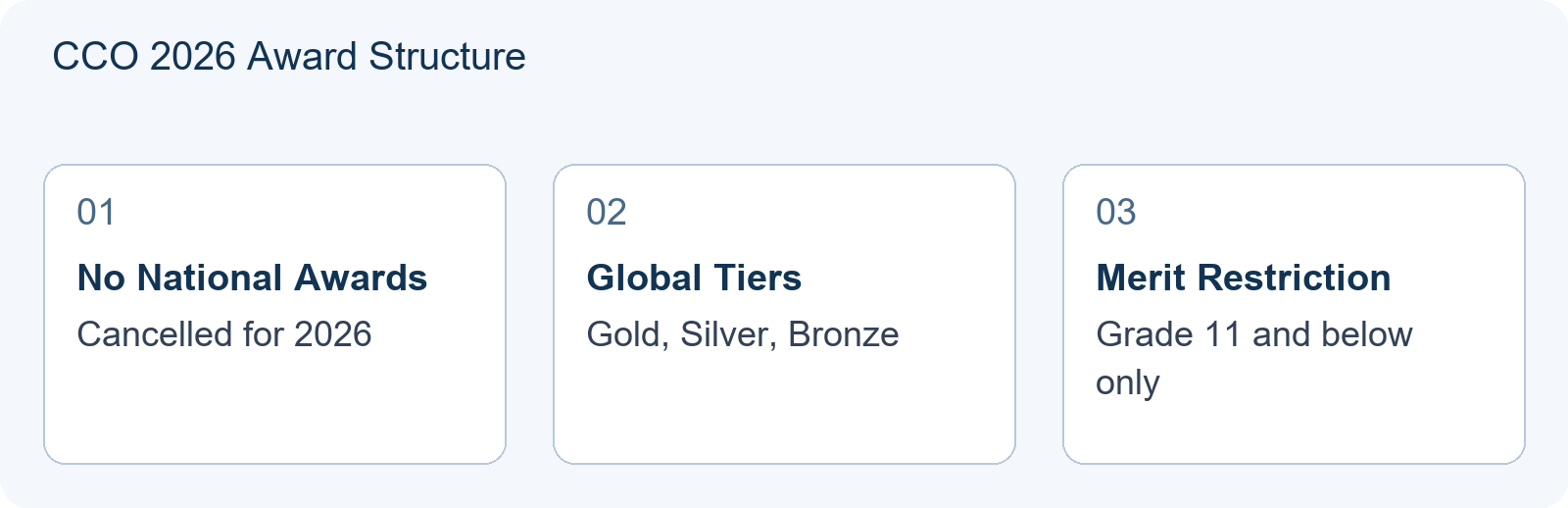
What changed in CCO 2026: national awards removed
According to a Hanlin operator note titled “Hot Topic Material | CCO 2026 Award Cut-offs · USNCO Nov 1 Registration” dated 2026-10-22, CCO cancels national awards from 2026 and moves to global-only recognition. The same note lists these global lines:
| 2026 CCO global award | Reported cut-off | Reported approximate top band | Restriction |
|---|---|---|---|
| Gold | 30 | About top 18.5% | Open to eligible entrants |
| Silver | 20 | About top 35% | Open to eligible entrants |
| Bronze | 10 | About top 62% | Open to eligible entrants |
| Merit | 5 | Not stated in the note | Grade 11 and below only |
Source: Hanlin operator note “Hot Topic Material | CCO 2026 Award Cut-offs · USNCO Nov 1 Registration” (2026-10-22), which attributes the lines to Asdan and CIC. These are operator-reported global cut-offs, not ACS or CIC regulation text reproduced here. Confirm the current rules with the administering body for your region. The note also says national awards are removed, so the old national-tier recognition is no longer the planning target. Do not assume the reported top bands are disjoint or guaranteed; they are approximate descriptors supplied alongside the cut-offs.
USNCO 2026-27 dates and the China-based eligibility caveat
The same Hanlin note cites an ACS official page for the USNCO 2026-27 calendar. Registration opens 2026-11-01. The Local Exam runs 2027-02-28 to 03-02. The National Exam runs 2027-04-16 to 04-18. Study Camp is still listed as TBD, and the IChO window is 2027-07-19 to 07-28. Those dates matter only after eligibility is confirmed.
USNCO is not a general open-entry exam from mainland China. The standard route is through a US high school or an ACS international chapter that confirms the student’s eligibility. If that route is not confirmed, the dates are irrelevant for that student. Read the USNCO Registration Guide for the 2026-2027 Season for the registration sequence. For a grade-by-grade preparation timeline, see When to Start USNCO Preparation: A Grade 9-12 Plan for China-Based Students (2026). CCO, by contrast, is discussed in the Hanlin course note as a higher-difficulty option after CCC, but it still has its own registration and eligibility route; the 2026 award note does not create open access by itself.
Format contrast: lab logic versus written proof depth
The Hanlin course note “UKChO/CCO/USNCO… Five Chemistry Competitions” dated 2026-09-27 offers an operator comparison, not an official ACS or CIC rule. It ranks overall difficulty as UKChO > CCO > USNCO > C3L6 > CCC. In that comparison, USNCO covers AP Chemistry plus first-year university topics and includes a practical-lab dimension. Its theory section leans toward inorganic chemistry, analytical techniques, equilibrium and electrochemistry. CCO uses full written or proof-style questions with physical-chemistry depth, including thermodynamics, kinetics and quantum-chemistry foundations.
The practical difference is output format. USNCO rewards fast, accurate multiple-choice decisions, data-table reading and error analysis. CCO rewards complete derivations, chemical modelling and written justification. A student who can calculate quickly may still lose marks in CCO if the reasoning is compressed. A student who writes beautiful proofs may still lose marks in USNCO if timing and data interpretation are weak.
Decision matrix for China-based families
| Factor | USNCO | CCO |
|---|---|---|
| Eligibility route | US high school or ACS international chapter; confirm before preparation | Regional CCO/CCC route; confirm with the local administrator |
| 2026 recognition | Local to National to Study Camp pathway; no global ranking | Global-only Gold/Silver/Bronze/Merit; Merit for Grade 11 and below |
| 2026-27 timing | Registration opens 2026-11-01; Local Feb 28-Mar 2, 2027; National Apr 16-18, 2027 | Operator timeline places CCO around September-October based on prior years; confirm the exact 2026 date locally |
| Skill fit | Lab logic, inorganic, analytical, data interpretation | Written proofs, physical chemistry, derivation depth |
| Best for | Students with a confirmed ACS route targeting the US pathway | Students with a confirmed regional route who want global-ranked proof writing |
| Preparation overlap | Stoichiometry, gases, equilibrium, redox, thermodynamics, kinetics | Same core concepts, different answer format and marking emphasis |
Worked teaching illustration: the Grade 11 student with AP Chemistry
This is a teaching illustration, not a real student or a predicted outcome. A Grade 11 student at an international school in Shanghai has strong AP Chemistry scores, a US passport and a school ACS chapter that confirms USNCO eligibility. They also want to add CCO.
The first decision is calendar control. They should register for USNCO immediately after 2026-11-01 because the Local Exam window is fixed. Winter preparation should target Local Exam past papers, multiple-choice speed and data-table interpretation. If they advance, the National Exam in April becomes the priority. If they do not advance, they do not automatically become CCO-eligible; they must confirm the CCC-to-CCO route with the local CCO administrator. If eligible, the 2026 global-only structure means there is no national-tier fallback. They should aim at the reported global lines rather than a local rank. Shared topics reduce extra study, but the output drills remain separate: USNCO speed versus CCO written derivation. No award or invitation is promised or implied.
Avoiding double-counting preparation
Families often worry that preparing for one competition wastes work for the other. The core chemistry overlaps: mole calculations, gas laws, acid-base equilibria, redox, thermodynamics and kinetics appear in both. The difference is how the answer is demanded. Keep one concept map for shared theory, then split practice by format. USNCO practice should be timed, multiple-choice heavy and data-centric. CCO practice should be untimed or extended-time, proof-heavy and derivation-centric.
Keep an error log by concept and by format. A units error in a USNCO data table and a skipped justification in a CCO derivation are different failure modes even when both involve equilibrium. If the same concept error appears in both formats, revise the concept. If it appears only in one format, revise the procedure for that exam. If you are still deciding whether CCC should be the stepping stone, the existing USNCO vs CCC: Which Chemistry Competition to Prepare for When You Cannot Do Both covers that different comparison.
Strategic timing: aligning calendars with academic loads
The 2026-27 academic year presents a specific challenge for students attempting both competitions. USNCO’s Local Exam falls in late February 2027, coinciding with the end of the second semester in many international schools. This period is typically high-stress due to IB/A-Level mock exams or AP finals. Students must assess their capacity to handle USNCO preparation during this peak academic load. If the school term is particularly demanding, prioritizing USNCO might require starting preparation earlier, in the fall of 2026, to avoid cramming in January and February.
CCO, according to operator timelines, often occurs later in the year, potentially overlapping with summer activities or early autumn preparations depending on the specific regional schedule. Because CCO relies heavily on deep theoretical understanding rather than rapid recall, it may suit students who prefer a slower, more reflective study pace. However, the lack of national awards means that CCO results are compared globally. This shifts the psychological pressure from “beating local peers” to “meeting a global standard,” which some students find less stressful and others find more daunting. Families should consider which type of pressure motivates their child more effectively.
Skill transfer analysis: what carries over?
While the formats differ, certain skills are highly transferable between USNCO and CCO. Stoichiometry, gas laws, and basic equilibrium calculations are universal. Mastery of these fundamentals benefits both exams. However, the application differs. In USNCO, these concepts are tested via multiple-choice questions that require quick identification of the correct principle. In CCO, the same concepts might be embedded in a multi-part problem requiring a written derivation of the result.
Inorganic chemistry is a strength area for USNCO, which emphasizes periodic trends, coordination chemistry, and qualitative analysis. CCO tends to lean more into physical chemistry, including thermodynamics and kinetics, with a focus on mathematical modeling. Students strong in organic chemistry may find neither competition perfectly aligned, as both prioritize inorganic and physical aspects over complex organic synthesis mechanisms found in UKChO. Therefore, a student with a balanced profile across all three pillars (inorganic, physical, organic) will perform well in both, but must tailor their revision strategy to the specific weighting of each exam.
Common pitfalls in dual-preparation
One common mistake is assuming that success in one competition guarantees eligibility or success in the other. USNCO advancement is strictly internal to the ACS system. CCO advancement depends on the CCC-to-CCO route or the relevant regional pathway. There is no automatic cross-credit between the two systems. Another pitfall is neglecting the lab component for USNCO. While CCO is purely written, USNCO includes a laboratory section that tests practical skills like titration, separation techniques, and observation recording. Students who ignore lab practice for USNCO often lose significant marks in the National Exam stage, even if their theoretical knowledge is strong.
Conversely, students preparing for CCO sometimes underestimate the time management aspect of written proofs. Unlike multiple-choice questions where you can guess or skip, CCO requires structured, legible, and logically sound arguments. Practicing under timed conditions is essential to ensure that the depth of explanation does not come at the cost of completing all questions. Using resources like USNCO Quizzes: Build Topic-Specific Practice Sets From Past Papers (2026) can help isolate specific topic weaknesses before tackling full mock exams.
Conclusion: eligibility first, format second, calendar third
CCO’s 2026 shift to global-only awards changes the recognition target: national awards are gone, and Merit is limited to Grade 11 and below. USNCO keeps its ACS pathway and its 2026-27 dates. The correct order of decision-making is eligibility, then format, then calendar. USNCO suits students with a confirmed ACS route who want lab-data and inorganic breadth. CCO suits students with a confirmed regional route who want global-ranked written proof depth. Neither choice should be made from prestige alone, and neither article should be read as a guarantee of awards, invitations or admissions outcomes.
General event background is available at Event background.
This is an independent preparation guide, not affiliated with, endorsed by, or sponsored by the American Chemical Society.
Frequently Asked Questions
Can Chinese students participate in USNCO directly?
Not through open mainland registration. USNCO is the ACS national pathway, and participation normally requires a confirmed US high school or ACS international chapter route. Some China-based students with the right school or chapter connection can enter, but each case depends on ACS eligibility rules. Confirm with the chapter before preparing around the dates.
What happened to CCO national awards in 2026?
Starting in 2026, CCO cancels national awards and moves to global-only recognition: Gold, Silver, Bronze and Merit. The Merit award is limited to Grade 11 and below, according to the Hanlin operator note dated 2026-10-22. The same note reports Gold 30, Silver 20, Bronze 10 and Merit 5 as global cut-off lines, with approximate top bands for Gold, Silver and Bronze.
Which competition is harder, USNCO or CCO?
They test different skills. The Hanlin course note dated 2026-09-27 ranks CCO above USNCO in overall difficulty, but that is an operator comparison, not an official ACS or CIC rule. USNCO stresses breadth, speed and lab-data interpretation. CCO stresses depth, physical chemistry and written proof. Difficulty depends on whether the student performs better in rapid multiple-choice conditions or extended derivation tasks.