For many China-based students aiming at chemistry, medicine, materials science, or pharmacy applications, the appeal of USNCO and UKChO is obvious. Both are English-medium chemistry olympiad-style competitions. Both signal serious academic interest. But the mistake is treating them as two names for the same preparation project. They are not. A student who prepares for USNCO and UKChO with one generic advanced-chemistry timetable usually discovers too late that the two exams reward different habits: breadth and speed in one case, long-form mechanistic depth in the other.
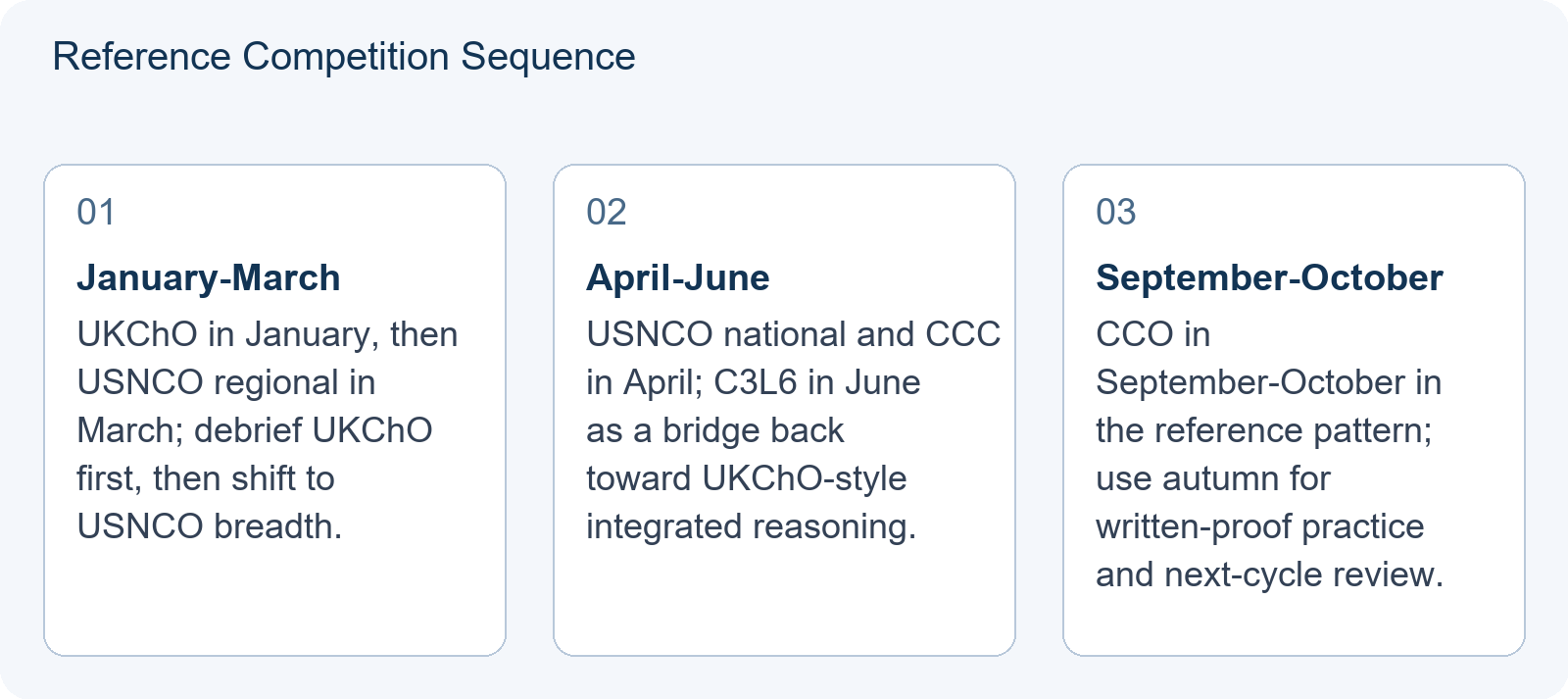
This article gives a planning calendar for one year, using a reference sequence described in a Hanlin course note published on 27 September 2026. The sequence is UKChO in January, USNCO regional in March, CCC and USNCO national in April, C3L6 in June, and CCO in September-October. Treat that as a reference pattern, not as official dates for any specific year. Dates, entry routes, and eligibility must be confirmed with the relevant competition organizers and local coordinators.
Why USNCO and UKChO Should Not Share One Preparation Plan
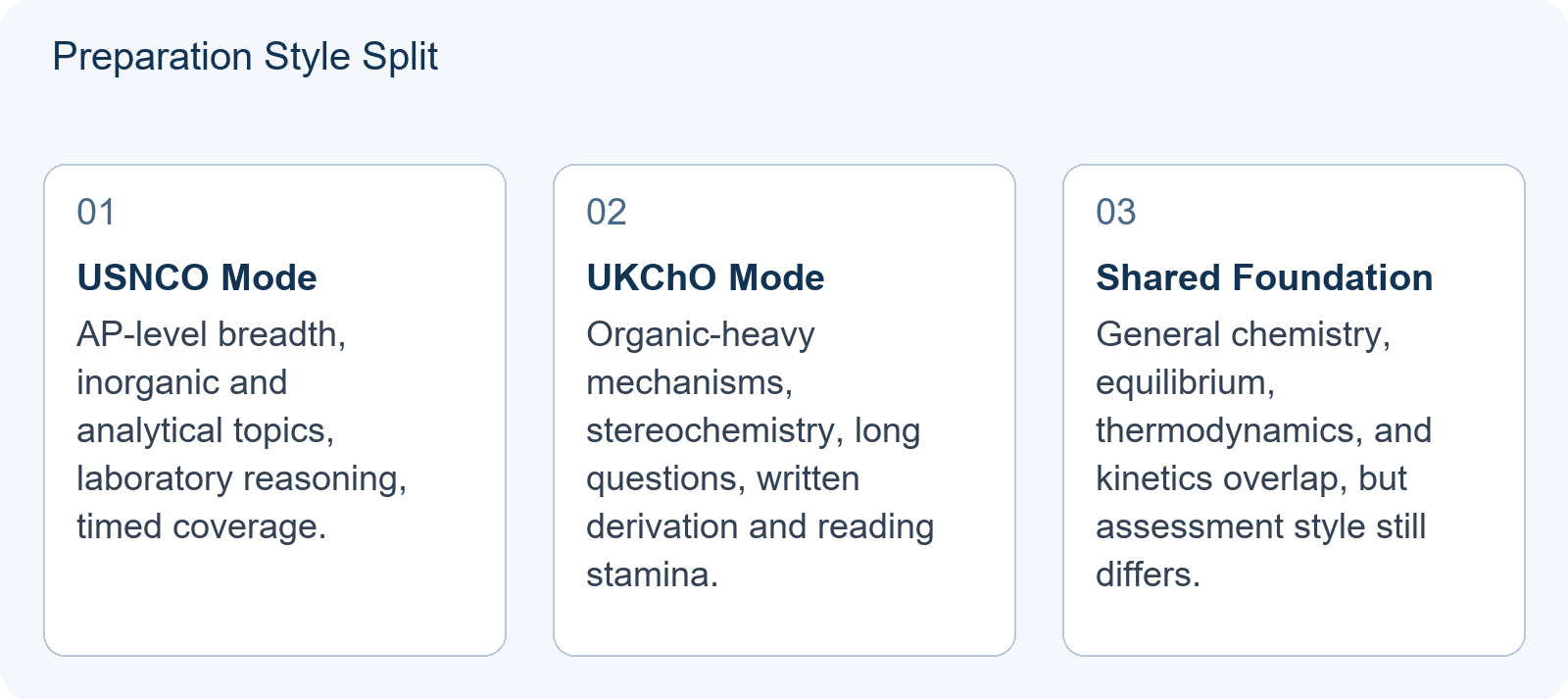
The same Hanlin course note describes USNCO as covering AP chemistry plus some first-year university content, with particular emphasis on laboratory work, inorganic chemistry, analytical chemistry, equilibrium, and electrochemistry. Its format is described as varied: multiple-choice questions test breadth, written questions test depth, and laboratory questions test practical reasoning. That profile rewards broad recall, fast unit handling, and comfort with data interpretation.
UKChO is described very differently. The source places organic chemistry at roughly 50-60% of the paper, with complex mechanisms, stereochemistry, retrosynthesis, multi-step calculations, and long questions. The note says UKChO has 5-6 major questions, each with 3-5 sub-parts, and that the paper can run to 10-15 pages of English reading. That rewards patience, clear written derivation, and the ability to extract chemical principles from unfamiliar context.
If you prepare for both using only one mock style, you create a predictable gap. A student who drills USNCO-style multiple-choice breadth may enter UKChO unprepared for long mechanistic explanations. A student who spends months on UKChO-style organic depth may lose speed on USNCO-style factual coverage and analytical data questions. The first planning decision is therefore not ‘Which exam is harder?’ but ‘Which skill does this month need?’
Reference Calendar: January to October, With Confirmation Caveats
The Hanlin source gives a useful annual shape for students comparing the two pathways. It lists UKChO in January, USNCO regional in March, CCC and USNCO national in April, C3L6 in June, and CCO in September-October. The source also places the difficulty order as UKChO > CCO > USNCO > C3L6 > CCC. That ordering is a planning signal, not an official ranking. It suggests that CCC can serve as a foundation event, C3L6 as a bridge into UKChO, and USNCO as a broad but demanding target that sits below UKChO in the source’s difficulty ladder.
Use the sequence to design phases, not to assume dates. If your local USNCO route differs, or if your school cannot enter a particular competition, adjust the calendar rather than forcing the pattern. The value of the reference sequence is that it separates the year into distinct cognitive modes: UKChO debrief, USNCO breadth, April dual pressure, summer C3L6 bridge, autumn written-proof work, and then review for the next cycle.
January-March: UKChO Debrief and USNCO Local Preparation
After UKChO in January, do not simply move on. Run a structured debrief within one week. Sort every lost mark into three categories: knowledge gap, reading or interpretation error, and expression error. UKChO is long-form, so expression errors matter. Did you draw a mechanism but omit a curly arrow? Did you reach the right product but fail to explain the stereochemical outcome? Did you leave a multi-step calculation half-justified? The source describes UKChO as organic-heavy and derivation-heavy, so these are exactly the places where a correct final answer may still be incomplete.
Then shift to USNCO preparation for the March regional exam. The source says USNCO emphasizes AP-level content plus laboratory, inorganic, analytical, equilibrium, and electrochemistry areas. That means your USNCO phase should be broader than your UKChO phase. Build a topic checklist across general chemistry, stoichiometry, solutions, gases, thermodynamics, equilibrium, electrochemistry, and descriptive inorganic chemistry. Because the source describes USNCO as including multiple-choice breadth and written or laboratory depth, do not prepare only one question style. Confirm which sections apply to your actual route, then practise the relevant mix.
A useful weekly split in February and early March is three sessions on USNCO breadth, one session on laboratory or data interpretation, and one short session revisiting UKChO-style mechanisms to keep that skill alive. The point is not to do equal work. The point is to prevent the UKChO skill from disappearing while USNCO breadth takes over.
April: USNCO National and CCC Overlap – What to Prioritise
April often creates a collision. The source lists CCC and USNCO national in the same month. If your main goal is USNCO national, that exam should receive the majority of your energy. The source describes USNCO as broad and demanding, with analytical and laboratory dimensions. The national level will punish weak inorganic or analytical chemistry, not just weak organic chemistry.
CCC can still be useful. The same source places CCC below USNCO in difficulty and describes it as 25 multiple-choice questions with a high-school chemistry base. If you are also considering Canadian universities, the source presents CCC and CCO as the Canadian pathway. But if you are already under pressure, do not try to master CCC and USNCO national at full intensity in the same fortnight. Use CCC as a confidence-building checkpoint if it fits your route. For students who genuinely cannot do both, the existing article USNCO vs CCC: Which Chemistry Competition to Prepare for When You Cannot Do Both addresses that narrower decision.
June-October: C3L6, CCO and the Next Cycle
June is the C3L6 window in the reference sequence. The Hanlin note says C3L6 and UKChO are closely related in knowledge base, with C3L6 in June and UKChO the following January. It describes C3L6 as based on AS-Level core content, while UKChO expands that base in depth and breadth. That makes C3L6 a natural bridge. Prepare for it by integrating topics rather than memorising isolated facts. The source says C3L6 uses 2-3 large questions, each telling a complete chemical story or research process. That is different from USNCO-style breadth. It trains the exact skill UKChO needs: following an unfamiliar narrative and extracting the chemistry.
By September and October, attention turns to CCO in the reference sequence. The source describes CCO as moving from CCC-style multiple-choice to all written or proof questions, with advanced physical chemistry including thermodynamics, kinetics, and introductory quantum chemistry. Even if CCO is not your target, this autumn period is ideal for retrospective work. Revisit your USNCO and UKChO papers. Build an error log that records the topic, the trigger, the correct reasoning, and the action you will take next time. The goal is to convert mistakes into a next-cycle syllabus.
Building Separate Mock Sets: USNCO Section Practice vs UKChO Long-Form Problems
Do not use the same mock test for both competitions. USNCO practice should be section-based. If your route includes a multiple-choice paper, practise short timed blocks and track accuracy by topic cluster. If it includes written or laboratory questions, practise explaining data, units, and error direction. The existing page USNCO Past Papers: Requesting Explanations Beyond an Answer Key is relevant because USNCO preparation improves when you can see why a distractor or incomplete explanation fails.
UKChO practice should be long-form. Take one 5-6 part question and write a full answer under timed conditions. Then mark your reasoning, not just your final result. The existing article An Answer Key Is Not a Mark Scheme: How to Mark Your Own Chemistry Work (2026) is useful here. UKChO rewards explicit logic, correct arrows, and justified approximations. If you only check the final answer, you will miss the real training effect.
A simple rule is: USNCO mocks build speed and coverage; UKChO mocks build endurance and expression. Keep separate folders, separate error logs, and separate review days. Mixing them produces a vague sense of progress without fixing either weakness.
How to Avoid Burnout When Preparing for Two Chemistry Olympiads
Burnout usually comes from mode confusion, not from total hours. If every study session feels like it must serve both exams, the brain never gets a clear target. Use modular weeks. For example, a USNCO week might focus on inorganic descriptive chemistry, electrochemistry, and timed multiple-choice. A UKChO week might focus on mechanism drawing, stereochemistry, and multi-step physical chemistry. A bridge week might use C3L6-style integrated questions.
Set monthly checkpoints. At the end of each month, answer three questions: Which exam style improved? Which topic remains weak? What will I drop next month if time is short? Because entry routes and eligibility differ for China-based students, confirm your actual competition access separately from your study plan. Preparation can be ambitious; registration decisions must be factual.
The strongest dual-competition plan is not the one that covers the most pages. It is the one that gives each exam the right kind of practice at the right time. Use the reference sequence as a planning scaffold, confirm the real dates and routes with organizers, and keep separate evidence of progress for USNCO-style breadth and UKChO-style depth.
FAQ
Can I use the same textbooks for USNCO and UKChO?
There is overlap in general chemistry, equilibrium, thermodynamics, and basic inorganic chemistry. But the source describes USNCO as AP-level plus laboratory, inorganic, and analytical emphasis, while UKChO is organic-heavy and extends into university-level mechanisms and derivations. Use one broad general-chemistry text for shared foundations, then add separate organic and physical chemistry resources for UKChO and separate analytical or laboratory practice for USNCO.
Is it better to drop one competition if I am struggling?
If quality is collapsing, prioritise the competition that fits your target university region and your actual eligibility route. The source presents CCC and CCO as a Canadian pathway and USNCO as a broad American pathway. Dropping one is a strategic choice, not a failure. The worst outcome is doing two competitions badly while learning neither skill set.
Do past papers from one competition help with the other?
Only in targeted ways. USNCO past papers help with speed, factual recall, and analytical data handling. UKChO past papers help with long-form explanation, mechanism drawing, and multi-step derivation. Cross-use them for transferable chemistry, but do not assume one paper format will train the other exam’s pacing or expression demands.
Frequently Asked Questions
Can I use the same textbooks for USNCO and UKChO?
There is overlap in general chemistry, equilibrium, thermodynamics, and basic inorganic chemistry. But the source describes USNCO as AP-level plus laboratory, inorganic, and analytical emphasis, while UKChO is organic-heavy and extends into university-level mechanisms and derivations. Use one broad general-chemistry text for shared foundations, then add separate organic and physical chemistry resources for UKChO and separate analytical or laboratory practice for USNCO.
Is it better to drop one competition if I am struggling?
If quality is collapsing, prioritise the competition that fits your target university region and your actual eligibility route. The source presents CCC and CCO as a Canadian pathway and USNCO as a broad American pathway. Dropping one is a strategic choice, not a failure. The worst outcome is doing two competitions badly while learning neither skill set.
Do past papers from one competition help with the other?
Only in targeted ways. USNCO past papers help with speed, factual recall, and analytical data handling. UKChO past papers help with long-form explanation, mechanism drawing, and multi-step derivation. Cross-use them for transferable chemistry, but do not assume one paper format will train the other exam’s pacing or expression demands.