
The USNCO Local Exam routinely tests whether you can distinguish electron-domain geometry from molecular shape. The two terms describe different objects: electron-domain geometry counts all regions of electron density (bonding plus lone pairs), while molecular shape describes only the positions of the atoms. Confusing them costs marks on straightforward multiple-choice questions and undermines your reasoning on more complex VSEPR problems. This article resolves the distinction with verified worked cases, shows where a superficially similar approach fails, and provides a short diagnostic to guide your next study task.
Why the Distinction Matters on the USNCO
The USNCO Local Exam includes questions that present a formula—say, SF4 or XeF2—and ask you to identify the molecular shape, the electron-domain geometry, or both. The answer choices often pair related terms: tetrahedral / trigonal pyramidal, or trigonal bipyramidal / seesaw. If you conflate the two concepts, you will select the geometry when the shape is required, or vice versa. The National Exam extends this to more complex species and to predicting bond angles and polarity from the same starting information.
From the The Periodic Table Is Provided. So What Should You Actually Memorise? A USNCO Recall System (2026), this topic falls under structure and bonding—material that the syllabus treats as foundational and that you should not lose marks on. The skill is not merely memorising a table; it is applying a two-step procedure reliably under time pressure.
The Two-Step Procedure: Verified and Checked
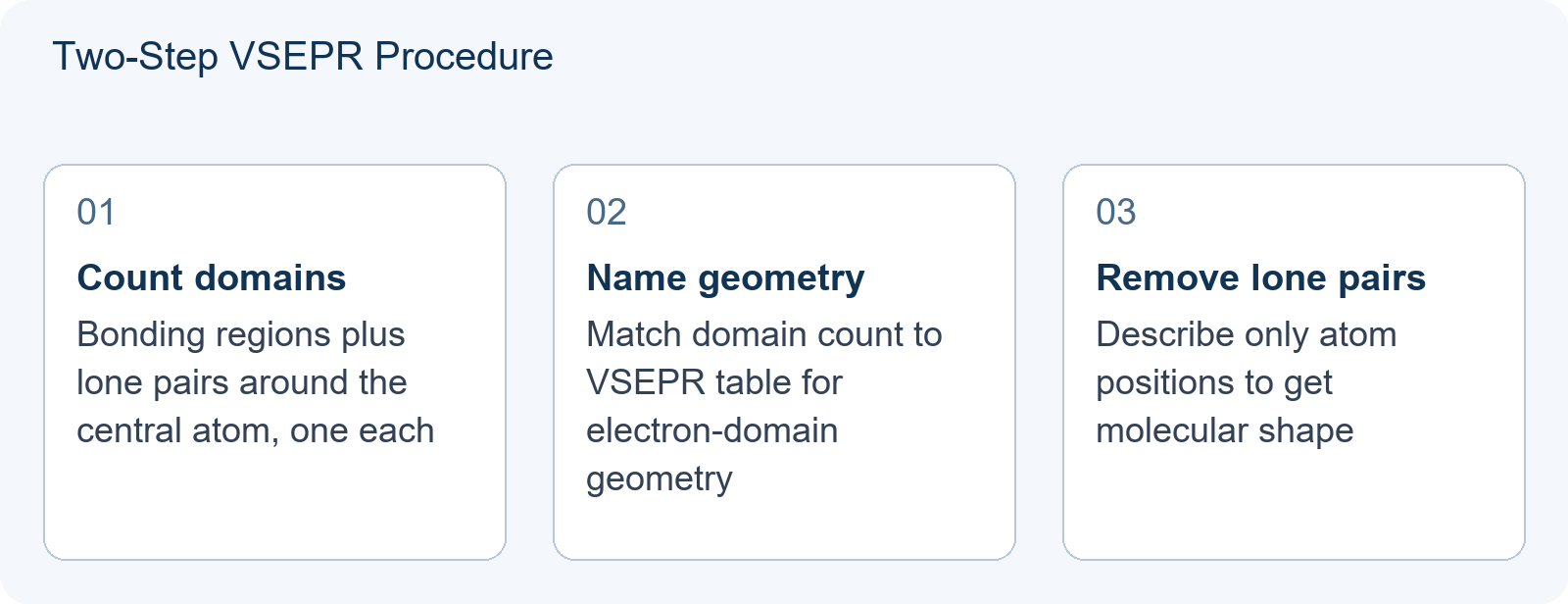
Step 1: Draw the Lewis structure and count electron domains around the central atom. A domain is a region of electron density: a single bond, double bond, triple bond, or lone pair each counts as one domain. Multiple bonds do not multiply the domain count.
Step 2: From the domain count, determine the electron-domain geometry using the standard VSEPR table: 2 domains → linear; 3 → trigonal planar; 4 → tetrahedral; 5 → trigonal bipyramidal; 6 → octahedral. Then, to obtain the molecular shape, remove the lone-pair positions and describe the arrangement of the remaining atoms.
Worked Example 1: Ammonia (NH3)
Lewis structure: nitrogen central, three N–H single bonds, one lone pair on nitrogen. Domain count = 4 (three bonding + one lone pair). Electron-domain geometry = tetrahedral. Molecular shape = trigonal pyramidal (three atoms at the corners of a tetrahedron, lone pair occupying the fourth position). The bond angle contracts from the ideal tetrahedral 109.5° to approximately 107° because lone-pair–bond-pair repulsion exceeds bond-pair–bond-pair repulsion. This ~107° value is the standard experimental reference; VSEPR correctly predicts the direction of distortion even though it is a qualitative model.
A Contrasting Case: Where Superficial Similarity Leads to Error
Worked Example 2: Xenon difluoride (XeF2)
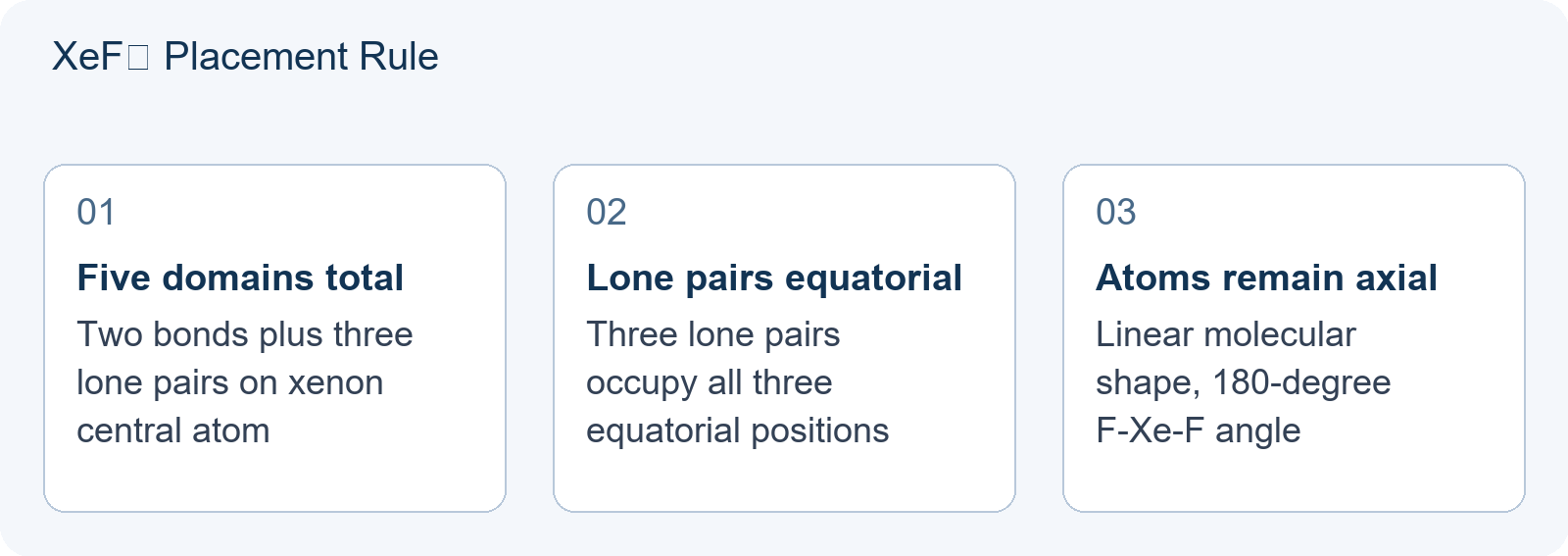
A student might reason: xenon is central, two Xe–F bonds, xenon has eight valence electrons, two used in bonds, six remain as three lone pairs. Domain count = 5 (two bonding + three lone pairs). Electron-domain geometry = trigonal bipyramidal. The student then concludes the molecular shape is “bent” or “linear” depending on which lone-pair arrangement they imagine.
The error: In a trigonal bipyramidal electron-domain geometry, lone pairs occupy equatorial positions to minimise 90° repulsions. With three lone pairs, all three must go equatorial—there is no alternative that keeps lone pairs apart. The two fluorine atoms occupy the axial positions, 180° apart. The molecular shape is therefore linear (F–Xe–F). A student who does not place the lone pairs correctly before removing them will misidentify the shape.
The equatorial placement is compulsory, not optional: each lone pair in an equatorial position experiences two 90° interactions with axial bond pairs, whereas an axial lone pair would experience three 90° interactions with equatorial bond pairs. Three lone pairs cannot all avoid each other in axial positions, so the equatorial arrangement is the only viable one. The molecular shape is unambiguously linear.
Another Checked Case: Sulfur tetrafluoride (SF4)
Sulfur central, four S–F bonds, sulfur has six valence electrons, four used in bonds, two remain as one lone pair. Domain count = 5 (four bonding + one lone pair). Electron-domain geometry = trigonal bipyramidal. The lone pair occupies an equatorial position because this gives two 90° lone-pair–bond-pair interactions, versus three such interactions if it were axial. Removing the lone pair, the four fluorine atoms occupy the remaining positions: two axial, two equatorial. Molecular shape = seesaw.
The ideal trigonal bipyramidal geometry has 90° axial-equatorial and 120° equatorial-equatorial angles. The actual structure distorts from these ideal values because the lone pair repels more strongly than bonding pairs, compressing the axial-equatorial angles on one side and expanding others. VSEPR predicts this qualitative distortion correctly, though exact angles require experimental measurement or computational methods.
The Common Failure Mode: Counting Domains Incorrectly
Students often miscount domains by treating multiple bonds as multiple domains or by forgetting lone pairs on the central atom. Consider CO2: carbon central, two C=O double bonds. Domain count = 2 (each double bond is one domain), not 4. Electron-domain geometry = linear. Molecular shape = linear. A student who counts four domains would predict tetrahedral, which is incorrect.
Conversely, for SO2: sulfur central, two S=O bonds, one lone pair on sulfur. Domain count = 3 (two bonding + one lone pair), not 2. Electron-domain geometry = trigonal planar. Molecular shape = bent. Forgetting the lone pair leads to predicting linear, which is wrong.
These errors are not arithmetic slips; they are procedural failures. The consistent rule is: count regions of electron density, not bonds or electrons.
Diagnostic: Test Your Current Understanding
Apply the two-step procedure to each species below. Check your answers before reading the solutions.
| Species | Central atom | Your domain count | Your electron-domain geometry | Your molecular shape |
|---|---|---|---|---|
| BF3 | B | ? | ? | ? |
| ClF3 | Cl | ? | ? | ? |
| BrF5 | Br | ? | ? | ? |
Solutions:
- BF3: Boron has three valence electrons, all in B–F bonds. Domain count = 3 (three bonding, no lone pairs). Electron-domain geometry = trigonal planar. Molecular shape = trigonal planar. Bond angles = 120°.
- ClF3: Chlorine has seven valence electrons, three in Cl–F bonds, four remain as two lone pairs. Domain count = 5 (three bonding + two lone pairs). Electron-domain geometry = trigonal bipyramidal. Lone pairs occupy equatorial positions (minimises lp–lp and lp–bp repulsion). Molecular shape = T-shaped.
- BrF5: Bromine has seven valence electrons, five in Br–F bonds, two remain as one lone pair. Domain count = 6 (five bonding + one lone pair). Electron-domain geometry = octahedral. Lone pair occupies any position (all equivalent in octahedral). Molecular shape = square pyramidal.
If you missed any of these, identify whether the error was in Lewis structure drawing, domain counting, geometry assignment, or lone-pair placement. Each failure mode has a specific remedy: practice Lewis structures, review the domain-counting rule, memorise the geometry table, or study the repulsion hierarchy (lp–lp > lp–bp > bp–bp).
What Your Diagnostic Result Means for Next Steps
If you answered all three correctly: You have reliable procedural knowledge. Your next task is speed—practice applying the two-step procedure under timed conditions, and extend to species with multiple central atoms or charged species (e.g., SO42−, XeO3F2).
If you missed one due to domain counting: Drill Lewis structures for 20–30 varied species. The The Periodic Table Is Provided. So What Should You Actually Memorise? A USNCO Recall System (2026) can guide your memorisation priorities.
If you missed one due to geometry-shape confusion: Create a personal table with columns for formula, central atom, domain count, electron-domain geometry, lone pairs, and molecular shape. Fill it for 15–20 species until the two-step procedure is automatic.
If you missed one due to lone-pair placement in trigonal bipyramidal or octahedral geometries: Focus specifically on the repulsion hierarchy. Work cases where multiple lone pairs force specific positions (e.g., XeF2, ClF3, XeF4, SF4).
Connecting to Broader USNCO Preparation
Molecular geometry feeds directly into polarity determination (dipole moment), intermolecular forces, and spectroscopic interpretation. A student who cannot reliably assign geometry will struggle with questions that ask whether a given compound has a dipole moment, or with interpreting IR and microwave data. The time invested in solidifying this two-step procedure pays dividends across multiple USNCO topics.
For students comparing competition options, see the USNCO vs UKChO: How the Two Biggest English-Medium Chemistry Olympiads Compare for guidance on which competition aligns with your strengths and preparation timeline.
Prospective families seeking structured preparation should note that the USNCO Registration Through an ACS Local Section: What the Coordinator Actually Needs From You requires coordination with a teacher or designated coordinator, and international students at U.S. high schools follow a specific route detailed in that guide.
Applying the Distinction to Polarity Prediction
Once you have correctly identified the molecular shape, the next logical step is determining whether the molecule possesses a net dipole moment. This requires combining geometry with bond polarity. A common error is assuming that any molecule with polar bonds must be polar overall. The spatial arrangement of those bonds determines if the individual dipoles cancel out.
Teaching Illustration: Carbon Dioxide vs. Sulfur Dioxide
Consider CO2. As established, it has two electron domains and a linear molecular shape (O=C=O). Each C=O bond is highly polar because oxygen is more electronegative than carbon. However, because the molecule is linear, the two bond dipoles point in exactly opposite directions (180° apart) and are equal in magnitude. They cancel perfectly. Therefore, CO2 is nonpolar despite having polar bonds.
Now consider SO2. It has three electron domains (two bonding regions, one lone pair), resulting in a bent molecular shape. The S=O bond dipoles do not point in opposite directions; they form an angle less than 180°. Consequently, the vector sum of the dipoles is not zero. The lone pair also contributes to the asymmetry. Thus, SO2 is polar.
Diagnostic Question
Predict the polarity of XeF4. Xenon has eight valence electrons. Four are used in Xe–F bonds, leaving four electrons as two lone pairs. Total domains = 6. Electron-domain geometry = octahedral. In an octahedral geometry, all positions are equivalent initially, but lone pairs will occupy positions to minimize repulsion. For two lone pairs in an octahedral arrangement, they must be trans (opposite each other) to maximize separation (180° apart). Removing the lone pairs, the four fluorine atoms lie in a single plane around the xenon center. Molecular shape = square planar.
Answer and Reasoning
XeF4 is nonpolar. Although each Xe–F bond is polar, the square planar geometry places the four fluorine atoms symmetrically at 90° intervals in a plane. The bond dipoles cancel pairwise across the center. The two lone pairs are also opposite each other, so their electronic contributions do not create a net asymmetry that survives the cancellation of the bond dipoles. If you had incorrectly predicted a seesaw or distorted shape, you might have wrongly concluded it was polar.
Next Practice Task
Select five species from your previous study list (e.g., BF3, ClF3, BrF5). For each, draw the Lewis structure, determine the molecular shape using the two-step procedure, and then sketch the bond dipole vectors. Visually assess whether the vectors sum to zero. Record your prediction (Polar/Nonpolar) and verify against reliable chemical data sources. Focus specifically on cases where lone pairs are present, as these often break symmetry unexpectedly.
Frequently Asked Questions
Does a double bond count as one domain or two in VSEPR?
One domain. A double bond and a single bond each occupy one region of electron density. Only the count of regions matters for electron-domain geometry, not the number of bonding pairs within the region.
Why does XeF₂ have a linear shape despite five electron domains?
The five domains give a trigonal bipyramidal electron-domain geometry. The three lone pairs occupy the three equatorial positions, leaving the two fluorine atoms in axial positions 180° apart. The molecular shape describes only atom positions, which are linear.
How can I avoid confusing electron-domain geometry with molecular shape under exam pressure?
Use the two-step procedure explicitly: write domain count first, name the geometry second, circle lone pairs, then state the shape. Practise this sequence until it is automatic, and verify with species where the two differ (NH₃, SF₄, ClF₃).