
For many high school chemistry enthusiasts, the dilemma of USNCO vs CCC is acute. With overlapping timelines and distinct academic profiles, preparing for both can dilute effort. If you must choose one, understanding the structural and eligibility differences is critical.
Format Reality Check: No Lab Components
A common misconception is that USNCO involves hands-on laboratory work during the initial selection phases. It does not. According to official guidelines, the USNCO Local Exam is a 60-question multiple-choice test lasting 110 minutes. Similarly, the Canadian Chemistry Challenge (CCC) consists of 25 multiple-choice questions. Neither competition’s entry-level exams require practical lab skills. The distinction lies in theoretical depth and question style, not experimental execution.
Difficulty and Scope: Breadth vs. Depth
| Feature | USNCO (Local/National) | CCC (Canadian Challenge) |
|---|---|---|
| Question Count | 60 MCQs | 25 MCQs |
| Time Limit | 110 Minutes | Varies by region (typically ~1 hour) |
| Curriculum Base | AP Chemistry + University Intro Level | High School Curriculum Core |
| Key Topics | Organic, Inorganic, Physical, Biochem | Equilibrium, Organic Basics, Electrochem |
| Difficulty Tier | Advanced (Top 0.1% signal) | Entry-Level (Foundation building) |
The USNCO vs CCC choice often comes down to your current academic standing. USNCO questions frequently exceed AP Chemistry scope, incorporating data from scientific journals and complex multi-step calculations. CCC is designed to be accessible to students mastering their high school syllabus, with roughly 70% of questions testing direct application of core concepts.
Eligibility: Citizenship and Residency
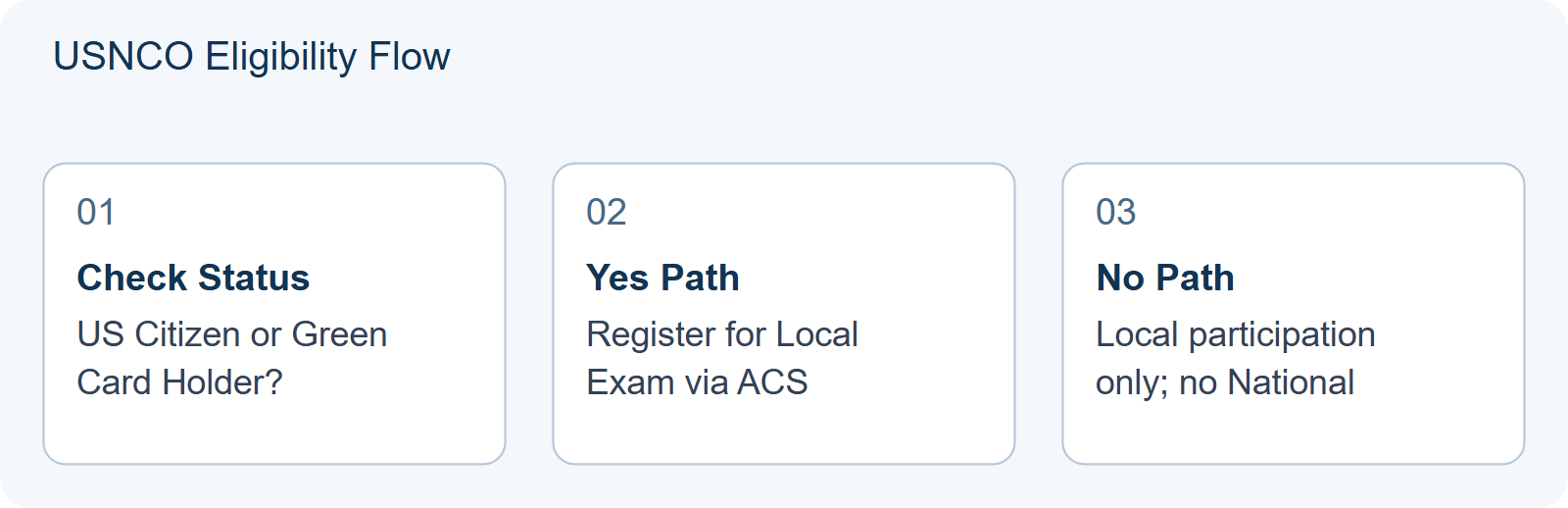
Eligibility is the most decisive factor for international students. For USNCO, the National Exam is restricted to US Citizens or Legal Permanent Residents (Green Card holders). A Chinese national holding a Green Card is eligible to advance to the National Exam. However, students without US citizenship or residency status may participate in the Local Exam depending on regional coordination but cannot proceed to the National stage. Always verify specific local section rules via the official route guide.
CCC has no such citizenship restrictions for participation, making it a viable option for non-US residents seeking international recognition within the Canadian system or as a stepping stone to CCO.
Strategic Choice: Who Should Pick What?
Choose USNCO If:
- You are a US Citizen or Green Card holder aiming for top-tier US universities (MIT, Caltech).
- Your chemistry knowledge extends beyond AP into university introductory levels.
- You thrive under time pressure with a high volume of questions (60 in 110 mins).
Choose CCC If:
- You are in Grades 8-10 and want a confidence-building introduction to competitions.
- You do not hold US citizenship/residency but want a recognized North American credential.
- You prefer a shorter exam format focused on core curriculum mastery.
Preparation Advice
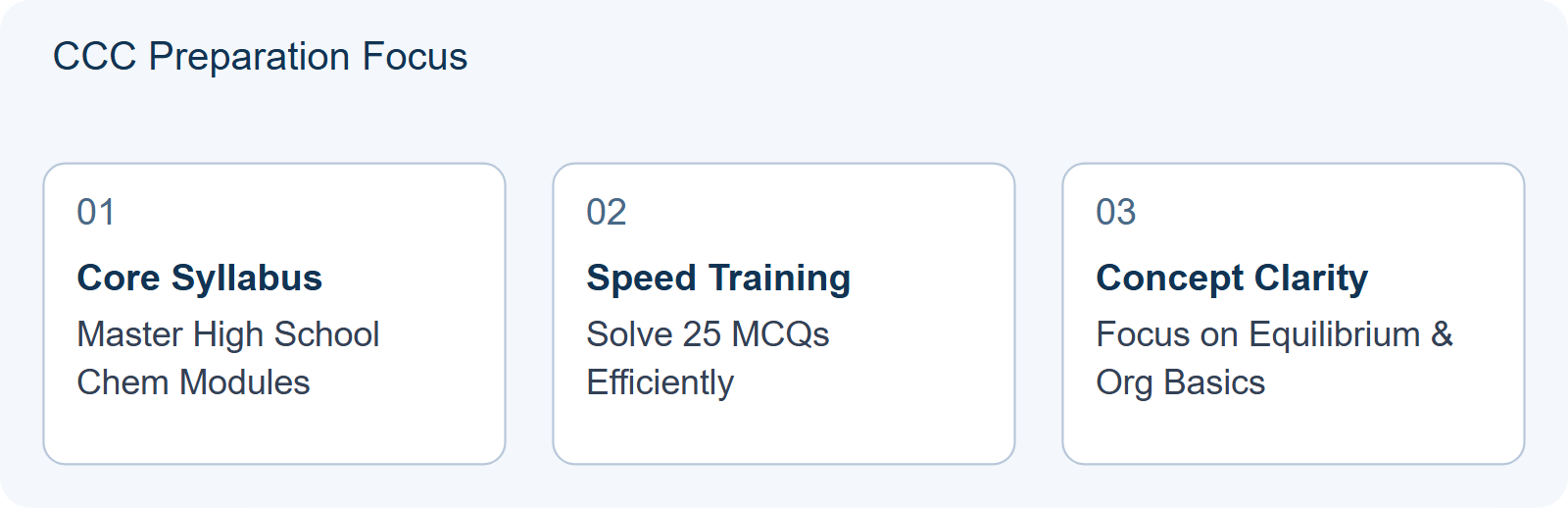
If you select USNCO, focus on topic-specific revision using past papers. The breadth of topics requires efficient recall systems, especially for periodic trends and organic mechanisms. For CCC, ensure your foundational understanding of equilibrium and stoichiometry is flawless, as these form the bulk of the easier questions.
Remember, neither competition offers a “lab” advantage at this stage. Success depends on theoretical agility and speed. Choose the path that aligns with your citizenship status and current academic depth.
HYPOTHETICAL/ILLUSTRATIVE: The “Two-Week Diagnostic” Decision Protocol
Choosing between USNCO and CCC is rarely a binary switch flipped in isolation; it is often a resource allocation problem. Consider the case of Alex, a Grade 11 student with strong AP Chemistry scores but limited extracurricular time. Alex faces the classic dilemma: attempting both dilutes preparation, while choosing wrong wastes a year. To resolve this without relying on external coaching or guessing, Alex implements a structured self-assessment protocol rather than simply reading about difficulty levels.
The core of this illustrative practice involves a controlled experiment using past papers from both competitions. Instead of studying new material, Alex dedicates two weekends to timed simulations. The first weekend focuses on a CCC sample set, emphasizing accuracy over speed. The second weekend tackles a USNCO Local Exam section, prioritizing rapid recall and multi-step calculation under strict time constraints. This approach transforms abstract advice about “breadth vs. depth” into concrete data points regarding personal cognitive load and endurance.
| Metric | CCC Simulation Outcome | USNCO Simulation Outcome | Decision Implication |
|---|---|---|---|
| Completion Rate | 100% (All questions attempted) | 85% (Left blank due to time) | USNCO requires faster processing speed. |
| Error Type | Conceptual gaps in equilibrium | Calculation fatigue / Panic | CCC needs targeted review; USNCO needs stamina training. |
| Confidence Level | High (Familiar territory) | Low (Unfamiliar organic mechanisms) | USNCO demands broader theoretical exposure. |
Alex’s results reveal a critical insight: while the content knowledge for CCC was largely present, the mental endurance required for USNCO was lacking. The errors in the USNCO simulation were not due to ignorance of chemistry, but rather an inability to manage the cognitive load of 60 questions in 110 minutes. Conversely, the CCC errors were specific knowledge gaps that could be closed with focused study. This distinction changes the decision matrix. If Alex had chosen USNCO based solely on prestige, they might have burned out trying to fix speed issues simultaneously with learning advanced topics. By recognizing that their bottleneck was endurance rather than foundational knowledge, Alex opted for CCC as a confidence-building step, planning to attempt USNCO the following year after strengthening their baseline speed through regular timed drills.
This example illustrates that the choice should not be driven by perceived status alone, but by diagnostic alignment. A reusable self-check for any student facing this crossroads is to ask: “Did I fail because I didn’t know the answer, or because I ran out of time?” If the latter dominates, the competition requiring higher throughput (like USNCO) may need more preparatory runway than currently available. If the former dominates, the competition testing deeper niche knowledge may require significant curriculum expansion. By treating preparation as a measurable variable rather than a static commitment, students can make strategic choices that align with their actual performance profiles, ensuring that their limited study hours yield the highest possible return on investment.
Choosing between USNCO and CCC requires assessing your specific chemistry strengths. If you prefer rigorous problem-solving, explore How to Start a USNCO Problem You Do Not Recognise. For those focusing on foundational accuracy, review Why You Keep Losing the Same Marks. Additionally, consider the logistical implications by reading What a Chemistry Olympiad Year Actually Costs to make an informed decision.
Frequently Asked Questions
Does USNCO have a practical lab round?
The Local Exam is multiple-choice, but USNCO also includes an experimental component at higher stages. Hanlin’s 20 June 2026 report describes USNCO’s laboratory work as a distinctive challenge, so preparation should cover laboratory reasoning and data handling alongside theory.
Can a Chinese citizen take the USNCO National Exam?
Only if they are also a US Citizen or Legal Permanent Resident (Green Card holder). Nationality alone does not exclude them if they meet the residency/citizenship criteria defined by ACS.
Is CCC easier than USNCO?
Generally, yes. CCC is aligned with high school curricula and has fewer questions (25 vs 60). USNCO covers more advanced topics and requires faster problem-solving under tighter time constraints per question.