
If a periodic table is on the desk, memorising atomic masses is wasted effort — and yet most students still revise as though nothing were provided. The useful question is narrower: which facts cannot be read off the table and cannot be derived under time pressure? That list is short, it is learnable in about three weeks, and everything else should be a method rather than a memory.
A provided table changes the question
A periodic table is provided for these papers, and the timing arithmetic explains why that matters so much. The Local Exam is 60 multiple-choice questions in 110 minutes, and Part I of the National Exam is 60 questions in 90 minutes — ninety seconds a question on the National paper, a little under two minutes on the Local, including reading. Equipment and materials rules are set by ACS and can change, so confirm the current ones on acs.org; if you are new to how the papers fit together, start with our overview of the competition and its structure.
At ninety seconds a question, the cost of a fact is not whether you know it but how long it takes to arrive. A fact you can produce in two seconds is free. A fact you can reconstruct in forty seconds is expensive but survivable once or twice a paper. A fact you cannot produce at all costs the whole question. Revision should therefore be organised by retrieval cost, not by topic — which is a different exercise from the topic-by-topic coverage planning most students already do.
The practical starting point is to look at what your table actually shows. Open a recent paper from your past-paper collection and read its front matter rather than skipping to question 1. A periodic table of the usual kind carries symbols, atomic numbers and atomic masses; whether anything else accompanies it is a question for the paper in front of you, and it is worth five minutes to find out rather than assume.
The three buckets: provided, derivable, memorised
Every fact you meet in a problem belongs in one of three buckets, and the entire method is deciding which one before making a flashcard. Getting the middle bucket wrong is what makes revision feel endless.
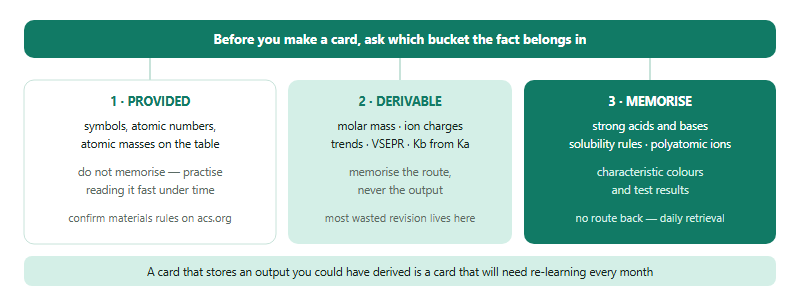
The triage matters because bucket two and bucket three fail in opposite ways. A student who memorises outputs instead of routes accumulates hundreds of brittle facts and still cannot answer an unfamiliar question. A student who tries to reason their way to a solubility rule in the exam simply stops, because there is nothing to reason from. In our own teaching this is one of the more reliable predictors of a plateau: when a student who practises diligently stops improving, their card deck usually turns out to be full of bucket-two material. That is our observation from coaching rather than an official statistic, and individual results vary.
The list that genuinely has no route back
Bucket three is much shorter than most revision guides imply. The table below is in priority order — if you only get through the first three rows before your next paper, you will still have taken most of the available gain.
| Priority | What to know cold | Why it cannot be derived | Rough cost | Where it pays on the paper |
|---|---|---|---|---|
| 1 | The strong acids and the strong bases, as a closed list | Strength is an empirical property, not a position on the table | One evening | Every pH question; decides whether you need an equilibrium constant at all |
| 2 | Solubility rules, including the exception sets for halides and sulfates | They are experimental regularities with named exceptions | Two evenings | Precipitation, net ionic equations, qualitative analysis, Ksp questions |
| 3 | Common polyatomic ions: formula, charge, name | Charges are not readable from group number | Three sessions | Formula writing, balancing, naming — a bottleneck everywhere |
| 4 | Characteristic colours: solutions, precipitates and flame tests | Purely observational | One evening | The descriptive and laboratory questions, where a colour is often the whole clue |
| 5 | Two or three acid–base indicators and roughly where each changes | Transition ranges are measured, not predicted | Thirty minutes | Titration questions that ask which indicator suits which curve |
| 6 | Common laboratory apparatus and what each measures precisely | Convention and design, not theory | Thirty minutes | Laboratory questions and any question about experimental error |
Two notes on the list. First, the naming ladder deserves special mention because it looks like memorisation and is actually a route: once you know the parent form of an oxyanion, the prefixes and suffixes that indicate one more or one fewer oxygen follow a fixed pattern, so learning one member of a family gives you four. Learn the pattern and one anchor per family rather than sixteen separate names. Second, resist adding reaction lists. A list of specific reactions is the least transferable thing you can memorise, because the exam rewards applying a small number of ideas to an unfamiliar case, and no list is ever long enough.
Routes worth owning, and where students store the wrong end
Bucket two is where the leverage is, because one route replaces dozens of facts. The routes below are each worth rehearsing until they run without conscious effort:
- Molar mass from the provided table, including the discipline of writing the formula out first. This is the single most common place a correct method produces a wrong number.
- Main-group ion charge from group position, with the transition metals treated as the exception set they are.
- Electron configuration and every periodic trend from position, reasoned through effective nuclear charge and shielding rather than recalled as a picture of arrows.
- Molecular shape and bond angle from the count of electron domains, with lone pairs treated as domains — the route that turns a shape question from recall into a ten-second derivation.
- Kb from Ka through the ion-product of water, so a question that gives you one constant has already given you both.
- Oxidation numbers from the rule hierarchy, applied in order rather than guessed, which is what makes an unfamiliar redox equation balanceable.
- Free energy from enthalpy and entropy, and the equilibrium constant from free energy, so the thermodynamic and equilibrium questions stop being separate topics.
The diagnostic for whether a route is genuinely yours is not whether you can recite it. It is whether you can apply it to a species you have never seen. Take an unusual formula from a past paper, derive its shape and its oxidation numbers cold, and see how long it takes. If the answer is more than about thirty seconds, the route is still stored as a set of examples rather than as a procedure.
Eight minutes a day: getting bucket three into recall
The reason revision fails here is almost never effort. It is that rereading a list produces recognition — the comfortable feeling of having seen something before — while an exam demands recall, production from nothing. Recognition rises quickly and predicts almost nothing. The only reliable fix is retrieval: closing the book and writing the list from a blank page.
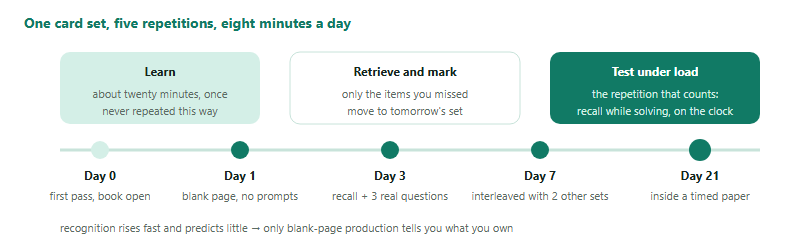
Three rules make the schedule work. Only the misses carry forward, so the daily set shrinks rather than grows. Sets are interleaved from day seven onwards, because a set you can predict is a set you are recognising. And the final repetition happens inside a real timed question, not on a card — retrieval under load is a different skill from retrieval at rest, and the exam only tests the first one. Our compiled past-paper pack is what makes that last step possible, since it lets you pull questions that use a given card set across many years; worked solutions are available for some years rather than all, so use the archive as retrieval practice first. Our guide on how to work through the past papers covers the wider method.
Finally, the honest note on who can sit these papers, because it changes what the work is for rather than whether it is worth doing. A student who is not a US citizen or permanent resident but attends a US high school may sit the Local Exam, and ACS states such students cannot be nominated to sit for the National Exam. A US citizen or permanent resident at an accredited American-curriculum school abroad, including inside mainland China, for at least a year and under 20, can run the full route through an ACS International Chemical Sciences Chapter. A student on a Chinese passport at a mainland-China school has no ACS entry route; our eligibility guide sets out all three cases. The recall system above is worth building in every one of those cases, because the six items in bucket three are assumed by every chemistry course and every chemistry competition that follows.
Frequently asked questions
Is a periodic table provided in the USNCO?
A periodic table is provided. Materials and equipment rules are set by ACS and can change, so confirm the current rules on acs.org.
Should I memorise atomic masses or solubility rules first?
Solubility rules. Atomic masses are on the table in front of you; solubility rules have no route back and appear across several question areas.
How many flashcards should a chemistry olympiad deck have?
Far fewer than most students build. If a card stores something you could derive from the table or a rule, it should be a method instead.
How do I know a fact is genuinely in recall?
Produce it from a blank page, then produce it again mid-problem on a timed paper. Recognition while rereading proves nothing.
This is the USNCO information desk, synchronising official ACS information for chemistry students in China, operated by Hanlin Education. The USNCO is run by the American Chemical Society (ACS), which sets all official rules and eligibility. Always confirm current details on acs.org. Errors are corrected within 7 working days of notice.