
Strong students prepare for the topics that frighten them and lose marks on the topics that do not. Moles, solution concentration and gas behaviour feel finished by the end of Grade 10, so they get almost no revision time — and then they appear inside almost every hard question as a first or last step, under time pressure, with a unit change hidden in the stem. This is how to close that band.
Why the foundation band leaks marks in an exam it cannot leak in class
In a school test, a stoichiometry question is a stoichiometry question. You know what is coming, the numbers are friendly, the units are the ones your teacher always uses, and you have enough time to check. Under olympiad conditions three things change at once, and each of them attacks this band specifically.
First, the calculation is rarely the question — it is step three of five. A problem about a buffer, a cell potential or a reaction mechanism will still require you to convert a mass of an impure solid into moles somewhere in the middle, and an error there propagates silently to the end. You do not get a wrong-looking answer; you get a plausible-looking wrong answer.
Second, the conditions move. School problems tend to use one set of units and one set of standard conditions all year. Competition problems change pressure units between questions, quote a solution as a mass percentage with a density instead of a molarity, or hand you a solid as a hydrate. None of that is harder chemistry. It is the same chemistry with the comfortable defaults removed.
Third, there is no partial credit on the multiple-choice paper, and in our experience the distractors tend to mirror exactly these slips. An option corresponding to “forgot the stoichiometric coefficient” and an option corresponding to “used the anhydrous molar mass” are usually both on the list, waiting. A student who is strong on thermodynamics and careless on unit handling will score below a student who is average on both.
The mole is the exchange rate, and everything else is a conversion
The single most useful reframing for this band is to stop treating moles, molarity, gas volumes and particle counts as four topics. They are four currencies with one exchange rate. A quantitative problem, however exotic its surface, almost always has the same three-part shape: convert what you are given into moles, apply the ratio the balanced equation or the formula demands, convert moles into whatever the question asked for.
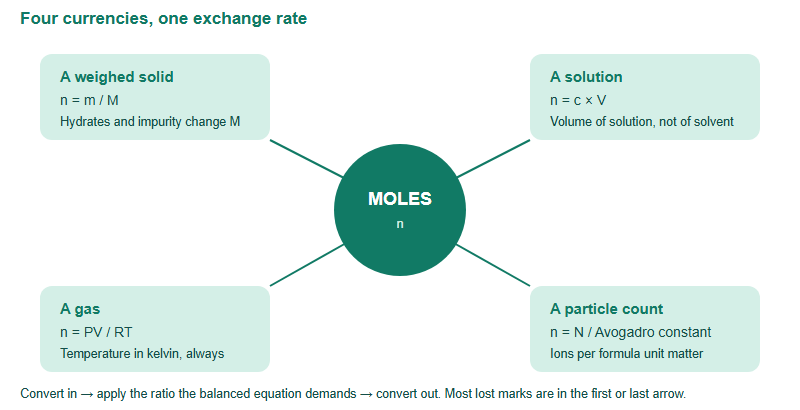
Two habits follow from that picture. Write the conversion you are doing before you do it, even in rough — a line reading “mass → mol” costs two seconds and prevents the commonest silent error. And identify the limiting reagent by dividing each reagent's moles by its stoichiometric coefficient, never by comparing raw mole numbers, which is only valid when the coefficients happen to be equal.
Solutions: four ways to say “how much”, and the two that get confused
Concentration is where we most often see a genuine gap open up for students on a Chinese curriculum, not because the chemistry is unfamiliar but because school work tends to live almost entirely in molarity. Competition problems use all four languages below and expect you to move between them with a density.
| Language | Definition | Where it turns up | The trap |
|---|---|---|---|
| Molarity, c | Moles of solute per litre of solution | Titration, equilibrium, osmotic pressure | Dividing by the volume of solvent added rather than the final solution volume |
| Molality, b | Moles of solute per kilogram of solvent | Freezing-point depression, boiling-point elevation | Reading it as molarity; the two are close only in dilute aqueous solution near room temperature |
| Mole fraction, x | Moles of one component divided by total moles | Raoult's law, partial pressures in gas mixtures | Forgetting that an electrolyte contributes more than one mole of particles |
| Mass percent and ppm | Mass of solute per mass of solution | Reagent-bottle labels, analytical and environmental data | Converting to molarity without using the density that the question supplied for exactly that purpose |
Colligative properties are the pay-off for getting molality right. Freezing-point depression and boiling-point elevation are proportional to molality, not molarity, and both carry the van't Hoff factor for a solute that dissociates: one formula unit of sodium chloride notionally contributes two particles, calcium chloride three. Notionally, because ion pairing means measured factors fall short of the ideal integer, and a well-designed problem will ask you to notice that gap rather than to quote it.
Osmotic pressure runs on molarity rather than molality, which is a small asymmetry worth memorising, because it is the kind of detail that decides a multiple-choice item in fifteen seconds.
A worked case that shows how much a single reading error costs. Suppose you dissolve 2.50 g of copper(II) sulfate pentahydrate and make the solution up to 100.0 mL. Using the molar mass of the hydrate, about 249.7 g per mole, gives roughly 0.0100 mol and therefore a copper(II) concentration of about 0.100 mol per litre. Using the anhydrous molar mass of about 159.6 instead gives about 0.157 mol per litre — a fifty-six per cent error produced entirely by ignoring five water molecules that were written on the label.
Gases: read the conditions, never assume them
The ideal gas law is the most reliable single relation in this band, and the most reliably misapplied, because students carry a memorised molar volume instead of reading the stated conditions. A molar volume of about 22.4 litres per mole corresponds to one atmosphere and 273.15 K. The current standard pressure of 100 kPa at the same temperature gives about 22.7 litres per mole instead. Neither number is a law of nature; both are consequences of the conditions someone chose. The habit to build is simple: if a question states a pressure and a temperature, use them, and never substitute a remembered volume for the conditions in front of you.
The other gas ideas that recur are worth listing compactly, because each of them turns up as a single step inside a longer problem rather than as a question of its own.
- Partial pressures. Each component contributes its mole fraction of the total pressure. This is the connection between a gas-phase equilibrium expressed in pressures and the same equilibrium expressed in concentrations.
- Gas collected over water. The measured total pressure includes water vapour. The pressure of the gas you actually made is the total minus the vapour pressure of water at that temperature, which the question will supply. Students who skip this step are systematically high on yield.
- Density as a route to molar mass. Rearranging the ideal gas law gives molar mass from density, pressure and temperature. This is the standard way an unknown gas gets identified, and it is worth being able to do without hunting for the rearrangement.
- Effusion. Lighter molecules effuse faster, with rate scaling as the inverse square root of molar mass. This is a favourite because it can be asked qualitatively in one line.
- Real behaviour. Deviation from ideality grows at high pressure and low temperature, where molecular volume and intermolecular attraction stop being negligible. You are more often asked to explain the direction of a deviation than to compute one.
A short numerical check you can do in your head as a sanity test: 0.500 g of a gas occupying 245 mL at 100.0 kPa and 300 K works out at roughly 9.8 millimoles, and so a molar mass near 51 g per mole. If your arithmetic gives you 5 or 500, you have a unit-conversion error, not a chemistry error — and knowing which of the two you have is half of the repair.
The five reads before you compute, and how to drill them
The fix for this band is not more content. It is a fixed, fast reading protocol applied before any arithmetic starts. Five questions, roughly fifteen seconds, executed in the same order every time until it stops feeling like a checklist.
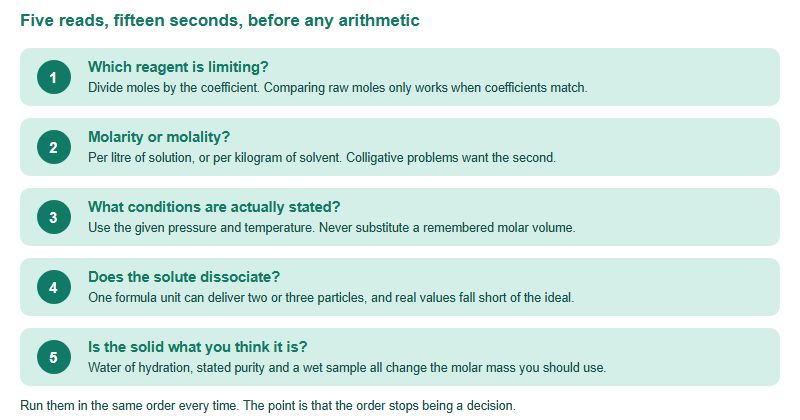
To drill it, do not do more mixed practice. Do the opposite: take a set of quantitative items and, for a week, answer only the five reads for each one without finishing the calculation. Twenty problems read properly in forty minutes trains the protocol far faster than five problems solved slowly. Then reintroduce the arithmetic and check whether your error pattern has moved. The pack of past papers we have gathered is the right source material for this, and the method for mining papers rather than merely attempting them is set out in our guide to using them.
One caveat about what this band can and cannot do for you. Closing it will not, by itself, move you from an ordinary score to a strong one; the hard topics still decide the top of the distribution. What it does is stop you from arriving at the hard topics having already given away marks you knew how to keep. If you are new to the competition and want the structure of the paper before the tactics, start with our overview. And whatever you read here, the syllabus and rules are ACS's, so confirm them on acs.org.
Frequently asked questions
Is 22.4 litres per mole wrong?
Not wrong, just conditional. It corresponds to one atmosphere and 273.15 K. Use the pressure and temperature the question actually states.
When do I need molality rather than molarity?
Freezing-point depression and boiling-point elevation run on molality. Osmotic pressure runs on molarity. That asymmetry is worth memorising.
How much of the paper is this band?
ACS publishes the syllabus, and we will not invent a percentage. Treat this band as something that appears inside other questions rather than as a topic quota.
My method is right but my answers are wrong. Where do I start?
Almost always units or a hydrate. Rework ten recent errors and label each as chemistry, arithmetic or reading before changing anything.
This is the USNCO information desk, synchronising official ACS information for chemistry students in China, operated by Hanlin Education. The USNCO is run by the American Chemical Society (ACS), which sets all official rules and eligibility. Always confirm current details on acs.org. Errors reported to us are corrected within 7 working days.