If you hold a US passport or green card and study at an accredited American-curriculum school in China, you are not in the group that cannot enter. ACS provides a route for US citizens and permanent residents living abroad, and it runs through an ACS International Chemical Sciences Chapter rather than through a US-based local section. This article covers that one case: the four conditions, who confirms each, and what to do when the route is not available.
First work out which of the three cases you are in
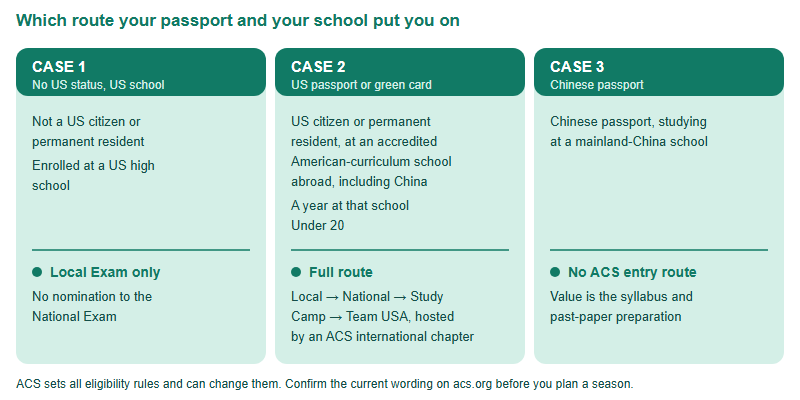
USNCO eligibility is often discussed as a single yes-or-no question, which is why so many families in China get it wrong in both directions — some assume they can register when they cannot, and some assume they are excluded when they are not. The rules ACS publishes describe three separate positions, and they turn on passport status first, geography second. Our fuller explainer is here; the summary below is the part you need before reading the rest of this article.
| Your legal status | Where you study | What ACS allows |
|---|---|---|
| Not a US citizen or permanent resident | Enrolled at a US high school | May sit the Local Exam. ACS states that such students take part in the Local Exam only, with no possibility of being nominated to sit the National Exam |
| US citizen or permanent resident | An accredited American-curriculum school abroad, including inside mainland China | The full route — Local, National, Study Camp and the Team USA selection that follows — organised through an ACS International Chemical Sciences Chapter, subject to the conditions below |
| Chinese passport, no US permanent residency | A mainland-China school | No ACS entry route. The value is in the syllabus and in preparing with past papers, not in registering |
Everything below is about the middle row only. If you are in the third row, the honest position is that no school letter, agent or fee changes it, and the rest of this article will not help you enter — though the preparation sections of this site still will.
What an ACS International Chemical Sciences Chapter is, and why the route runs through it
Inside the United States, the competition is administered geographically. Students enter through the ACS local section that covers where their high school is located — not one they choose, and not the one with the most convenient date. That single design decision is what makes the overseas case work the way it does.
Abroad, the equivalent administrative body is an ACS International Chemical Sciences Chapter. ACS's published guidance for US citizens living abroad states that a local and national competition “must be organized by an ACS International Chemical Sciences Chapter”. Read that sentence carefully, because it carries the whole practical consequence of this article: the chapter is not a membership club you join for the certificate, it is the body that has to actually run both stages of the exam where you are.
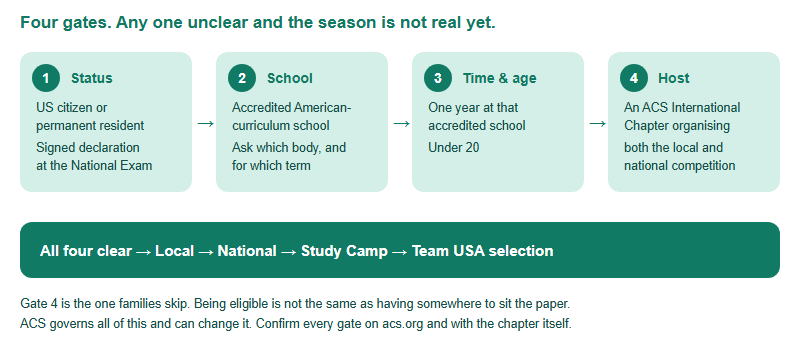
The consequence is uncomfortable but worth saying plainly. Eligibility on paper and a seat in an exam room are two different things. A student can satisfy every condition ACS lists and still have nowhere to sit the paper, because no chapter is administering the competition in that city. This is the single most common way a well-prepared family loses a year: they confirm the passport rule, assume the rest, and start looking for a registration link in the spring.
The route is not theoretical, though. ACS's own published results have included students who entered through an international chapter based in China — a school in Shanghai has appeared in the national-level results ACS publishes. So the honest position is: this is a real, working route for a small number of students, and whether it is open to you this season is a question with a specific answer that a specific person can give you.
The four conditions, and what each one actually means
ACS sets out four things for this case. None of them is negotiable, and three of them are checkable months in advance.
- Legal status. You must be a US citizen or a permanent resident. At the National Exam this becomes a hard, documented rule: a signed declaration of legal status is required, and ACS states that exams cannot be accepted without that signed document. There is no version of this where a strong score substitutes for the paperwork.
- An accredited American-curriculum school. The school has to be accredited, and ACS names the accrediting bodies it recognises — the list it publishes includes MSACS, WASC, SACS, NEASC, NCASC and NACS. Confirm the current list on acs.org rather than trusting this article a year from now.
- Time at that school. You must have been at the accredited school for a year. For families who move schools mid-cycle, this is a planning constraint, not a formality — a transfer in Grade 11 can push the first eligible sitting a full year later than expected.
- Age. You must be under 20.
A word on the accreditation condition, because it is where most of the confusion sits in China. A school having “international division”, “American programme” or a US-sounding name in its title tells you nothing about accreditation. Accreditation is a status granted by a named body for a named term. The usable question to ask your school is not “are we accredited?” but “which body accredits us, and when does the current term run to?” A school that cannot answer that in one email is telling you something.
The verification checklist: who to ask, and what a real answer sounds like
Most families ask the wrong person and accept the wrong kind of answer. A school registrar will happily say “yes, our students do chemistry olympiads” without knowing whether the specific exam in question is administered anywhere near you. Below is the version of the conversation that actually produces information. Run it in the autumn, not in the spring.
| What you need to know | Who can answer it | A usable answer | A non-answer to push back on |
|---|---|---|---|
| Is our school accredited, and by whom? | School principal or accreditation officer | A named accrediting body and a current accreditation term | “We follow the American curriculum” |
| Is a chapter administering the competition where we are? | The chapter, or ACS via acs.org | A named chapter, a named coordinator, and a stated intention to run it this cycle | “I think there is something in Shanghai” |
| Does that chapter run both the local and the national stage? | The chapter coordinator | Confirmation of both stages, because progression needs both | Silence on the national stage |
| What does the legal-status declaration require? | The chapter coordinator, following ACS rules | The specific document and the deadline for returning it signed | “Bring your passport on the day” |
| When does registration open and close for this cycle? | The chapter coordinator | Dates in writing, for this cycle, not last year's | A date copied from a forum post |
| Where is the exam physically sat? | The chapter coordinator | A venue and a date, so travel and school absence can be planned | “We will let you know closer to the time” in March |
One more caution that has cost students real money. A commercially run “China round” of a US olympiad is not automatically the ACS competition, and paying an agency does not create eligibility that ACS has not granted. If a programme is offering you entry, the question to ask is which ACS body is administering it and under what chapter. If that question produces a marketing brochure rather than a name, treat the answer as no.
If there is no chapter route, and what the route does not change anyway
Suppose you work through the four gates and gate four fails: nobody is administering the competition where you are. That is a real answer, and it deserves a real response rather than a year of hoping. The useful moves are: ask your school to write to ACS directly, since an accredited school is a more credible correspondent than a family; and in the meantime, decouple your preparation from your entry status entirely.
This matters because the preparation has independent value, and because it is available to every reader of this site including students in the third row of the table above. The syllabus ACS publishes is a serious specification of what a strong pre-university chemist should know, and the papers are among the best training material in English at that level. The pack of past papers we have gathered, and the four-step method for working through them rather than merely reading them, is set out in our guide to using them. Students who train on that material do measurably better in AP, A-Level and IB chemistry, and arrive at first-year university chemistry with a genuine advantage — which is a return that does not depend on any registration form.
Finally, a corrective for students who do clear all four gates and feel that the hard part is over. It is not. Clearing the gates is administration. The exam itself is the same exam, marked to the same standard, sat by students who have often been training for years. Nothing about the international route makes the chemistry easier, and nothing about it changes the shape of the paper — the three parts, the syllabus and the standard are described in our overview of the competition. Being allowed to sit a paper and being ready to sit it are separate projects, and the second one takes longer.
Frequently asked questions
I have a US passport but my school in China is not accredited. Can I still enter?
The accredited-school condition is part of the route ACS sets out for citizens abroad. Ask your school which body accredits it, then confirm with acs.org.
Does joining an ACS chapter as a member make me eligible?
No. The chapter matters because it administers the competition where you are, not as a membership credential. Eligibility comes from the ACS rules.
I moved schools last year. Does the one-year condition restart?
The condition refers to time at the accredited school. Confirm how it is applied in your case with the chapter coordinator and on acs.org before planning.
Can my parents' green cards make me eligible?
The condition is about the student's own status as a citizen or permanent resident, and it is documented by a signed declaration at the National Exam. Confirm on acs.org.
This is the USNCO information desk, synchronising official ACS information for chemistry students in China, operated by Hanlin Education. The USNCO is run by the American Chemical Society (ACS), which sets all official rules and eligibility. Always confirm current details on acs.org. Errors reported to us are corrected within 7 working days.