
Most school chemistry olympiad efforts fail the same way. A keen teacher starts a club, a dozen students come, the strongest ones do well, the teacher changes school and the whole thing evaporates. A programme is different from a club in three respects: it has a defined cohort, it survives the person who started it, and it knows before it starts who can actually enter what.
A club runs events; a programme builds capability
The distinction matters because it changes what you build first. A club optimises for the current cohort: interesting problems, a mock exam, some medals if the year group happens to be strong. A programme optimises for the school's capability three years out — the number of staff who can mark a free-response script, the paper library that does not leave in a suitcase, the Grade 9 pipeline that means next year is not a lottery.
This article assumes you are a head of chemistry, a science coordinator or the teacher who has just been handed “can we do chemistry olympiad?” It is written from working alongside chemistry departments at international schools in China, and it deliberately does not re-explain how to run a single mock event, which is a component rather than a programme. For the exam itself and how its tiers fit together, see our overview of the USNCO; the competition is run by ACS, which sets all rules, so confirm current details on acs.org.
One framing point before the build. The most valuable output of a school chemistry programme is not a medal count. It is a group of students who can read a hard problem without flinching, hold a multi-step calculation together, and write an argument a stranger can follow. Those students then do better in school chemistry, in university applications generally, and in first-year university chemistry specifically. If the programme is designed around medals, it will be fragile, because medals depend on which students happened to enrol in your school that year. If it is designed around capability, it compounds.
Get the entry routes right before you promise anything
This is the step schools skip, and it is the one that causes genuine harm — a student trains for a year on the understanding that they will sit an exam they were never eligible to sit. Entry to the USNCO is governed by ACS, and it depends on passport status and school, not on geography or effort. There are three separate cases and they must not be collapsed into one another.
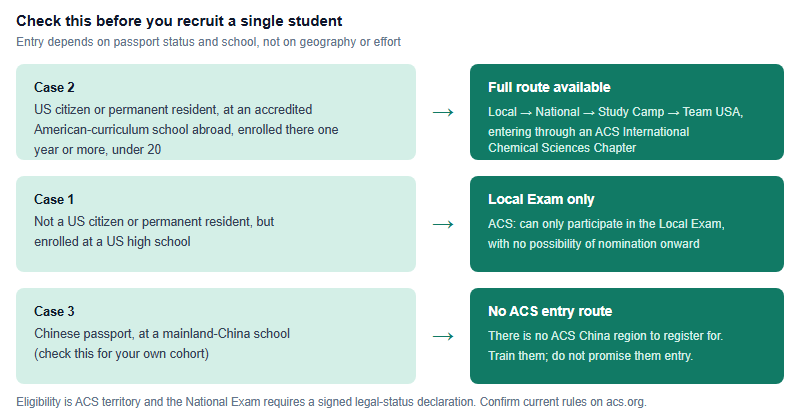
Two governance habits follow from that chart. First, ask about passport status and school-enrolment history before the recruitment assembly, not after, and phrase the programme's promise accordingly — “training to this standard” is a promise you can keep for everyone, while “you will sit this exam” is not. Second, record the accreditation status of your own school and the enrolment date of any student who may use the citizens-abroad route, because the one-year condition attaches to that date and a Grade 11 transfer student may fall on the wrong side of it. The full position, including the accreditation bodies ACS lists, is in our eligibility guide; treat acs.org as the authority and re-check it every season, because rules can change and a school that promised on last year's reading is the one that gets caught.
The three-year build
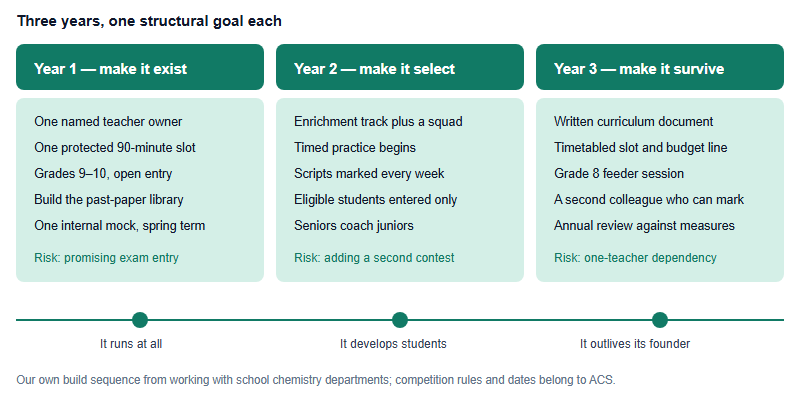
The sequence below is deliberately slow in year one. Programmes that try to do stratification, timed practice and exam entry in their first year usually produce a strong first cohort and nothing behind it.
| Year | Cohort | Weekly rhythm | Deliverable by year end | What you deliberately do not do |
|---|---|---|---|---|
| Year 1: exist | Grades 9–10, open entry | One protected 90-minute session | A paper library, a named owner, one internal mock | No selection, no timed practice, no entry promises |
| Year 2: select | Broad enrichment track plus a small squad | Enrichment session plus a squad session; weekly marked scripts | Squad students who can write a followable solution; eligible students entered | No expansion of scope; no second competition added |
| Year 3: survive | Grades 9–12 with a Grade 8 feeder | Same rhythm, now timetabled rather than voluntary | A written curriculum document and a second staff member who can mark | No dependence on one teacher or one strong year group |
Staffing, timetable and materials: the constraints that decide it
It is worth being concrete about what year one actually looks like week to week, because “build a base” is the kind of instruction that quietly becomes nothing. A workable first term is six sessions: two spent on quantitative fundamentals at a level above the school course, two on a single topic taken properly deep — thermodynamics is the usual choice — one on how to write a solution that another person can follow, and one on a short set of problems the students take away and return marked. That is enough to find out which students will still be there in February, which is the only question year one really has to answer.
Marking is the bottleneck, not teaching. Anyone can set a problem set. Marking a free-response script properly — reading the argument, not just checking the final number — takes us fifteen to twenty minutes per script, and that is the figure to budget against. A squad of eight is two to three teacher-hours of marking per round, on top of the sessions themselves. That number is why year three's “second colleague who can mark” is a structural goal rather than a nicety: a programme with one marker has a single point of failure and an implicit cap on squad size.
Protect the slot, and pick the term honestly. A voluntary lunchtime session loses to every fixture, rehearsal and revision clinic in the calendar. Even in year one, get the slot written down. And be realistic about the shape of the year: in recent seasons the exam window has fallen in late winter and early spring — confirm the current dates on acs.org — which means the intensive block lands in the same months as internal mocks and, for Grade 12s, applications. Plan the heavy training for the autumn and treat the spring as sharpening.
Materials are cheaper than people think. A programme needs the current syllabus, one good general chemistry text, and an organised library of past papers. We keep a gathered and organised pack of papers for exactly this purpose, with worked solutions for some years only, and how you use papers matters far more than how many you have — a school that works six papers properly beats one that distributes thirty. Where a student is eligible to enter, any registration arrangements and costs sit with the relevant ACS local section or chapter; confirm those on acs.org rather than budgeting from hearsay.
What to measure, and the conversation with parents
Medals are a bad primary measure for a school programme because they are dominated by which students enrolled in your school, and because most of your cohort may have no entry route at all. These measures track what you actually control:
- Retention from Grade 10 to Grade 11. The single best indicator of programme health. Students leave when sessions stop being useful, long before they say so.
- Proportion of squad who complete a timed section without unattempted questions. A hard, honest fluency measure that improves with training.
- Number of students who can write a followable solution, judged by handing scripts to another student. This is the skill that transfers to everything else.
- Staff capacity: how many colleagues can mark a script. Two is resilient; one is a countdown.
- Downstream chemistry: uptake of the harder chemistry option, and students continuing to chemistry-adjacent study. Slow to move, and the reason the programme is worth funding.
The parent conversation should be held in the first term, not in the second. Three things belong in it. Entry depends on passport status and school, and for many students in a China-based cohort there is no ACS route — say so plainly and explain what they gain instead. No programme, ours or anyone's, can promise a result or an admissions outcome; competition performance is one signal among many and universities read it as such. And the time cost is real: three to five hours a week during the heavy block, which has to come out of something. Parents respond well to that conversation. What they respond badly to is discovering in March that their child was never eligible to sit the exam they trained for.
Frequently asked questions
How many students do we need to start?
Six to eight committed students is plenty for year one. Large open clubs look healthy and produce less than a small consistent group.
Should we enter students in the first year?
Usually not. Year one is for building the library, the rhythm and the owner. Entry belongs in year two, for eligible students only.
What if most of our students cannot enter?
Train them anyway, and say so honestly up front. The chemistry, the writing and the problem-solving transfer regardless of route.
How do we stop it collapsing when a teacher leaves?
Write the curriculum down and train a second marker. Everything else in a programme can be rebuilt; those two cannot be rebuilt quickly.
This is the USNCO information desk, synchronising official ACS information for chemistry students in China, operated by Hanlin Education. The USNCO is run by the American Chemical Society (ACS), which sets all official rules and eligibility. Always confirm current details on acs.org. Errors reported to us are corrected within 7 working days.