
Structure, bonding and periodic trends are the fastest marks on any chemistry olympiad paper. The questions are short, the reasoning is deterministic, and a trained student answers most of them in well under a minute. They are also the marks students quietly lose, because this cluster gets revised in the first month, assumed known, and never drilled again.
The fast-marks cluster nobody re-drills
Ask a student preparing for a chemistry olympiad what they are working on and you will hear thermodynamics, equilibrium, organic mechanisms, kinetics. You will almost never hear electron configuration or VSEPR. Those got covered in the first weeks of the course, felt easy, and dropped off the revision rota permanently.
That is a scoring mistake, and the arithmetic of it is simple. The multiple-choice section of the National Exam runs 60 questions in 90 minutes, per the format the American Chemical Society publishes — an average of ninety seconds per question across every topic, so confirm current details on acs.org before you plan around any number. A hard equilibrium item might legitimately need two minutes. The only way to afford that is to bank time on questions that should take thirty seconds, and structure-and-bonding items are exactly those questions. Every one you answer slowly, or wrongly, is paid for twice.
There is a second reason to take this cluster seriously. It is predictive. Once you can read a periodic position and infer size, ionisation energy and electronegativity, you can predict bond polarity, acid strength, lattice energy, oxidising power and solubility behaviour without memorising any of them separately. Students who skip this cluster end up memorising four times as much downstream. For the structure of the competition itself, see our overview of what the USNCO is.
Atomic structure: the four things that actually get tested
The syllabus area is broad but the examinable core is narrow. Four items carry almost all of it.
Electron configuration, written from position rather than recited. You should be able to place any main-group element without counting from hydrogen, and you should know the two familiar transition-metal exceptions — chromium and copper — as consequences of half-filled and filled d subshells rather than as facts to be remembered. The detail that catches people is ionisation order: for a transition metal you remove the outer s electrons before the d electrons, so iron(II) is a d-six ion, not an s-two d-four ion.
Effective nuclear charge. Almost every trend question is really a shielding question. The usable version is that electrons in the same shell shield each other poorly, while electrons in inner shells shield well. That single sentence generates the period trend, the group trend, and the reason an anion is larger than its parent atom while a cation is smaller.
Quantum numbers and orbital shapes. Expect to count orbitals and electrons for a given shell, identify which combinations of quantum numbers are impossible, and count radial and angular nodes. The node formulas — angular nodes equal to the azimuthal quantum number, total nodes equal to the principal quantum number minus one — turn a whole family of questions into arithmetic.
Photoelectron and ionisation data. Successive ionisation energies are given as a table and you are asked to identify the group; the large jump appears when you break into a full inner shell. Photoelectron spectra are read the same way: peak position gives binding energy, peak height gives the number of electrons in that subshell.
Periodic trends: four ladders and the exceptions that make the questions
Learn the four main ladders as directions, not as lists, and learn the exceptions as consequences of the same two causes. Setters lean heavily on the exceptions, because the smooth part of a trend does not discriminate between candidates.
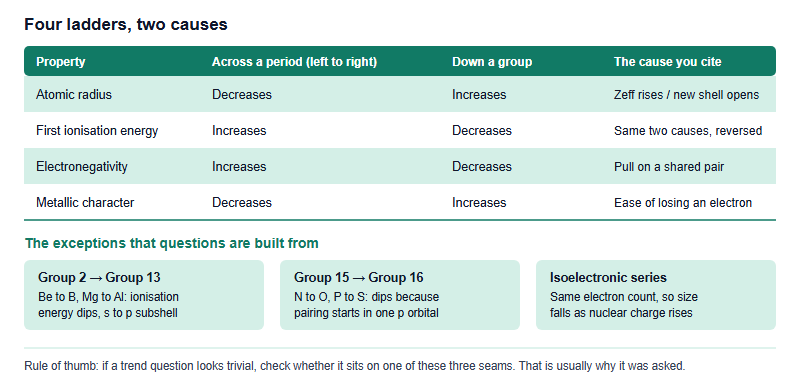
Two further habits pay for themselves. First, when comparing sizes, always check whether the species are isoelectronic before reaching for the period trend, because an isoelectronic comparison is decided purely by nuclear charge. Second, when a question asks about a second or third ionisation energy rather than the first, redraw the configuration of the ion you are actually ionising; the answer usually turns on whether you are about to break into a noble-gas core.
Lewis, VSEPR and hybridisation: a sixty-second routine
Shape questions are pure procedure, and procedure is trainable to the point of being automatic. The routine below is four moves, and the whole thing should take under a minute for a species you have never seen.
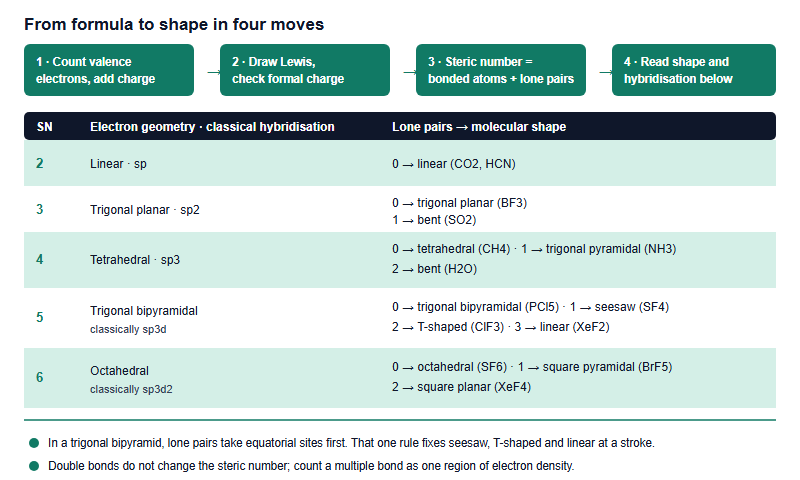
Three refinements separate a fast student from a merely correct one. Formal charge, computed as valence electrons minus non-bonding electrons minus half the bonding electrons, decides between competing Lewis structures — pick the structure with formal charges closest to zero and any negative charge on the more electronegative atom. Resonance changes bond order rather than shape, which is why every nitrogen-to-oxygen bond in nitrate carries a bond order of one and one third. And bond angles compress in a predictable order as lone pairs are added, so methane, ammonia and water form a descending sequence rather than three facts to memorise.
Molecular orbital theory shows up narrowly but reliably, almost always for second-period diatomics. Two facts do most of the work: bond order equals half the difference between bonding and antibonding electrons, and oxygen is paramagnetic, which is the classic demonstration that simple Lewis structures are incomplete. The subtlety worth knowing is that s-p mixing raises the sigma orbital above the pi pair for the lighter diatomics through nitrogen, then the order reverses for oxygen and fluorine — which is exactly the discrimination a well-set question is looking for.
Intermolecular forces and the solid state
This is where structure turns into physical properties, and where a surprising number of marks sit. The examinable logic is that you identify what holds the particles together, then rank.
| Interaction or solid type | Where it operates | Relative strength | What the question usually asks |
|---|---|---|---|
| London dispersion | Every species, without exception | Weak individually, large when the molecule is big or polarisable | Why boiling point rises down a halogen or noble-gas series |
| Dipole-dipole | Polar molecules with a net dipole | Moderate | Ranking isomers of similar mass |
| Hydrogen bonding | Hydrogen bound to nitrogen, oxygen or fluorine | Strong for an intermolecular force | Why water, ammonia and hydrogen fluoride break the trend |
| Ion-dipole | An ion dissolved in a polar solvent | Strong | Solvation energy and solubility reasoning |
| Molecular solid | Discrete molecules in a lattice | Low melting point, poor conductor | Identifying a substance from its property table |
| Ionic solid | Cations and anions | High melting point, conducts only when molten or dissolved | Lattice energy comparisons by charge and size |
| Covalent network | Continuous covalent bonding, as in diamond or silica | Very high melting point, hard, generally insulating | Why diamond and graphite differ despite one element |
| Metallic | Cations in delocalised electrons | Variable, conducts in the solid state | Malleability and conductivity explanations |
The trap to know is that dispersion beats dipole-dipole once the molecules get large enough. Hydrogen iodide boils higher than hydrogen bromide, which boils higher than hydrogen chloride, because dispersion grows faster down the group than polarity falls — while hydrogen fluoride sits above all three on hydrogen bonding alone. A student who has learned polar beats non-polar as an unconditional rule gets that family of questions wrong every time.
Crystal structures reward a small amount of memorisation. The three cubic cells are worth knowing cold, because density and radius calculations reduce to substitution once you have them.
| Cubic cell | Atoms per cell | Coordination number | Edge length in terms of radius | Packing efficiency |
|---|---|---|---|---|
| Simple cubic | 1 | 6 | Edge equals twice the radius | About 52 percent |
| Body-centred cubic | 2 | 8 | Body diagonal equals four radii | About 68 percent |
| Face-centred cubic | 4 | 12 | Face diagonal equals four radii | About 74 percent |
A two-week drill, and who can sit the exam
Because this cluster is procedural rather than conceptual, it responds to short, frequent, mixed practice far better than to a long weekend of reading. Fifteen minutes a day for two weeks is usually enough to move it from slow-and-mostly-right to fast-and-automatic.
- Days 1 to 3 — configurations and trends. Ten elements a day: write the configuration from position, then predict radius, first ionisation energy and electronegativity relative to a neighbour, and state the cause in one clause.
- Days 4 to 7 — the shape routine. Eight species a day, mixed charges, run cold against a timer. Target under sixty seconds each including hybridisation. Include the awkward five-region cases deliberately.
- Days 8 to 10 — ranking questions. Boiling point, lattice energy, bond polarity and acid strength sets. Force yourself to write the deciding factor before you write the order.
- Days 11 to 14 — mixed retrieval under time. Pull only the structure-and-bonding items out of several past papers and run twenty at a stretch. Do not work whole papers; you are training one pathway.
That last step is where a targeted past-paper pack earns its keep, because slicing by topic across many years gives you far more repetitions of the same question type than working papers front to back ever will. Our gathered past-paper collection and the method for working through it is built for exactly that kind of slicing, with worked solutions for some of the years rather than every one.
Finally, keep the access rules straight before you organise a term around this. Per ACS, the National Exam requires United States citizenship or permanent residency. A student who is not a US national but attends a high school in the United States may sit the Local Exam yet cannot be nominated onward. A US citizen or green-card holder enrolled for at least a year at an accredited American school abroad, including in China, and under twenty, competes through an ACS International Chemical Sciences Chapter, and that route does reach the National Exam. A student who is neither a citizen nor a permanent resident, at a school in mainland China, has no ACS route at all, and there is no China region to register for. The full position is set out in our guide to who can and cannot enter the USNCO, and eligibility is always ACS territory, so confirm current rules on acs.org.
None of that changes the value of this particular cluster. Structure, bonding and periodic trends are the most portable chemistry you will ever learn. They carry into AP, A-Level and IB examinations, into any chemistry competition you are eligible for, and into first-year university physical and inorganic courses essentially unchanged. Two weeks of drilling buys years of speed.
Frequently asked questions
Why does ionisation energy dip from nitrogen to oxygen?
Oxygen begins pairing electrons in one 2p orbital, and that electron-electron repulsion makes the first electron easier to remove.
Do multiple bonds change the steric number?
No. Count each multiple bond as a single region of electron density, so carbon dioxide has a steric number of two and is linear.
Is sp3d hybridisation still considered correct?
It works as bookkeeping for shape, but modern treatments question real d-orbital participation. Use the label, know the caveat.
Why does hydrogen iodide boil higher than hydrogen chloride?
Dispersion forces grow with size and polarisability faster than polarity falls down the group, so the larger molecule wins.
This is the USNCO information desk, synchronising official ACS information for chemistry students in China, operated by Hanlin Education. The USNCO is run by the American Chemical Society (ACS), which sets all official rules and eligibility. Always confirm current details on acs.org. Errors reported to us are corrected within 7 working days.