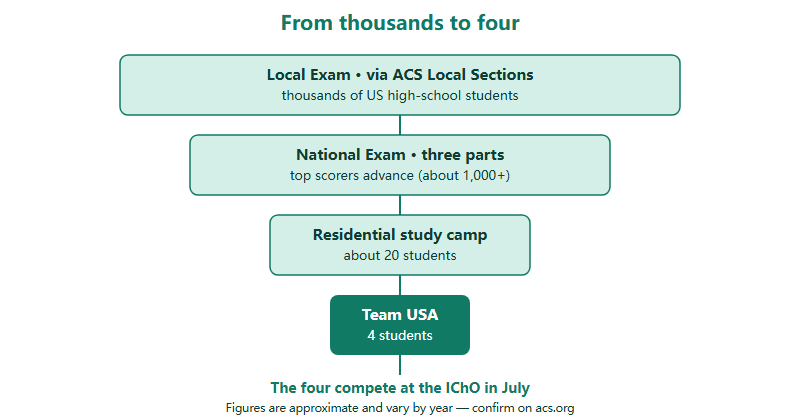
Team USA for the International Chemistry Olympiad is four students — and the USNCO is the machine that narrows thousands of high-school chemists down to them. It runs a Local Exam, then a three-part National Exam, then a residential study camp of about twenty, and finally names the four. Crucially, going past the Local Exam requires US citizenship or permanent residency — but not a US address: ACS also runs the funnel abroad through its International Chemical Sciences Chapters, and a student at an international school in Shanghai reached Team USA for IChO 2026 through it. Here is how the funnel works, and which readers here can and cannot enter it.
The funnel in one picture
The American Chemical Society (ACS) has run the USNCO since 1984, and the selection has a clear shape: broad at the bottom, extremely narrow at the top. Each stage filters harder than the last, and the exams get longer and more hands-on as you climb. If you want the plain-language overview of all four stages first, our explainer on what the USNCO is is the place to start; this article zooms in on how the top of the funnel actually selects a national team.
Stage by stage: what each level actually tests
The exams do not just get harder — they change in kind. The Local Exam rewards speed and breadth; the National Exam demands sustained problem solving and real bench technique; the study camp is where a shortlist is trained intensively and then tested again to pick the four.
| Stage | Roughly when | Approx. scale | What it tests | Eligibility note |
|---|---|---|---|---|
| Local Exam | About March | Thousands | 60 multiple-choice questions in 90 minutes — speed and breadth | At a U.S. school: via that school’s ACS Local Section — no citizenship test at this level. Abroad: via an ACS International Chemical Sciences Chapter, which per ACS requires U.S. citizenship or permanent residency, at least one year at an accredited American school, and age under 20 |
| National Exam | About April | Top scorers (~1,000+) | Three parts: multiple-choice, written free-response, and a lab practical | Same route, but US citizenship or permanent residency now required |
| Study camp | Late spring / early summer | About 20 | Intensive training plus selection exams over roughly two weeks | To continue toward Team USA: US citizen or permanent resident |
| Team USA | Named after camp | 4 | Represents the United States at the IChO | US citizenship or permanent residency required |
A few details are worth spelling out. The National Exam is the pivot point of the whole system: Part I is 60 multiple-choice questions (90 minutes), Part II is a written free-response section (105 minutes) that rewards multi-step reasoning, and Part III is a genuine wet-lab practical (90 minutes). Confirm current timings on acs.org, but the design has long insisted that a top US chemistry student can both calculate and work at the bench.
The study camp gathers roughly the top twenty performers for about two weeks of concentrated coaching — historically hosted at a US university — followed by further selection exams. Only after that are the four members of Team USA announced. Along the way, the USNCO also recognises strong national performers with tiers such as High Honors and Honors, which sit below team selection but still mark a serious result.
The gate almost nobody talks about: citizenship
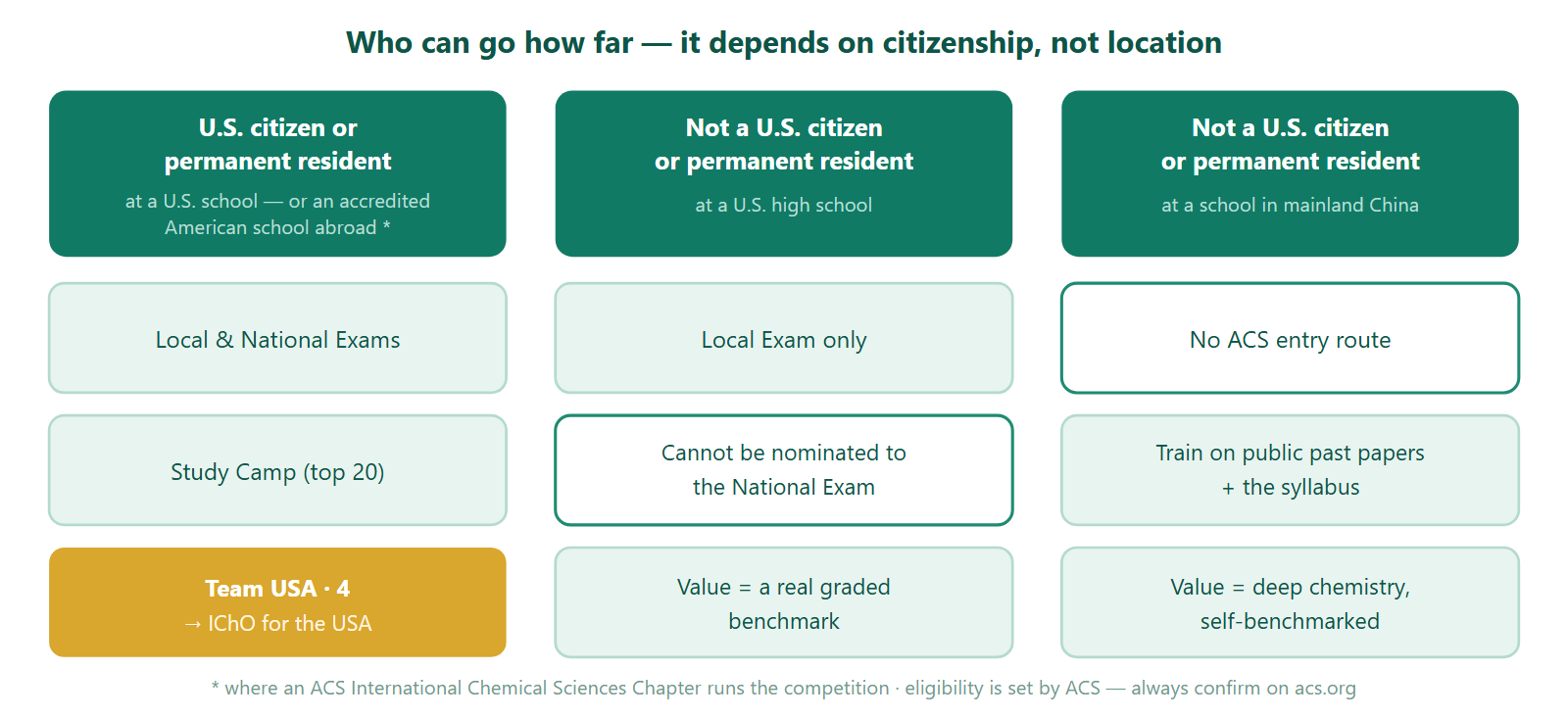
Here is the fact that matters most for readers in China — though not quite in the way it is usually told. Reaching Team USA requires US citizenship or permanent residency, and per ACS that gate closes earlier than most people assume: a student who does not meet the citizenship criteria “can only participate in the Local Exam without the possibility of being nominated to sit for the National Exam, regardless of their performance (score).” This is not a scoring rule; it is an eligibility rule, and it sits above raw ability.
What that gate is not is a geography rule, and this is where our earlier wording was too blunt. Three cases separate cleanly. A student who is not a US citizen or green-card holder but attends a high school in the United States may sit the Local Exam through that school's ACS Local Section — and stops there. A US citizen or permanent resident who has been enrolled for at least a year at an accredited American school abroad, including in China, and is under 20, has the whole funnel: ACS states that for such students the local and national competition is organised by an ACS International Chemical Sciences Chapter. That is not theoretical — ACS's own published lists show students at an international school in Shanghai competing through the Shanghai International Sciences Chapter, one of whom was named to Team USA for IChO 2026.
The third case is the common one among our readers: a student in mainland China who holds neither US citizenship nor permanent residency has no ACS route. There is no individual sign-up from abroad — entry always runs through a coordinator, a Local Section or an International Chapter — and the provision for students abroad requires citizenship or permanent residency, so that door does not open on score. For the complete picture of who can and cannot take the exam, see our dedicated piece on whether international students can take the USNCO, and always confirm eligibility on acs.org.
What a China-based student should take from the funnel
If you fall into that third case and cannot enter the funnel, understanding its machinery is still genuinely useful. Three practical lessons stand out:
- Calibrate against the right bar. The National Exam — not the Local Exam — is the level serious olympiad chemists work toward. If you want a real benchmark, measure yourself against National-level problems and the lab practical, not just multiple-choice.
- Train the same skills the camp trains. Speed on multiple-choice, disciplined multi-step written solutions, and bench technique are exactly what the funnel filters for. Building all three makes you a stronger chemist regardless of which competitions you eventually enter.
- Know your own eligibility elsewhere. The IChO is a contest of national teams. If you hold citizenship or residency in another country, that country's own selection — not the USNCO — is your possible route. Investigate the rules where you are actually eligible.
To turn USNCO material into a structured benchmark rather than random practice, our guide on how to use USNCO past papers lays out a workable method. Our team also keeps a curated, organised pack of USNCO papers with worked notes for selected years, which we add to over time. If Team USA is closed to you, the point is not to chase a medal you cannot win; it is to build chemistry at that level with the best material available.
Frequently asked questions
How many students make Team USA?
Four. They are selected after a residential study camp of roughly twenty national finalists and then represent the United States at the IChO. Confirm current details on acs.org.
Do you need to be a US citizen to make Team USA?
Yes — reaching Team USA and representing the USA at the IChO requires US citizenship or permanent residency. This eligibility rule sits above test scores.
Where is the USNCO study camp held?
It has historically been hosted at a US university over about two weeks. Venues and dates can change, so verify the current arrangement on acs.org.
Can a student in China join this funnel?
It depends on the passport, not the postcode. A US citizen or permanent resident enrolled at an accredited American school in China can: ACS organises local and national competition abroad through its International Chemical Sciences Chapters, and a Shanghai student reached Team USA for IChO 2026 that way. A student who is not a US citizen or permanent resident has no ACS route and trains on the material instead. See our eligibility explainer and confirm on acs.org.
This is the USNCO information desk synchronising official ACS information for chemistry students in China, operated by Hanlin Education. The USNCO is run by the American Chemical Society (ACS), which sets all official rules and eligibility; always confirm current details on acs.org. Any errors are corrected within 7 working days.