The USNCO (chemistry), USABO (biology), USAMO (mathematics) and USAPhO (physics) are the four best-known U.S. national subject olympiads, each run by a different organisation, each feeding a different International Olympiad. They are not interchangeable: the format, the funnel, and the kind of thinking rewarded differ sharply. This guide compares them so a chemistry-leaning student can choose a focus deliberately rather than by accident.
Four olympiads, four organisers
The single most important thing to know before comparing formats is that these are separate programmes run by separate national bodies. That is why their rules, dates and eligibility never quite line up — and why you must check each on its own official site.
| Olympiad | Subject | U.S. organiser | Feeds | Official source |
|---|---|---|---|---|
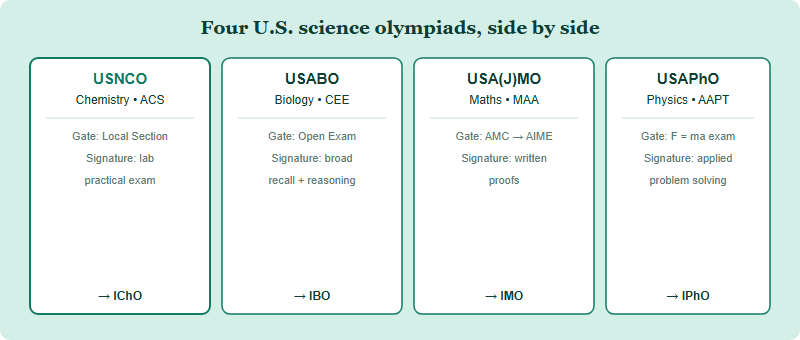
| USNCO | Chemistry | American Chemical Society (ACS) | International Chemistry Olympiad (IChO) | acs.org |
| USABO | Biology | Center for Excellence in Education (CEE) | International Biology Olympiad (IBO) | cee.org |
| USA(J)MO | Mathematics | Mathematical Association of America (MAA) | International Mathematical Olympiad (IMO) | maa.org |
| USAPhO | Physics | American Association of Physics Teachers (AAPT) | International Physics Olympiad (IPhO) | aapt.org |
Because we are the USNCO information desk, we speak with the most confidence about the chemistry track; for the biology, maths and physics programmes we point you to their organisers for authoritative rules. Treat the comparison below as a map, and confirm every specific on the relevant official site.
How the funnels differ
Each olympiad is a multi-stage selection, but the number and character of the stages vary. Knowing the shape helps you judge how much of a multi-year commitment each represents.
- USNCO (chemistry): Local Chemistry Olympiad via an ACS Local Section → National Exam → Study Camp (University of Maryland) → Team USA of four to the IChO. The National Exam is unusual for including a hands-on laboratory practical alongside written papers. Our What Is the USNCO? guide walks the full path.
- USABO (biology): an Open Exam, then a Semifinal Exam, then a residential Finals, then Team USA to the IBO — a written-and-practical progression administered by CEE. Confirm the current structure on cee.org.
- USAMO (mathematics): the well-known AMC 10/12 → AIME → USA(J)MO ladder run by the MAA, with proof-based problems at the USAMO stage, feeding IMO team selection. Confirm on maa.org.
- USAPhO (physics): a qualifying “F = ma” exam gates entry to the USAPhO, then a training camp and Team USA to the IPhO, administered by AAPT. Confirm on aapt.org.
The eligibility reality — and it differs by programme
This is the point that reshapes the whole decision for a student in China, and it does not work the same way for all four. For the USNCO, the ACS rules produce three distinct outcomes. A student at a high school in the United States may take the Local Exam through that school’s ACS Local Section whatever their nationality, but can only be nominated for the National Exam if they are a U.S. citizen or a green-card holder. A U.S. citizen or permanent resident enrolled for at least a year at an accredited American school abroad — including such schools in China — has the whole route, run through an ACS International Chemical Sciences Chapter, up to the National Exam, Study Camp and Team USA. A student who is neither, at a school in mainland China, has no ACS entry route: there is no individual sign-up from abroad, because entry always runs through a section or chapter coordinator rather than an open form. The other three programmes set their own arrangements — USABO, for instance, has had a China-region route that the USNCO does not offer that third group — so never assume one programme’s answer carries over. We spell out the chemistry cases in Can International Students Take the USNCO? Eligibility, Honestly; confirm each programme on its own official site.
What follows from that? For students in that third position — most of our readers — the practical value of these olympiads is as a study standard and a way to understand the U.S. system, using their publicly available past papers, rather than as a contest you personally enter. The USNCO’s 1999–2025 past papers, for example, are an outstanding chemistry training set on their own terms — see USNCO Past Papers: The Pack and How to Use It.
Time cost and prerequisites — an honest comparison
Beyond subject taste, the four olympiads differ in how much groundwork they assume and how long the climb typically takes. Underestimating this is the most common planning error, so it is worth being blunt about it.
| Olympiad | Typical prerequisites | Where the ceiling sits | What the top stage tends to demand |
|---|---|---|---|
| USNCO | Strong algebra; comfort with advanced high-school / intro-college chemistry | Well above a typical school syllabus, especially in thermodynamics, equilibrium and organic | Speed and accuracy across written papers plus a laboratory practical |
| USABO | Broad, careful reading across all of biology | Far beyond a single course; molecular biology through ecology | Recall depth plus applied reasoning, then practical work at Finals |
| USA(J)MO | Years of contest maths (AMC/AIME level) before the USAMO gate even opens | Among the steepest of the four to reach | Writing complete, rigorous proofs under time pressure |
| USAPhO | Solid mechanics and calculus-style problem solving | Well beyond introductory physics | Modelling unfamiliar systems from first principles |
The pattern to notice: none of these is a “study for a term and sit it” contest. Each is a multi-year commitment, and the maths olympiad in particular has a long qualifying ladder before the national stage is even in reach. For a chemistry-leaning student, the USNCO’s demand profile — reasoning-heavy written chemistry plus an experimental dimension — is the relevant one to plan around. The specifics of every stage should be confirmed on the organiser's official site, since prerequisites and gates evolve.
Which subject should you lean into?
If you are genuinely choosing — not already committed by passion — a few honest heuristics help. None of these is a rule; they are tendencies.
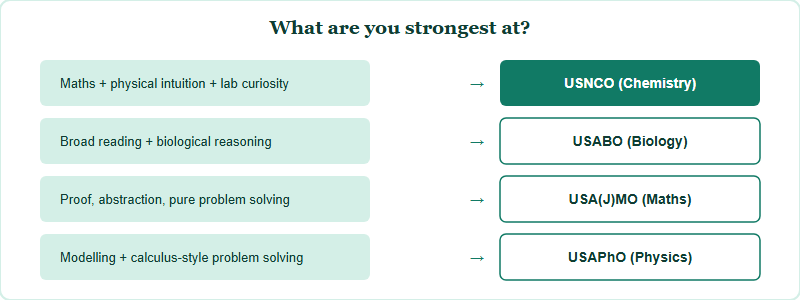
- Pick chemistry (USNCO) if you like problems that sit between maths and the physical world: stoichiometry, equilibrium, thermodynamics, and a laboratory dimension. The National Exam’s lab practical rewards students who think experimentally, not just on paper.
- Pick biology (USABO) if you enjoy synthesising a very broad body of knowledge — molecular biology through ecology — and reasoning from it. It rewards depth of reading more than heavy calculation.
- Pick maths (USAMO) if you are drawn to proof: constructing a rigorous argument, not just getting a number. The AMC/AIME gate alone is a multi-year build.
- Pick physics (USAPhO) if you like modelling messy situations with a compact toolkit of principles and strong calculus-style problem solving.
How to trial a subject before you commit
You do not have to guess. Because the past papers for these olympiads are public, you can test your fit cheaply before sinking a year into any of them. A short trial usually settles the question better than a personality quiz.
- Sit one real past paper in each candidate subject, timed. For chemistry, work a USNCO multiple-choice section under conditions. Do not just read it — attempt it, and notice whether the difficulty energises or drains you.
- Mark it and read the solutions. The telling signal is not your score but your reaction to the worked answers: does the reasoning feel like something you want more of, or something you are relieved to be done with?
- Give it two or three weeks, not one afternoon. First contact with any olympiad paper is humbling in every subject. Sustained curiosity after the initial shock is the real indicator of fit.
- Weigh what you can sustain, not what sounds impressive. The “prestigious” choice you abandon in three months is worth far less than the subject you will still be working at in two years.
For the chemistry trial specifically, our past-paper guide shows exactly how to run a timed section and mark it against the key, so a fit test doubles as the first session of real preparation.
Common mistakes when choosing
A few predictable errors send students down the wrong path. Naming them makes them easy to avoid.
- Choosing by perceived prestige. There is no universal “hardest” or “most impressive” olympiad; a strong result in the subject you love beats a mediocre one in the subject you thought would look good.
- Assuming eligibility. Picking a programme you cannot actually enter from where you are, and only discovering it later, wastes months. Confirm the entry route on the official site before you commit.
- Hedging across several at once. Four half-built profiles is a weaker position than one credible one, both for skill and for how the effort reads later.
- Ignoring the calendar. Each olympiad has its own season and gates; a subject that clashes with your school peak may be a poor practical fit even if you love it. The USNCO season is mapped in our overview guide.
One focus, done deeply, beats four dabbled
The strongest reason to compare these carefully is so you can then stop comparing and commit. Each of these olympiads represents a serious multi-year build; spreading yourself across chemistry, biology, maths and physics simultaneously usually produces four thin profiles instead of one credible one. Colleges and the science itself reward depth.
For a chemistry-leaning student, that means treating the USNCO ecosystem — its syllabus and its past-paper archive — as a long-term training standard, understanding the U.S. pathway honestly, and building genuine chemical fluency. Whether or not you are ever eligible to sit the exam itself, the discipline of working to its level is where the value lives.
FAQ
Are the USNCO, USABO, USAMO and USAPhO run by the same body?
No. They are run by ACS, CEE, the MAA and AAPT respectively, and each feeds a different International Olympiad. Confirm rules on each organiser's site.
Which is hardest?
There is no fair single ranking; each rewards different thinking. The right question is which subject you can go deepest in over several years.
Can a student in China enter all four?
Do not assume so — the answer depends on who you are and on the programme. For the USNCO, ACS allows a U.S. citizen or green-card holder enrolled at an accredited American school in China to compete through an ACS International Chemical Sciences Chapter, all the way to the National Exam and beyond; a student who is neither a citizen nor a permanent resident has no ACS route from a mainland school. The other programmes set their own international arrangements — USABO, for instance, has had a China-region route. Check each on its official site.
Should I try more than one to hedge?
Usually not. One olympiad pursued deeply builds a far stronger profile and skill set than several pursued shallowly.
This is the USNCO information desk synchronising official ACS information for chemistry students in China, operated by Hanlin Education. The USNCO is run by the American Chemical Society (ACS), which sets all official rules and eligibility; the USABO, USAMO and USAPhO are run by CEE, the MAA and AAPT respectively. Always confirm current details on acs.org and each programme's official site. Any error will be corrected within 7 working days.