
If you are preparing for the US National Chemistry Olympiad (USNCO) organic section, the fastest way to stop losing stereochemistry marks is to use one priority-first workflow for every R/S, E/Z, and Fischer projection question. Assign Cahn-Ingold-Prelog (CIP) priorities before you interpret geometry; then apply a fixed spatial rule for the drawing type. The method below is standard stereochemistry teaching, not an official USNCO rule or scoring statement. All worked examples are teaching illustrations, not actual contest problems.
The core answer: rank the four groups around a stereocenter or the two groups on each alkene carbon using atomic number, breaking ties by moving outward atom by atom. Only after priorities are fixed should you decide whether the drawing is a 3D wedge/dash structure, a Fischer projection, or an alkene. Then apply the matching spatial rule. This single sequence prevents the common mistake of rotating a drawing in your head before you know which groups are being compared.
The Priority-First Workflow
For any stereochemical assignment, start with CIP priorities. Look only at the atoms directly attached to the stereocenter or double-bond carbon. Higher atomic number means higher priority. If two atoms are identical, move outward to the next attached atoms until the tie is broken. A tie can also be broken by mass number for isotopes, by duplicate atoms for multiple bonds, and by lone pairs for atoms that carry them.
Three priority rules are worth drilling until they are automatic:
- Atomic number first. Br (Z = 35) outranks Cl (Z = 17), which outranks F (Z = 9), which outranks H (Z = 1).
- Isotopes break ties by mass. Deuterium (D) has higher priority than protium (H) when atomic numbers are tied.
- Lone pairs are lowest. A lone pair is treated as lower priority than any bonded atom, including hydrogen. Do not ignore it on sulfur, phosphorus, or other atoms that can carry one.
Once priorities are assigned, the drawing type determines the next step. Do not mix the rules for 3D structures, Fischer projections, and alkenes. Each has its own convention.
R/S Configuration Clinic
The most common R/S error is mishandling the lowest priority group, usually hydrogen. If the lowest priority group is pointing away from you (dashed bond), read the direction of 1→2→3 directly. Clockwise is R, counter-clockwise is S. If the lowest priority group is pointing toward you (wedged bond), the result is inverted: clockwise becomes S, counter-clockwise becomes R.
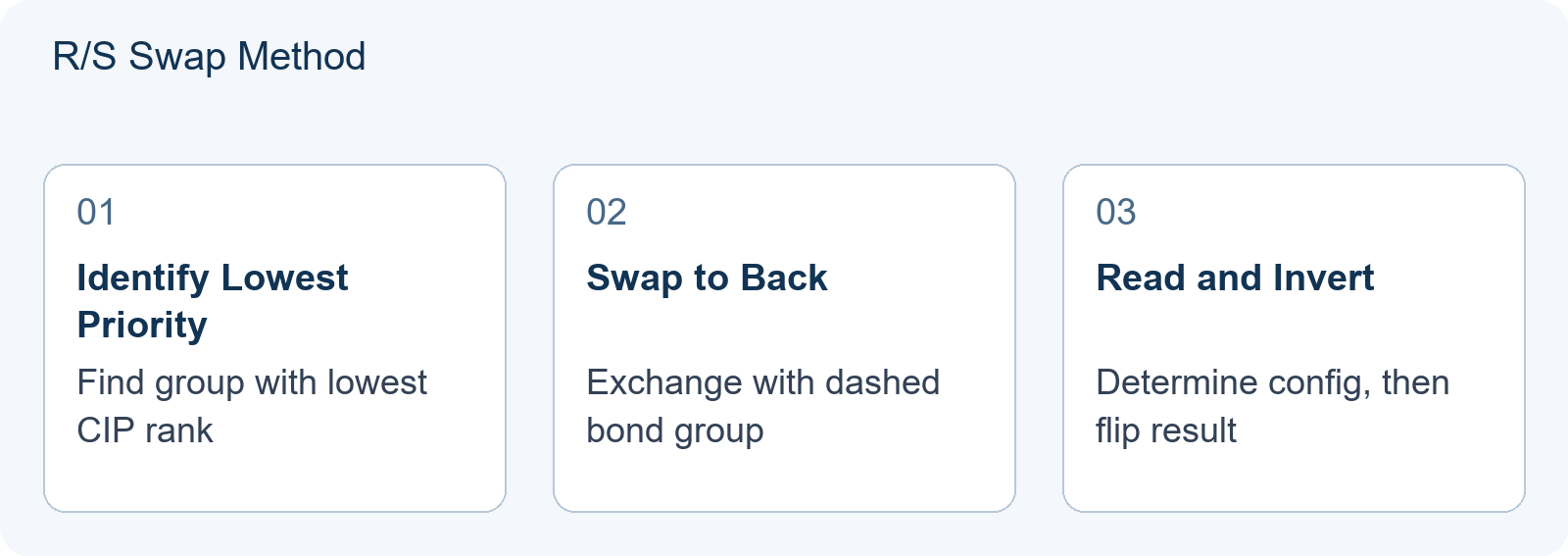
A frequent trap occurs when the lowest priority group is in the plane of the paper. In that case, do not mentally rotate the molecule unless you are certain of the outcome. Instead, use the swap method. Swap the lowest priority group with the group currently pointing away. Determine the configuration of this new arrangement. Then invert the answer because one swap changes the chirality at that center.
For a second drill, suppose H is in the plane and CH3 is dashed away. Swap H with CH3. Now H is dashed away, and CH3 is in the plane. Assign priorities to the new arrangement, read R/S directly, then invert the final answer because you made one swap. This procedure is slower than a confident mental rotation, but it is far less error-prone under time pressure.
E/Z Alkene Determination
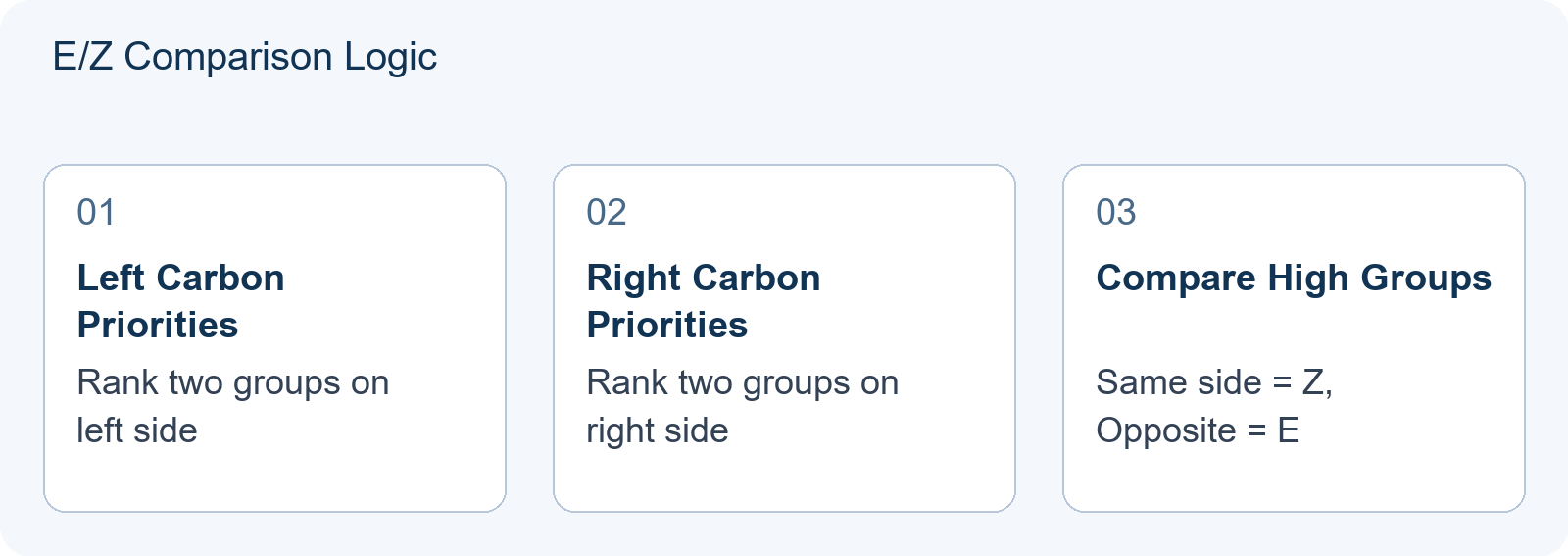
For alkenes, treat each carbon of the double bond independently. Assign priorities to the two substituents on the left carbon and the two substituents on the right carbon. Compare the positions of the highest priority group on each side. If both high-priority groups are on the same side of the double bond, the configuration is Z (zusammen, together). If they are on opposite sides, it is E (entgegen, opposite).
A common mistake is comparing the highest priority group on one side with the lowest priority group on the other, or failing to break ties correctly when substituents have identical first atoms. Also remember that cis/trans is ambiguous for tri- or tetra-substituted alkenes. E/Z uses CIP priorities and remains unambiguous.
Fischer Projection Conversions
Fischer projections require strict adherence to convention: vertical bonds project away from the viewer, and horizontal bonds project toward the viewer. Never rotate a Fischer projection by 90 degrees, as this changes the stereochemistry. Rotating by 180 degrees preserves it.
To determine R/S from a Fischer projection, identify the lowest priority group. If it is on a vertical bond, read 1→2→3 directly. If it is on a horizontal bond, read 1→2→3 and invert the result. Alternatively, perform single swaps to move the lowest priority group to the top vertical position. Keep track of how many swaps you make. An odd number of swaps inverts the configuration relative to the original; an even number preserves it.
Common Distractor Patterns
In timed stereochemistry problems, several predictable traps appear. One pattern involves isotopes, where deuterium (D) has a higher priority than protium (H) because mass number breaks the atomic-number tie. Another involves lone pairs, which are assigned lower priority than any bonded atom. A third involves implicit hydrogens: ensure you account for all four substituents before assigning priorities, even if one or more hydrogens are not drawn explicitly.
| Error Type | Cause | Correction Strategy |
|---|---|---|
| Inverted R/S | Lowest priority group facing viewer | Use swap method or invert final reading |
| Misassigned E/Z | Comparing wrong pairs of groups | Assign priorities per carbon separately |
| Fischer Rotation Error | Rotating 90 degrees | Only rotate 180 degrees or use swap logic |
Ten-Minute Diagnostic Drill
To build speed and accuracy, create a mixed set of five problems: two R/S assignments, two E/Z determinations, and one Fischer conversion. Set a timer for ten minutes. After completing the drill, log every error in a dedicated section of your notebook. Categorize errors as “Priority Assignment,” “Spatial Interpretation,” or “Convention Violation.” Reviewing this log helps identify whether your weakness is conceptual, such as misunderstanding CIP rules, or procedural, such as forgetting to invert when H is wedged.
Run this diagnostic once a week during organic revision. If your error count does not fall after three cycles, change the drill: slow down to one problem per five minutes and write every priority assignment explicitly. Speed without correct priorities only reinforces the wrong habit.
Reviewing Past Papers Efficiently
When reviewing organic past papers, avoid rereading entire textbook chapters for every mistake. Instead, isolate the specific stereochemical rule violated. If you missed an E/Z question, review only the CIP priority rules for alkenes. If you failed a Fischer projection, practice converting three-dimensional models to Fischer diagrams. This targeted approach saves time and reinforces the exact skill needed for the next encounter.
Keep a short checklist next to your past-paper notes: priorities first, drawing type second, spatial rule third, final inversion check fourth. That four-step frame turns stereochemistry from a visual intuition test into a reliable procedure.
Course Fit and Resource Preparation
If systematic errors persist despite drilling, consider seeking guidance focused on organic chemistry problem-solving strategies. When preparing for consultation, bring your error log and specific examples of questions where you struggled. This allows instructors to diagnose whether the issue lies in foundational knowledge or exam technique. For further study on related topics, explore our guides on The Last Six Questions: USNCO Organic and Biochemistry, Decoded (2026), USNCO Molecular Geometry: Separate Electron Domains From Molecular Shape, and Why You Keep Losing the Same Marks: A Chemistry Error Log That Actually Works (2026).
One final check before any stereochemistry answer leaves your pencil: have you assigned CIP priorities before interpreting the drawing, and have you applied the correct inversion rule for the drawing type? If the answer is yes, you have converted a common USNCO organic trap into a repeatable mark.
Diagnostic: The Fischer Swap Trap
Use this Fischer projection to test the workflow. A central carbon bears four groups: OH at the top, CH3 on the right, H on the left, and COOH at the bottom. CIP priorities are OH (1; O directly attached), COOH (2; C attached to O,O,O), CH3 (3; C attached to H,H,H), and H (4).
Because H is on a horizontal bond, it points toward the viewer. Read 1→2→3 as drawn: OH (top) → COOH (bottom) → CH3 (right). This path is counter-clockwise, which would be S if H were pointing away. Since H is pointing toward you, invert the result. The correct configuration is R.
You can cross-check with one swap. Swap H (left) with OH (top). Now H is on a vertical bond and points away. In the swapped drawing, the groups to rank are OH (left, priority 1), COOH (bottom, priority 2), CH3 (right, priority 3), and H (top, priority 4). Read 1→2→3: OH (left) → COOH (bottom) → CH3 (right). This path is counter-clockwise, giving S in the swapped drawing. One swap inverts the configuration, so the original drawing is R. Both methods agree.
Practice task: redraw the original molecule as a wedge-dash structure and verify the R assignment visually.
General event background is available at Event background.
This is an independent preparation guide, not affiliated with, endorsed by, or sponsored by the American Chemical Society.
Frequently Asked Questions
Can I use cis/trans instead of E/Z?
No. Cis/trans is ambiguous for tri- or tetra-substituted alkenes. E/Z uses CIP priorities and is unambiguous.
What if the lowest priority group is in the plane?
Use the swap method: swap it with the group pointing away, determine the configuration, then invert the answer.
Do lone pairs affect R/S assignment?
Yes. A lone pair is assigned lower priority than any bonded atom, including hydrogen. Do not ignore it.