For many Grade 9 and 10 students in China-based international schools, the question of which chemistry competition to enter first is not about prestige. It is about readiness. Families often look at the U.S. National Chemistry Olympiad (USNCO) first because of its reputation and its link to a well-known national pathway. But USNCO is not automatically the right first competition for a younger student whose school chemistry is still coming together. The Cambridge Chemistry Challenge Level 6 (C3L6) offers a different kind of entry point, built on A-Level and IB core content and assessed through longer, structured questions. Understanding how these two competitions differ in content depth, question style, and preparation demands is the practical way to decide what a Grade 9 or 10 student should actually commit a year to.
The comparison below is deliberately narrow. It is not a ranking of prestige or a statement about university admissions. It is a description of two exams as pieces of assessment design, followed by a decision framework for the younger end of the secondary-school range. For readers who also want the scheduling question of USNCO versus CCC, that is a separate discussion in our guide on USNCO vs CCC: Which Chemistry Competition to Prepare for When You Cannot Do Both.
What C3L6 Is: A-Level/IB Core With Longer Structured Questions
C3L6 is a Cambridge chemistry challenge that functions, in effect, as a thinking-skills check before the more demanding UK Chemistry Olympiad (UKChO). According to a September 2026 Hanlin comparison of five major international chemistry competitions, C3L6 is based primarily on A-Level and IB core chemistry, but the reasoning it requires sits deeper than the standard syllabus. It is not a recall test. The exam is built around two to three major questions, and each question typically tells a complete chemical story or research process rather than isolating a single topic.
That design changes what the exam rewards. A candidate cannot simply identify a formula and plug in numbers. They have to read a scenario, work out which principles apply, bring together content from more than one chapter — energetics with equilibrium, for example, or bonding with periodic trends — and then justify the reasoning in writing. The published comparison notes that the knowledge integration, logic, and explanation requirements are the same capability types that UKChO later tests, but with lower information density and lower calculation complexity. For a Grade 9 or 10 student who has completed some AS-level or IB Higher Level chemistry, that makes C3L6 a rigorous but reachable challenge. It lets a younger candidate practice building a coherent scientific argument without needing the entire university-level toolkit first.
What USNCO Is: AP Chemistry, First-Year Topics, and a Lab Component
The USNCO is structured on a different logic. The same Hanlin comparison describes it as covering the full AP Chemistry syllabus plus some first-year university chemistry, with the theoretical depth sitting below UKChO but the overall demands still very high because of breadth. The USNCO format is mixed: multiple-choice questions that sample a wide range of topics, free-response questions that require derivation and explanation, and — distinctively among the major English-medium chemistry competitions — a laboratory component that tests hands-on skill, data recording, and result analysis. The comparison specifically flags USNCO’s emphasis on inorganic chemistry, analytical chemistry, equilibrium work, and electrochemistry, as opposed to UKChO’s heavier weighting towards organic mechanisms and theoretical modelling.
For a student whose school curriculum is AP Chemistry, USNCO is a natural extension: the class material and the competition syllabus overlap on a large fraction of content. For a student on A-Level or IB, the same overlap is smaller. Some of the topics the USNCO expects — parts of descriptive inorganic chemistry, certain analytical techniques, and the lab skills exercised in the practical component — sit outside the standard A-Level or IB Higher Level sequence and are usually taught later or not at all. That gap is not a reason to avoid USNCO forever, but it is a reason not to treat it as a default first step for a Grade 9 student who is still finishing introductory topics.
Difficulty and Readiness: Why USNCO Is Not Automatically the First Step
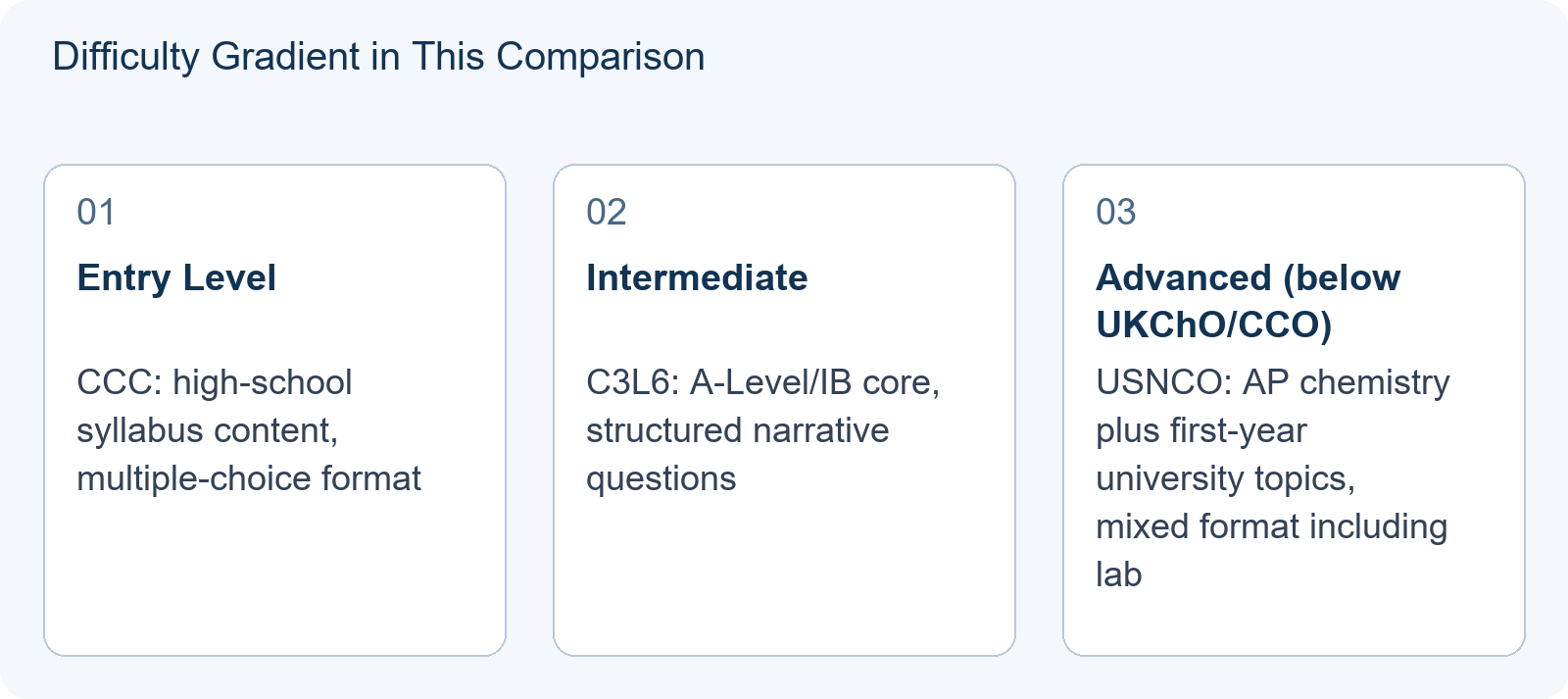
A common misconception among families is that all national olympiads sit at roughly the same level. The Hanlin comparison gives a concrete gradient across five mainstream English-medium chemistry competitions: UKChO hardest, then CCO, then USNCO, then C3L6, then CCC. Two implications follow from that ordering. First, C3L6 is a genuinely lower step than USNCO in terms of the raw knowledge volume the exam assumes. Second, C3L6 is not an easy exam — it is simply a step calibrated to the A-Level/IB core rather than to the AP-plus-first-year university range.
This ordering matters for a Grade 9 or 10 student because the biggest risk in their first competition is not losing marks. It is spending a season studying topics the exam will barely test, or arriving at the exam underprepared for the breadth it demands. A student who has only finished stoichiometry and basic atomic structure can still build useful reasoning habits with selected C3L6-style questions that do not depend on advanced content, but full C3L6 papers will remain out of reach until more of the A-Level or IB core is covered. The same student sitting USNCO practice under exam conditions will, in most cases, meet inorganic, analytical, and electrochemical content they have not yet formally covered. That experience is not fatal, but it tends to be discouraging and it produces weak diagnostic information for the next year’s planning.
It is worth saying plainly what this section is not claiming. The gradient printed above is a description of relative demand, not an official statement from any exam board, and it is not a prediction of individual outcomes. A well-prepared Grade 10 student on an accelerated track can absolutely enter USNCO first and have a useful season. The point is only that the default assumption — ‘start with the famous one’ — is unlikely to be the right default for a Grade 9 student on A-Level or IB.
Question Style: C3L6 Narrative Problems vs USNCO Multiple-Choice, Free-Response and Lab
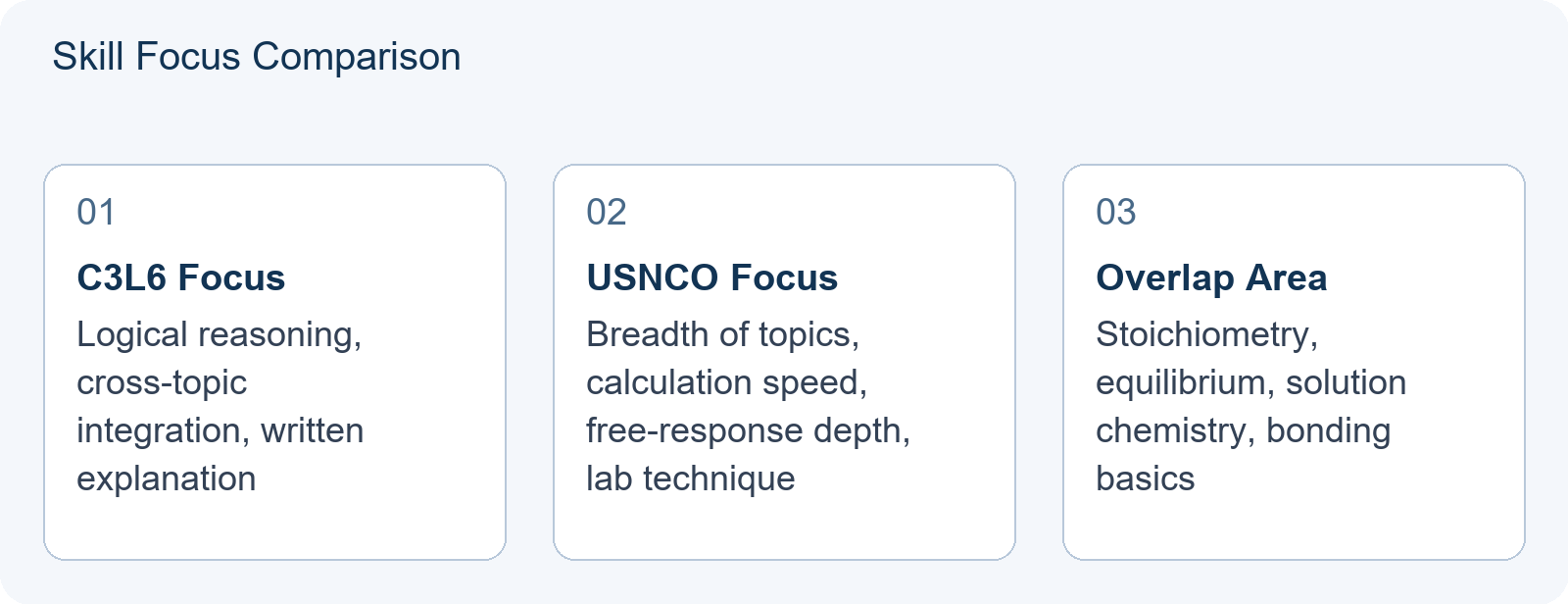
The format of an exam shapes the type of thinking it develops, and this is where the two competitions pull in different directions. C3L6 is a narrative-problem exam. A candidate reads a scenario, identifies the chemical principles that apply, and writes a coherent argument. That mirrors the style of university tutorial work and long-form problem sets more than it mirrors a timed multiple-choice screen. Practising for C3L6 therefore trains a specific habit: building an explanation that other chemists can follow, and keeping the reasoning consistent across several connected sub-questions.
USNCO requires three overlapping skill sets instead of one. The multiple-choice portion rewards quick, accurate recall and arithmetic under time pressure. The free-response portion rewards structured derivation and reasoning. The laboratory component tests practical competence — setting up, recording, and interpreting an experiment, and reasoning about the direction of error. A student who is strong at narrative reasoning but has never written a full experimental analysis will be less comfortable on the USNCO lab side than on the C3L6 side; the reverse is true for students who are fast on calculation but tend to leave explanations thin. Neither profile is better in the abstract, but a Grade 9-10 family should ask honestly which profile their student currently has. A candidate who enjoys writing out a reasoned argument will get more out of a C3L6 season. A candidate who already reads AP-level material quickly and is comfortable in a lab will get more out of an early USNCO season, provided the school offers the lab experience the exam assumes.
Preparation Time and School Background: A Decision Framework for Grades 9-10
The most useful piece of advice for this age group is to match the competition to the school syllabus, not to the rankings. If the student is on AP Chemistry, USNCO preparation can be layered on top of classwork with relatively little duplicated effort. The multiple-choice and free-response rounds will feel like harder versions of the material being covered in class, and the lab component will feel like an extension of school practicals. If the student is on A-Level or IB, C3L6 is a closer fit first. The content the exam asks for is largely already in the syllabus; the season’s work becomes about depth, integration, and explanation rather than about learning new topics from scratch.
For a Grade 9 student who has begun the advanced chemistry modules but is not yet ready for the full AP-plus-first-year range, C3L6 is often the more sensible starting point. It allows the student to develop competitive reasoning habits — reading a scenario carefully, planning an argument, keeping units and signs consistent — on content that is closer to what they have already seen. Families often worry that a ‘lower’ competition is wasted time, but a first season is primarily diagnostic. The point is to find out how the student handles time pressure, unfamiliar wording, and multi-step reasoning, and to build a study plan from that evidence. C3L6 produces that evidence cleanly. USNCO, taken too early, tends to produce a jumble of noise — some questions the student genuinely got wrong, some they simply had not been taught yet — which is much harder to act on.
Preparation time should be budgeted differently for the two exams. A C3L6 preparation cycle is naturally shorter, because the content footprint is narrower: most of the hours go into reading carefully, writing complete explanations, and reviewing the logic of past questions. A USNCO preparation cycle is longer, because the syllabus is broader. The student has to cover material they have not seen, drill calculation speed on multiple-choice, and rehearse free-response conventions, and if the school does not run regular labs, they also need to build the practical instincts the laboratory component assumes. A reasonable planning range for a China-based Grade 9-10 student on A-Level or IB is around three to four months of structured work before a first USNCO-style attempt, versus roughly half that for a first C3L6-style attempt. Those figures are planning ranges, not guarantees, and they will vary with the student’s starting level.
How USNCO Resources Can Still Help a C3L6 Candidate
Choosing C3L6 first does not mean ignoring USNCO material. USNCO past papers are an excellent source of stoichiometry, gas-law, and solution-chemistry questions that overlap with what C3L6 assumes. Working through USNCO multiple-choice items — not under USNCO time pressure, but as focused content drills — improves calculation accuracy and exposes the student to the exam conventions they will meet later. Similarly, the way USNCO free-response questions are worded is worth studying even a year in advance, because it shows how much reasoning an examiner expects to see written down.
The key discipline when borrowing USNCO material for a C3L6 season is to use it as topic practice, not as a mock exam. Scoring a Grade 9 student against a USNCO paper they are not yet prepared for produces low numbers that say nothing useful about the student. Scoring them on the specific sections that match what they have studied produces information that translates directly into the next study block. In either case, the answer key alone is rarely enough. Our guide on USNCO Past Papers: Requesting Explanations Beyond an Answer Key explains how to get the reasoning out of a past paper rather than just the final number, which is the habit that pays off across both exams.
When to Move From C3L6-Style Practice to USNCO-Style Papers
The transition from C3L6-style work to USNCO-style work should be driven by evidence, not by the calendar. A good indicator is that the student is now comfortably down the A-Level or IB Higher Level chemistry sequence — thermodynamics, equilibrium, kinetics, electrochemistry — and can write a full, argued response to a narrative question without needing to look up definitions. At that point, the gap to the USNCO syllabus has narrowed to a manageable list, and it is reasonable to start adding USNCO-specific topics such as descriptive inorganic chemistry, analytical techniques, and the extra equilibrium calculation patterns the exam favours. If the school runs regular lab sessions, it is also worth asking a teacher to preview the sort of experimental analysis the USNCO laboratory component expects; if the school does not, that gap has to be filled deliberately during the transition year.
It also helps to think about the timing within the school year. In recent seasons, USNCO local exams have fallen around March and C3L6 has run around June, so a student aiming at both in the same year would typically encounter USNCO first. That is a reason to structure the year so the earlier exam is not the unprepared one. A student planning to sit USNCO in the spring should not wait until after C3L6-type practice to start USNCO content; the C3L6 date is useful for building reasoning depth, but it comes after the USNCO paper. Our guide on When to Start USNCO Preparation: A Grade 9-12 Plan for China-Based Students (2026) lays out a grade-by-grade plan that helps families place these dates on a realistic timeline rather than treating the calendar as a surprise.
The goal of a first chemistry olympiad season for a Grade 9 or 10 student is not to win anything specific. It is to build a working method — how to read a problem, how to plan a response, how to check that the answer is chemically sensible — and to gather honest information about what the student needs to learn next. C3L6 tends to produce that evidence earlier and more cleanly for a student on A-Level or IB. USNCO tends to produce it for a student already fluent in AP-level material, especially if the school supports the lab side. Both are reasonable first competitions; the mistake is picking one on reputation rather than on fit.
Frequently Asked Questions
Can I take both C3L6 and USNCO in the same year?
It is possible, but the order matters. In recent seasons USNCO local exams have been scheduled in the spring and C3L6 has run in June, so a student aiming at both would usually sit USNCO first. That means USNCO preparation cannot wait until after C3L6 practice; the C3L6 work is more useful for building reasoning depth that carries forward into the next year. Families should plan the calendar with the earlier exam as the one that gets the longer runway.
Is C3L6 easier than USNCO?
In terms of the knowledge the exam assumes, yes. A Hanlin comparison of five major international chemistry competitions places the difficulty order as UKChO, CCO, USNCO, C3L6, then CCC. C3L6 is built on A-Level and IB core content with deeper reasoning, while USNCO assumes AP Chemistry plus some first-year university material and includes a laboratory component. For a Grade 9 or 10 student on A-Level or IB, C3L6 is usually the more manageable first step, though the exam itself is still demanding.
Which competition is better for university applications?
They signal different strengths rather than occupying a single ranking. C3L6 rewards analytical reasoning and written explanation, which fit naturally with UK-style assessment. USNCO rewards breadth, calculation accuracy, and laboratory competence, which fit naturally with US-style coursework. The better choice for any given student depends on their school curriculum, the direction they are considering for university, and which skills they currently need to build. Both are respected, and neither should be chosen purely on the basis of being harder than the other.