
For students preparing for the U.S. National Chemistry Olympiad (USNCO), stoichiometry underpins nearly every quantitative problem. Within that domain, identifying the limiting reagent is a frequent source of lost marks—not because the arithmetic is difficult, but because the verification step is skipped. This article presents a disciplined workflow through three original teaching illustrations, shows where an unchecked assumption leads to error, and offers a practice decision framework for competition conditions.
The Verification Gap
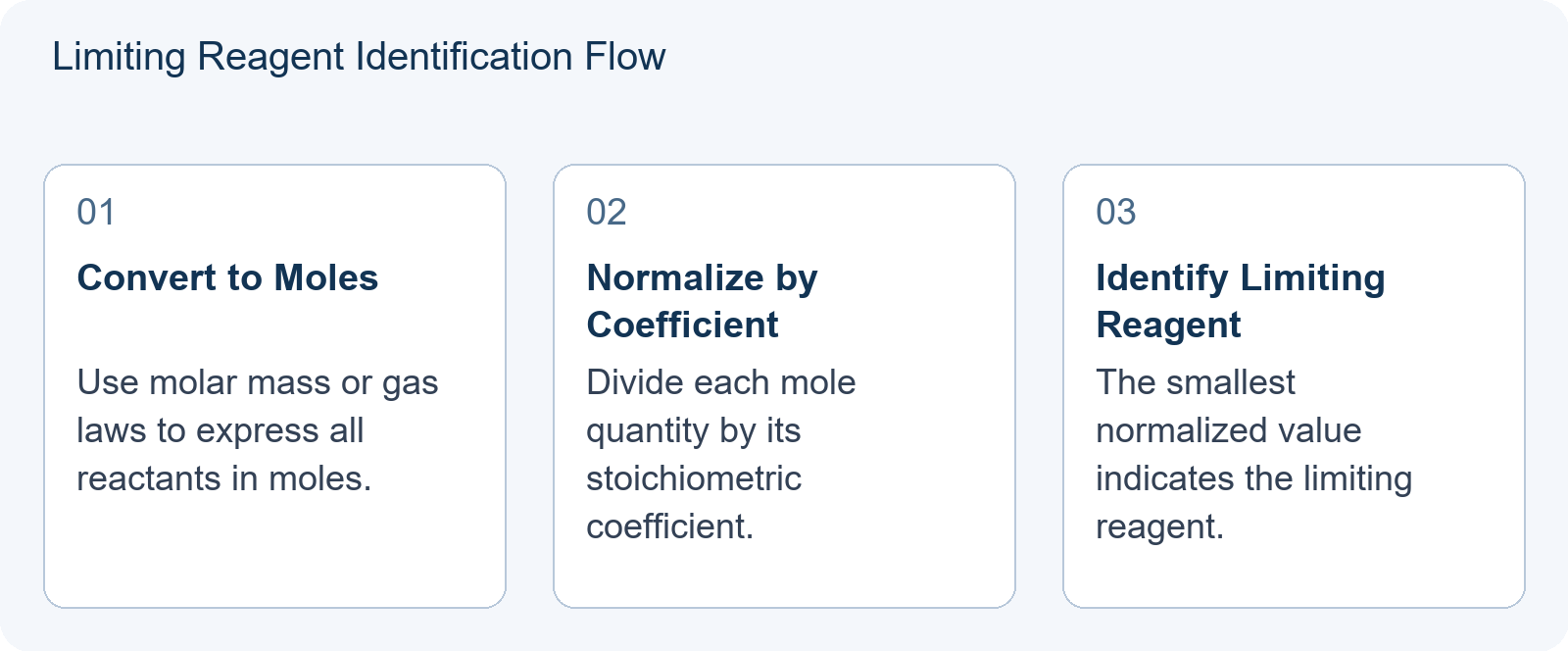
Many students convert masses to moles, then immediately calculate a theoretical yield from whichever reactant they notice first. The correct sequence requires an intermediate comparison: which reactant, relative to the balanced equation, will be exhausted first? Only after answering that question should any yield be computed.
The error pattern is not primarily arithmetic. It is procedural: the yield calculation precedes the limiting-reagent identification. USNCO multiple-choice questions exploit this by offering distractors that are numerically correct for the wrong reactant.
Teaching Illustration 1: Straightforward Comparison
Consider the Haber process:
N₂ + 3H₂ → 2NH₃
Available: 2.00 mol N₂ and 5.00 mol H₂.
Step 1—Normalize each reactant by its stoichiometric coefficient:
- N₂: 2.00 mol ÷ 1 = 2.00
- H₂: 5.00 mol ÷ 3 = 1.67
Step 2—Identify the smaller value: 1.67 < 2.00, so H₂ is limiting.
Step 3—Calculate yield from the limiting reagent only:
5.00 mol H₂ × (2 mol NH₃ / 3 mol H₂) = 3.33 mol NH₃
Unchecked assumption that fails: A student who calculates from N₂ without verification obtains 2.00 mol N₂ × (2 mol NH₃ / 1 mol N₂) = 4.00 mol NH₃. This value appears as a plausible distractor but is impossible given the available hydrogen.
Teaching Illustration 2: Where Mass Ratios Mislead
Consider the combustion of propane:
C₃H₈ + 5O₂ → 3CO₂ + 4H₂O
Available: 44.1 g C₃H₈ and 160.0 g O₂.
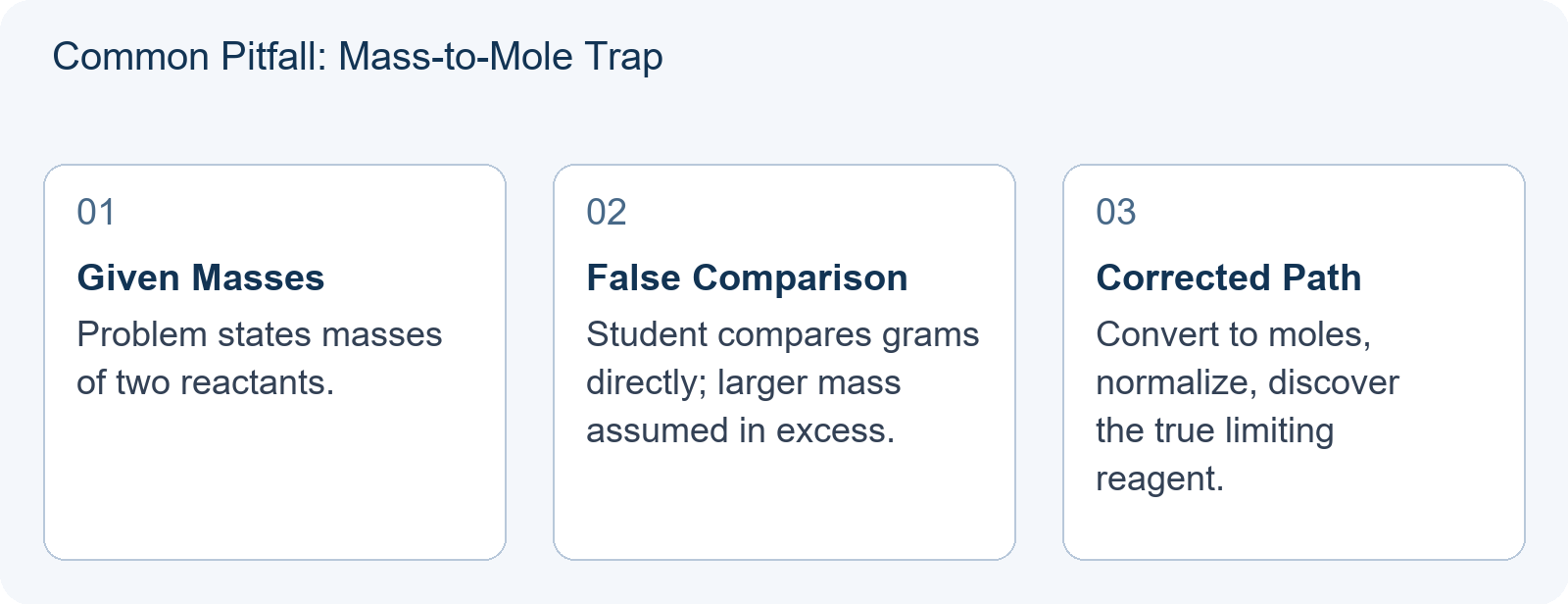
A student might note that 160.0 is much larger than 44.1 and assume O₂ is in excess. Convert to moles:
- C₃H₈: 44.1 g ÷ 44.10 g/mol = 1.000 mol
- O₂: 160.0 g ÷ 32.00 g/mol = 5.000 mol
Normalize by coefficients:
- C₃H₈: 1.000 ÷ 1 = 1.000
- O₂: 5.000 ÷ 5 = 1.000
The normalized values are equal. The reactants are in exact stoichiometric ratio; neither is in excess. The theoretical yield of CO₂ is 1.000 mol C₃H₈ × (3 mol CO₂ / 1 mol C₃H₈) = 3.000 mol CO₂.
Critical point: If the O₂ mass were reduced to 150.0 g (4.688 mol), the normalized O₂ value would drop to 0.938, making O₂ limiting despite its larger mass. The initial mass ratio (160:44.1) correctly suggested O₂ excess only because it happened to match the stoichiometric requirement; the general rule is unreliable.
Teaching Illustration 3: The Contrasting Mistake Worked Through
Using the same propane combustion, a student receives 16.0 g CH₄ (methane, not propane—distractor confusion) and 160.0 g O₂. The student writes the wrong equation:
CH₄ + 2O₂ → CO₂ + 2H₂O
Available: 16.0 g CH₄ and 160.0 g O₂.
Step 1—Convert to moles:
- CH₄: 16.0 g ÷ 16.04 g/mol = 0.998 mol ≈ 1.00 mol
- O₂: 160.0 g ÷ 32.00 g/mol = 5.00 mol
Step 2—Normalize by coefficients:
- CH₄: 1.00 ÷ 1 = 1.00
- O₂: 5.00 ÷ 2 = 2.50
Step 3—Identify limiting reagent: CH₄ at 1.00 < 2.50.
But the student, rushing, calculates yield from O₂: 5.00 mol O₂ × (1 mol CO₂ / 2 mol O₂) = 2.50 mol CO₂. This is the distractor value. The correct yield from CH₄ is 1.00 mol CO₂. The error: using the excess reagent, failing to identify the limiting reagent first. The 2.50 mol CO₂ answer appears in options precisely because it is arithmetically correct from a plausible but wrong starting point.
Diagnostic Table: Three Error Patterns
| Error | Manifestation | Correction |
|---|---|---|
| Mass comparison | Comparing gram amounts directly without molar-mass conversion. | Convert all quantities to moles first. |
| Coefficient neglect | Using mole values without dividing by stoichiometric coefficients. | Normalize: moles ÷ coefficient. |
| Wrong-reactant yield | Calculating product from the excess reagent. | Identify limiting reagent first; derive yield only from that reactant. |
Practice Decision Framework
For timed USNCO conditions, use this sequence:
- Balance: Verify the equation is balanced.
- Convert: Change all quantities to moles.
- Normalize: Divide each by its coefficient.
- Identify: Select the smallest quotient as limiting.
- Yield: Calculate product using only the limiting reagent.
This five-step protocol prevents the common failure mode of premature yield calculation. For broader context on where stoichiometry fits within the USNCO exam structure, see our analysis of Stoichiometry, Solutions and Gases: The USNCO Topics You Think You Have Already Mastered (2026). This article differs by focusing narrowly on the specific reasoning failure of limiting-reagent identification rather than repeating the broad topic overview found there.
For practice material beyond answer keys, our guide on USNCO Past Papers: Requesting Explanations Beyond an Answer Key discusses how to extract learning from worked solutions. Students comparing competition options may also consult USNCO vs CCC: Which Chemistry Competition to Prepare for When You Cannot Do Both. For administrative guidance, see USNCO Registration Through an ACS Local Section: What the Coordinator Actually Needs From You.
Next Skill: Multi-Step Synthesis
After mastering single-step limiting-reagent identification, the next progression is multi-step synthesis. In such problems, the limiting reagent of the first step caps the amount available for the second step. The output mole quantity of step 1 becomes the input for step 2, and the same normalization procedure applies at each stage. Practicing this chaining is essential for National Exam problems that combine stoichiometry with equilibrium or thermodynamic calculations.
Frequently Asked Questions
Can the limiting reagent change if I add more of the other reactant?
Yes. Adding excess of the other reactant does not change the limiting reagent until the added amount exceeds the stoichiometric requirement relative to the original limiting reagent. At that point, the original limiting reagent may become the excess reagent, or the mixture may reach a new stoichiometric match.
How do limiting reagents apply in acid-base titrations?
In titrations, the equivalence point represents the stoichiometric match between analyte and titrant. Before equivalence, the titrant is the limiting reagent; after equivalence, the analyte is exhausted and the titrant is in excess. The calculation of equivalence volume is structurally identical to limiting-reagent analysis.
Is there a shortcut for comparing two reactants without calculating full yields?
Yes. Compare the ratio (moles A / coefficient A) versus (moles B / coefficient B). The smaller ratio identifies the limiting reagent directly, without computing either theoretical yield.