If you study at a high school in the United States but hold neither US citizenship nor a green card, you can sit the USNCO Local Section Exam, and you cannot be nominated for the National Exam, whatever you score. That line is drawn by the American Chemical Society’s rules, not by your school. This guide covers how entry works from a US school, a September-to-March plan, and how to report a Local-only result accurately.
First, check that this is your case: status decides, not the map
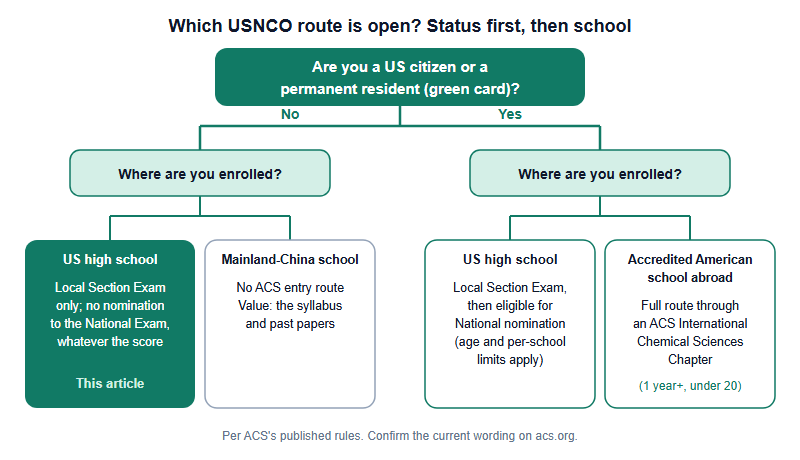
USNCO eligibility turns on legal status first and on the school second. The type of visa in your passport is not what ACS asks about; the question is whether you are a US citizen or a permanent resident. For many Chinese students at American boarding and day schools the answer is neither, and that puts you in the case this article covers. The table separates it from the three positions it is most often confused with.
| Your legal status | Where you are enrolled | What ACS allows |
|---|---|---|
| Not a US citizen or permanent resident, for example on a student visa | A high school in the United States | The Local Section Exam only. ACS states that such students cannot be nominated to sit the National Exam, regardless of score. This article. |
| US citizen or permanent resident (green card holder) | A high school in the United States | The standard route: the Local Section Exam, then eligibility for nomination to the National Exam, within ACS’s age and per-school limits |
| US citizen or permanent resident | An accredited American-curriculum school abroad, including in mainland China, attended for at least a year, while under 20 | The full route, organised through an ACS International Chemical Sciences Chapter |
| Chinese passport, no US permanent residency | A school in mainland China | No ACS entry route. The value lies in the syllabus and the past papers, not in registration |
Three edge cases catch families out, so check them before you plan anything:
- A green card changes your row. The National Exam requirement is citizenship or permanent residency, and a signed legal-status declaration is required at that stage. If your status is changing, raise the timing with your coordinator and confirm it on acs.org rather than assuming.
- Changing US schools can change your section. ACS places each student in the competition of the section where their high school is located, so a mid-year move can mean a new coordinator, a new exam date and a new registration conversation.
- A US online high school does not bring the route to China. ACS assigns a cyber student to the local section where they are geographically located, not where the online school is based. As we read the rules, a student living in mainland China without US citizenship or permanent residency is therefore not in this case and has no ACS entry route; confirm on acs.org if your arrangement is unusual.
How entry works when your school is in the United States
Inside the United States the competition runs through ACS local sections, and ACS gives you no choice about which one: a student may take part only in the competition of the section in which their high school is located. For a boarding student, that means the section around the school, not anywhere connected to home. If you want the structure above the Local tier first, our overview of what the USNCO is sets out all four stages.
ACS publishes a student registration date each season and directs parents and guardians to their USNCO Coordinator. For the 2027 season, registration opens on 1 November 2026. Registering does not itself establish National Exam eligibility or nomination; ask your coordinator to confirm your participation route and arrangements.
The paper itself is set by ACS. It lists the Local Section Exam as 60 multiple-choice questions in 110 minutes. The 2025 booklet gave four options per question, scored correct answers only, and told candidates it was to their advantage to answer every question; a periodic table and a data page were printed inside. Only non-programmable calculators are allowed, and a phone, or any device that can go online or photograph the paper, is grounds for disqualification.
| Question | Who decides | What we can tell you |
|---|---|---|
| May I sit the Local Section Exam? | ACS rule | Yes, at a US high school, if your section can accommodate you |
| Can I be nominated for the National Exam? | ACS rule | No, without US citizenship or permanent residency |
| How do I register? | ACS, through your coordinator | ACS directs parents and guardians to contact their USNCO Coordinator; registration does not guarantee a seat |
| What is the paper? | ACS | 60 multiple-choice questions in 110 minutes; non-programmable calculators only |
| When and where do I sit it? | Your local section | 28 February–2 March 2027; your coordinator confirms the local date and venue |
| Is there a translated paper? | Your local section, within ACS’s rules | ACS’s rules allow the exam to be translated; do not assume a Chinese version exists, and ask |
| What result will I receive? | Your local section | Ask before the exam; do not assume a certificate or a ranking |
A September-to-March plan for a boarding-school student
For boarding-school students, plan permission to leave campus, winter-break travel and the local exam appointment early. Use the current ACS dates below and ask your school and USNCO Coordinator to confirm the practical arrangements.
| 2027 USNCO milestone | Date |
|---|---|
| Student registration opens | 1 November 2026 |
| Local Exam | 28 February–2 March 2027 |
| National Exam — eligible nominees only | 16–18 April 2027 |
| Study Camp | To be confirmed by ACS |
| IChO | 19–28 July 2027 |
- September. Confirm your row in the first table. Then ask your chemistry teacher two questions: does our school take part in the local section’s selections, and who is our USNCO coordinator? If nobody knows, ask the head of science next, and the section itself after that.
- From 1 November 2026. Complete the student registration process with your USNCO Coordinator’s guidance. State your citizenship and school situation accurately, and ask the coordinator to confirm your participation route and local closing date.
- November to January. Build pace for 60 questions in 110 minutes, which is about 110 seconds a question. Use winter break for two full timed papers, because it is the longest uninterrupted block you will get before the window.
- February to March. Get your section’s date and venue in writing, check them against spring break, and arrange a campus sign-out if the exam is off site. Pack a non-programmable calculator and leave the phone in your room.
- After the exam. Coordinators choose National nominees from the local results, and you will not be among them. Ask what the section issues, and record it exactly as issued.
The practice material is the same for everyone. Our gathered pack of past papers runs from 1999 to 2025, with worked solutions for some years and not others, and you can request it through this site. Work the Local papers for pace, but also work some National-style written questions, even though you will never sit that paper. That is where you build the depth a chemistry teacher can see and describe.
What “Local only” means, and the titles you cannot claim
ACS’s wording leaves no room for interpretation: students who do not meet the citizenship criteria take part in the Local Exam only, without the possibility of nomination to the National Exam, however well they score. Nomination is scarce even for eligible students, because no more than two students per high school per local section may be nominated, and those places can only go to students who meet the citizenship rule.
Several titles are therefore out of reach from this case, and they should never appear anywhere in an application: National Exam nominee or qualifier; High Honors, awarded to roughly the top 50 at the National Exam; Honors, the next 100 or so; Study Camp invitee; and Team USA. Per our own records, six students we taught advanced to the National Exam in 2026 and one was selected for the Study Camp, and under ACS’s rules every one of them had to be a US citizen or permanent resident. We say so because families sometimes assume that a coach, a school letter or a fee can move the line. None of them can.
The better move is to set targets the Local tier can carry: a benchmark score on unseen timed papers before the window, a set of written solutions your teacher has actually read, and a result on the day that you can report without qualification.
Making a Local-only result count in a US application
Admissions readers rarely take a single line at face value. They check an award against the transcript, the activity list and the essays, and a claim becomes believable when those parts corroborate one another. A Local Section Exam score is a modest signal on its own. It becomes a stronger one when your chemistry grades, a recommendation from the chemistry teacher who saw your preparation, and a sustained chemistry activity all point the same way. Nothing here guarantees an outcome; the point is that an accurate result inside a consistent file is easy to believe, and an inflated one is easy to doubt.
| Draft line | Use it? | Why |
|---|---|---|
| “USNCO National qualifier” or “USNCO Honors” | No | Both belong to the National Exam, which ACS does not open to students without US citizenship or permanent residency |
| “Top 5% in the USNCO” | Only if your section issued that figure | A percentile you estimated yourself is not a result |
| “USNCO Local Section Exam, [section name] ACS Local Section, 2027: 44/60” (illustrative score) | Yes | It names the tier and the section, and reports what was issued |
| Additional information: “Under ACS citizenship rules I was eligible for the Local Section Exam only.” | Yes, in one sentence | It explains why the record stops before a reader has to wonder |
| A teacher recommendation that mentions your olympiad preparation | Yes, if the teacher saw the work | Independent corroboration of the same claim |
One more habit costs almost nothing: keep dated, marked copies of the timed papers you sit through the autumn. They show a trajectory, and they give a recommender something concrete to describe. If you are still unsure which row of the first table you are in, read our eligibility guide covering all three cases before you register. If this is your case, the route is short but real: register early, sit the paper well, and describe the result exactly.
Frequently asked questions
Can I be nominated for the National Exam if I top my local section?
No. ACS allows students without US citizenship or permanent residency to take the Local Exam only, with no nomination regardless of score.
Which ACS local section do I enter through?
The one where your high school is located. ACS does not let you choose, so a boarding student enters where the school is, not near home.
Is there a penalty for wrong answers on the Local Section Exam?
The 2025 booklet scored correct answers only and advised answering every question. Read the current booklet’s directions on the day.
I live in China and attend a US online high school. Does this route apply?
No. ACS places cyber students in the section where they are geographically located. Without US citizenship or a green card, there is no ACS route.
This is the USNCO information desk, synchronising official ACS information for chemistry students in China, operated by Hanlin Education. The USNCO is run by the American Chemical Society (ACS), which sets all official rules and eligibility; always confirm current details on acs.org. Anything we get wrong here is corrected within 7 working days of being reported.