
Honestly: it front-loads about half of what a chemistry degree asks of you, and that half is the problem-solving one. The thermodynamics, equilibrium and organic reasoning you drill for the USNCO map closely onto first-year problem sets. Bench hours, uncertainty analysis, instrument work, reading the literature and long-form writing do not appear on any olympiad paper, and a degree is assessed on those too.
The short answer, and the caveat that comes with it
A chemistry degree assesses two broadly different capabilities. One is quantitative reasoning: can you take a described chemical situation, choose a model, and get a defensible number out of it under time pressure. The other is practice and communication: can you make a measurement that means something, work out how wrong it might be, read what other people have found, and write it up so that a stranger could repeat it.
Olympiad preparation is an unusually efficient way of building the first capability, largely because it forces density. A student who has worked through a decade of past papers has met a far higher density of multi-step quantitative chemistry than a school course usually delivers. That is a real head start, and it shows up early.
It does close to nothing for the second capability, and it is worth being blunt about that rather than pretending the two halves are one skill. There is also a selection effect that any honest account has to name: the students who take to olympiad chemistry tend to be students who would have done well in a chemistry degree anyway. The training is one input, not a cause, and nothing here promises an outcome at any university or in any course.
What transfers almost intact
The transfers are more specific than “you get better at chemistry”. Each one is a habit that reappears in a recognisable place.
| Habit built by olympiad preparation | Where it reappears in a degree | How strong the transfer is |
|---|---|---|
| Multi-step mole and stoichiometry bookkeeping | Weekly problem sets across every first-year strand | Direct, almost unchanged |
| Free energy, equilibrium constants and rate laws as one connected system | Physical chemistry | Direct; the formalism is the same, the depth increases |
| Acid-base, buffer and solubility equilibria | Analytical chemistry and any titration-based practical | Direct, and unusually useful in the teaching lab |
| Reasoning about electrons rather than memorising reactions | Organic chemistry | Strong, provided you learned it as reasoning |
| Periodic trends and bonding models rebuilt from principles | Inorganic chemistry | Strong for the descriptive foundations |
| Unit discipline and significant figures carried through a chain | Every laboratory report, permanently | Partial: the habit transfers, the depth does not |
| Reading a dense problem before starting to compute | Closed-book examinations of any kind | Direct, and it generalises beyond chemistry |
| Sustained independent study without being set work | The whole degree, immediately | Often the single most valuable transfer |
The last row deserves emphasis because it is the one students undervalue. Most of what makes the first year of a science degree hard is not the content; it is that nobody checks your homework, nobody notices when you fall behind, and the assessment arrives months after the teaching. A student who has already run a self-directed year of chemistry, with their own schedule and their own error log, has rehearsed exactly that.
What olympiad training leaves you missing
The gaps are not accidental omissions. They are the things a written examination structurally cannot test.
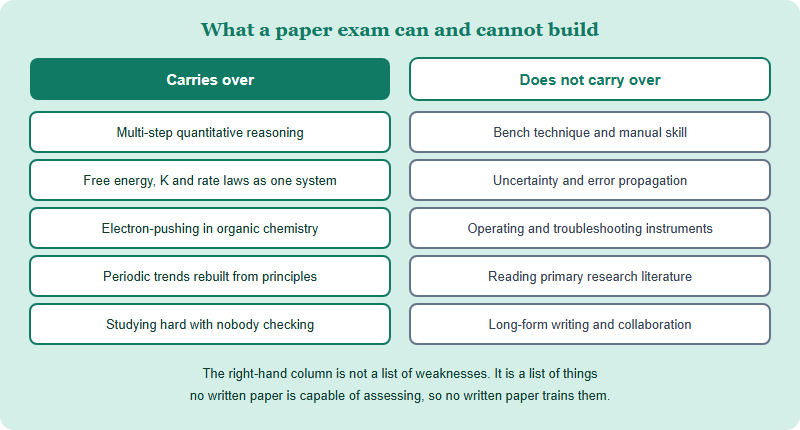
Two of these are worth expanding, because students routinely believe they already have them.
Uncertainty is not significant figures. Olympiad papers train you to round sensibly and carry units. A degree asks something harder: given the tolerance of the glassware, the resolution of the balance and the spread across repeats, how wrong might this number be, and which single measurement dominates that error. Rounding rules are a shadow of that question. Students who mistake the shadow for the thing can arrive confident and still lose marks on laboratory reports until they learn the difference.
Writing is a genre, not a transcription. An olympiad answer is judged on whether the chemistry is right and legible. A report is judged on structure, on whether the method could be repeated by a stranger, on whether the discussion engages with the error rather than apologising for it. Nothing about writing fast, correct exam answers prepares you for that, and it is one place a strong problem-solver can get a mediocre mark.
The laboratory gap is the real one, and the exam structure shows it
There is a neat piece of evidence for how central the practical half is, and it comes from the competition itself. The USNCO National Exam is not a single written paper: it is built in parts, with a laboratory practical sitting alongside the written components, so that the assessment does not rest on paper alone. You can read how the exam is structured for the wider picture, and the current format should always be confirmed on acs.org. The design point stands on its own: a written paper is not the whole of how the competition measures a chemist.
For many readers of this site the gap is doubled, because entry to the exam depends on passport and enrolment rather than on ability, and there are three distinct cases rather than one rule. If you are studying the syllabus without a route to sit any of it, set out in the eligibility position, honestly, then you will never meet a practical component at all. That makes closing the laboratory gap deliberately more important, not less.
You cannot manufacture a research laboratory. You can do more than most students assume:
- Treat school practicals as the real thing. It is easy to execute a recipe and copy the expected result. Run the same practical as if the answer were unknown: record what you actually observed, including the parts that went wrong.
- Keep a dated notebook, in ink, in order. Not a write-up produced afterwards. A record made while working, with the failed attempt still in it, is the habit that transfers.
- Repeat a measurement five times. One titration teaches technique. Five teaches you what spread looks like, which is the beginning of understanding uncertainty.
- Propagate error on data you measured yourself. Take one of your own results, find the tolerance of every instrument you used, and work out which one dominates. Doing this once properly is worth more than reading about it.
- Read a procedure and predict the failure. Before you start, write down where you expect the error to enter. Then check whether you were right.
- Write one full report to journal conventions. One, done properly and criticised by someone, beats ten school write-ups.
A two-year plan that closes the gap rather than widening it
The failure mode for a committed olympiad student is not laziness. It is a lopsided profile: superb at problem sets, invisible in a laboratory, and unable to write. Sequencing fixes that without giving up the problem-solving gains.
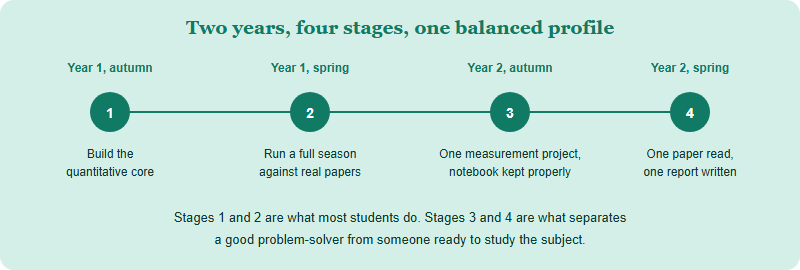
Stage two is the only stage that needs specific material. Work against genuine papers rather than invented exercises, because the density and the phrasing are the point; our gathered pack runs from 1999 to 2025, with worked solutions for some years and not others, and the method for using it matters more than the volume. Stage three needs no equipment beyond what a school teaching laboratory already has. Stage four needs one review article you are prepared to read four times, slowly, with a dictionary.
What this does not decide
A strong olympiad background does not tell you whether you will enjoy a chemistry degree, and the two experiences are less alike than the subject name suggests. A competition rewards speed on problems with known answers. Research rewards patience on problems with no answer yet, where most of the work is making a measurement trustworthy. Students who love the first sometimes find the second slow, and students who found competitions stressful sometimes flourish at a bench. Neither result is a failure of preparation.
On applications, the useful framing is corroboration rather than credit. A chemistry claim becomes believable when independent parts of a file agree with it: the transcript, what a teacher has actually seen you do, and what you can discuss in detail all pointing the same way. Several results across one profile corroborate each other, and that is what makes the whole file credible. What no result does is guarantee anything, and any figure attached to that claim should carry its source.
The practical conclusion is simple enough. Olympiad chemistry is one of the most efficient ways to build the quantitative half of a chemist, and it is worth doing for that reason alone, whether or not an entry route is open to you. Just do not mistake half a chemist for a whole one, and spend some of the second year building the half no paper can test.
Frequently asked questions
Does olympiad chemistry prepare you for a chemistry degree?
It front-loads the quantitative half of first year and almost none of the laboratory half, so treat it as one part of the job.
What does olympiad training not give you?
Bench hours, uncertainty analysis at depth, instrument work, reading primary literature and writing long-form laboratory reports.
Can I close the laboratory gap without a research laboratory?
Partly. Run school practicals properly, keep a dated notebook, and do real error propagation on data you measured yourself.
Is the training wasted if I have no route to sit the exam?
No. The chemistry transfers whether or not a certificate exists, though the entry rules still decide what you can claim.
This is the USNCO information desk, synchronising official ACS information for chemistry students in China, operated by Hanlin Education. The USNCO is run by the American Chemical Society (ACS), which sets all official rules, formats and eligibility; always confirm current details on acs.org. Anything we get wrong here is corrected within 7 working days of being reported.