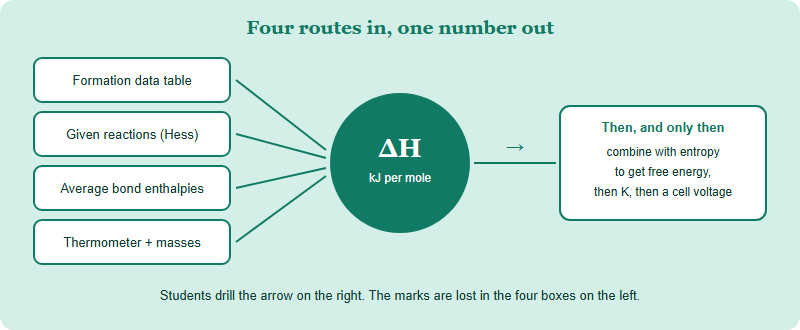
An enthalpy change is almost never handed to you. It is reconstructed, by one of four routes: tabulated formation data, a Hess cycle built from reactions you are given, average bond enthalpies, or a thermometer reading. Each route has its own equation, its own sign trap, and its own built-in error. Knowing which route a question wants is most of the work.
Four routes to one number
Thermochemistry is the quiet half of thermodynamics. The loud half is free energy and spontaneity, and that half gets drilled hard because it is obviously examinable. But every free-energy question needs a ΔH from somewhere, and the place it comes from is decided by what the question puts in front of you. Read the data block before you read the question, and the route chooses itself.
| What the question gives you | Route | The relationship | Built-in error |
|---|---|---|---|
| A table of standard enthalpies of formation | Formation data | Sum over products minus sum over reactants, each weighted by its coefficient | None to speak of, provided the physical states match |
| Two or three reactions with their own enthalpy changes | Hess cycle | Reverse, scale and add the given equations until they sum to the target | None; the error is arithmetic and sign, not method |
| A list of average bond enthalpies | Bond enthalpies | Bonds broken minus bonds formed | Real: values are averages, and the method assumes everything is a gas |
| Masses, concentrations and a temperature change | Calorimetry | Heat from mass, specific heat capacity and temperature rise, then divide by moles | Heat lost to the surroundings and the calorimeter itself |
Formation data: the default route, and the state trap
The formation route is a subtraction: add up the standard formation enthalpies of the products, each multiplied by its coefficient, and subtract the same sum over the reactants. Two things make it go wrong.
The first is the zero. An element in its standard state has a formation enthalpy of zero, and you have to know which form counts as standard: dioxygen rather than ozone, graphite rather than diamond, liquid bromine rather than bromine vapour. A table that lists a value for graphite of zero and a small positive value for diamond is not being pedantic; it is telling you that diamond is not the reference.
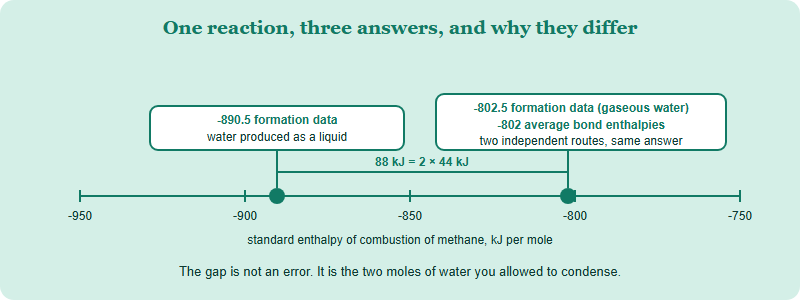
The second, and by far the more expensive, is physical state. Consider the combustion of methane, using a typical set of tabulated values in kJ per mole: methane gas at -74.6, carbon dioxide at -393.5, liquid water at -285.8 and gaseous water at -241.8. With liquid water as the product the answer comes to -890.5 kJ per mole. With gaseous water it comes to -802.5. The two differ by 88 kJ, which is exactly twice the 44 kJ it takes to vaporise a mole of water at room temperature, because the only difference between the two calculations is whether you let the two moles of product water condense.
That 88 kJ is not a rounding difference. It is bigger than the entire enthalpy change of many reactions you will be asked about. Whenever a combustion answer is out by something close to a round multiple of 44, check the state symbols before you check anything else.
One caution that applies to every number in this article: tabulated values differ slightly between sources, and an exam supplies its own data. Use the table in front of you rather than one you memorised. The values here are typical published ones, used to show the shape of the calculation.
Bond enthalpies: the approximate route, and why it disagrees on purpose
The bond-enthalpy route is bonds broken minus bonds formed. Breaking bonds costs energy, so that term is positive; forming bonds releases it, so that term is negative overall. In our own marking this sign is reversed more often than any other in thermochemistry, usually because they have half-remembered that “bond forming is exothermic” and applied it to the wrong end of the subtraction.
Run the same methane combustion with one common set of average bond enthalpies: a carbon-hydrogen bond at 413, an oxygen-oxygen double bond at 498, a carbon-oxygen double bond in carbon dioxide at 799, and an oxygen-hydrogen bond at 463, all in kJ per mole. Breaking gives four C-H bonds and two O=O bonds, or 1652 plus 996, which is 2648. Forming gives two C=O bonds and four O-H bonds, or 1598 plus 1852, which is 3450. The estimate is 2648 minus 3450, or about -802 kJ per mole.
Compare that with the two formation-data answers. It agrees closely with the gaseous-water figure of -802.5 and misses the liquid-water figure of -890.5 by nearly 90 kJ. That is the whole lesson of the method in one comparison. Bond enthalpies describe gas-phase species being pulled apart and put back together; they cannot know that your product condensed. Compare like with like and the agreement is good. Compare a bond-enthalpy estimate against a liquid-water combustion value and you will conclude, wrongly, that you have made an arithmetic error.
Hess cycles: bookkeeping you can show
Enthalpy is a state function, which is a formal way of saying the route does not matter, only the endpoints. That single property is what licenses the whole method: reverse a given equation and flip the sign of its enthalpy change; double an equation and double its enthalpy change; add equations and add their enthalpy changes. Do this until the given reactions sum to the target reaction, and the enthalpy changes sum to the answer.
A small worked case. Suppose you are given that burning carbon to carbon dioxide releases 393.5 kJ per mole, and that burning carbon monoxide to carbon dioxide releases 283.0 kJ per mole. The target is the formation of carbon monoxide from its elements, which is very hard to measure directly because you cannot easily stop the combustion halfway. Subtract the second reaction from the first: -393.5 minus -283.0 gives -110.5 kJ per mole. That number is the standard formation enthalpy of carbon monoxide, obtained without ever running the reaction cleanly.
Two disciplines make Hess questions reliable. Write every intermediate equation out in full rather than manipulating them mentally, because the whole method is bookkeeping and mental bookkeeping is where signs die. And check that the species you wanted to cancel actually cancelled, on the correct side, in the correct amount.
The Born-Haber cycle is the same idea applied to an ionic solid, assembled from atomisation or sublimation, ionisation energies, bond dissociation, electron affinities and the lattice enthalpy. It is usually set up so that the lattice enthalpy is the unknown, because it is the one term that cannot be measured directly. There is a genuine landmine here: lattice enthalpy is defined in one convention as the formation of the solid from gaseous ions, which is exothermic and negative, and in another as the dissociation of the solid into gaseous ions, which is endothermic and positive. Different textbooks use different conventions. Read the definition given in the question and follow that one, even if it is not the one you were taught.
Calorimetry: where the chemistry meets a thermometer
The calorimetry route starts from heat absorbed by the surroundings: mass multiplied by specific heat capacity multiplied by temperature change. The heat released by the reaction is the negative of that. Then, and this is the step students most often stop before, you divide by the number of moles that actually reacted to turn joules into an enthalpy change per mole.
Take a neutralisation. Fifty millilitres of hydrochloric acid at one mole per litre is mixed with fifty millilitres of sodium hydroxide at the same concentration, both starting at 21.0 degrees Celsius, and the temperature rises to 27.8. The mass that warms up is the whole 100 grams of solution, not the mass of solute; the specific heat capacity is taken as that of water, 4.18 joules per gram per kelvin. The heat is 100.0 times 4.18 times 6.8, which is about 2842 joules, or 2.84 kJ. The moles of water formed are 0.0500. Dividing gives about -56.8 kJ per mole, which is close to the accepted value for strong-acid neutralisation.
The recurring traps are worth listing plainly:
- Wrong mass. The solution warms up, so use the combined mass of the mixed solutions, not the mass of the solute or the mass of one reagent.
- Forgetting the calorimeter. If the question gives a heat capacity for the apparatus, that term is additional and is not optional.
- Stopping at joules. An enthalpy change is per mole. A question asking for kJ per mole and answered in J is answered in the wrong quantity.
- The sign. Temperature went up, so the surroundings gained heat, so the reaction lost it, so the enthalpy change is negative. Say that sentence to yourself rather than trusting a remembered rule.
- Limiting reagent. Divide by the moles that actually reacted, which is not always the moles you added.
One distinction that separates olympiad-level thermochemistry from school thermochemistry: a coffee-cup calorimeter runs at constant pressure and therefore measures an enthalpy change directly, while a bomb calorimeter runs at constant volume and measures an internal energy change. Converting between them requires the change in the number of moles of gas: at 298 K each mole of gas difference is worth about 2.48 kJ. For many reactions the correction is small, which is exactly why it is easy to forget when it is not.
Drilling it, and a note on who can sit the papers
This block rewards short, frequent practice more than long sessions, because in our experience most of the loss here is procedural rather than conceptual. A two-week repair worth trying:
- Days 1 to 3. Twelve formation-data calculations, deliberately mixing liquid and gaseous water, until state symbols are the first thing you look at.
- Days 4 to 6. Eight bond-enthalpy estimates, each one compared against a formation-data answer for the same reaction, so that you build an instinct for how large the disagreement should be.
- Days 7 to 9. Six Hess problems written out in full, plus two Born-Haber cycles solved for the lattice enthalpy under each of the two sign conventions.
- Days 10 to 12. Calorimetry with a deliberate mix: some questions supplying a calorimeter heat capacity, some with a limiting reagent, some asking for the answer per mole of a specified reactant.
- Days 13 and 14. Mixed set, untimed, marking only whether you chose the right route from the data block. Route selection is the skill; the arithmetic follows.
For source material, work from real papers rather than invented drills, because the way a question buries the route inside the data block is the part you are training against. Our gathered past-paper pack runs from 1999 to 2025; some years come with worked solutions and some do not, and how to actually use the pack matters more than how many papers you own. If you want the wider picture of where thermochemistry sits among the exam parts, start with what the USNCO is and how the exam is built. All exam details, dates and formats should be confirmed on acs.org, which is the only authority on them.
A closing point on access, since it changes what this preparation is for. Whether you can sit the exam at all depends on your passport and on where you are enrolled, and there are three distinct cases rather than one rule; the eligibility position, set out honestly, is worth reading before you plan a season around it. The chemistry in this article is worth learning in every one of those cases, because enthalpy bookkeeping is a permanent skill rather than an exam trick.
Frequently asked questions
Which route should I use if a question gives me both formation data and bond enthalpies?
Use the formation data. It is exact for the states given, while bond enthalpies are averages that assume every species is a gas.
Why does my bond-enthalpy answer disagree with the textbook value?
Usually because the textbook value produces liquid water and the bond-enthalpy method cannot, so the gap is roughly the condensation enthalpy.
Do I divide by moles in a calorimetry question?
Yes. Heat comes out in joules for the amount you used; an enthalpy change is per mole, so divide by the moles that actually reacted.
Which lattice enthalpy sign convention is correct?
Both are in use. Read the definition printed in the question and follow it, rather than the convention your own textbook happens to prefer.
This is the USNCO information desk, synchronising official ACS information for chemistry students in China, operated by Hanlin Education. The USNCO is run by the American Chemical Society (ACS), which sets all official rules, formats and eligibility; always confirm current details on acs.org. Anything we get wrong here is corrected within 7 working days of being reported.