ACS publishes the blueprint for the USNCO multiple-choice paper, and it is far more useful than most students realise: sixty questions, ten topic areas, six questions each, arranged in a fixed order. Every area carries exactly the same weight. That one fact decides where your revision hours should go — and it turns any past paper you own into ten separate topic tests.
An even split is a strategic fact, not a piece of trivia
Most exams reward a bet. You look at the weighting, find the topic worth a quarter of the paper, and pour hours into it. The USNCO multiple-choice paper refuses that bet. ACS describes the paper as sixty questions covering broad chemistry topics, and its published breakdown allocates six questions to each of ten areas. Nothing is worth more than anything else, and nothing can be dodged.
Two consequences follow, and they point in the same direction. The first is that there is no topic you can safely skip: a subject you have never studied does not cost you a fraction of a mark, it costs you a contiguous block of six questions. The second is subtler and more useful. Because every block is capped at six, the marks that are cheapest to win are always sitting in whichever block you currently score lowest in. Lifting a block from two to four is ordinary work. Lifting a block from five to six means beating the hardest question in that area, which is a different order of effort for a fifth of the reward.
For orientation, the published formats are these. The Local Exam is 110 minutes for 60 multiple-choice questions. The National Exam has three parts: Part I, 90 minutes for 60 multiple-choice questions; Part II, 105 minutes for 8 written questions on chemical theories and models; Part III, 90 minutes for 2 laboratory practicals. ACS can adjust any of this, so confirm current details on acs.org before you build a timetable around them. If you are new to how these papers fit together, our overview of what the USNCO is sets out the whole structure first.
The map: which topic sits at which question number
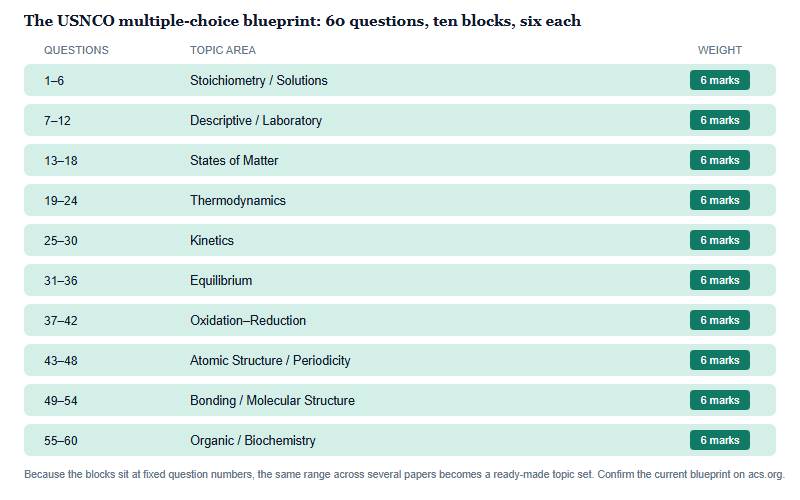
The part that changes how you practise is not just the ten-way split but the fact that the areas appear in a fixed order, by question number. The blueprint ACS publishes reads as follows.
| Questions | Topic area | Marks available | What the block mostly rewards |
|---|---|---|---|
| 1–6 | Stoichiometry / Solutions | 6 | Fast, clean execution |
| 7–12 | Descriptive / Laboratory | 6 | Recall and lab familiarity |
| 13–18 | States of Matter | 6 | Model choice and gas reasoning |
| 19–24 | Thermodynamics | 6 | Sign discipline and chains |
| 25–30 | Kinetics | 6 | Reading rate data |
| 31–36 | Equilibrium | 6 | Set-up before arithmetic |
| 37–42 | Oxidation–Reduction | 6 | Half-equations and bookkeeping |
| 43–48 | Atomic Structure / Periodicity | 6 | Trend direction and rules |
| 49–54 | Bonding / Molecular Structure | 6 | Structure drawing and inference |
| 55–60 | Organic / Biochemistry | 6 | Pattern recognition and naming |
The vertical drill: ten papers become ten topic sets
Here is the method the blueprint unlocks, and it is the single most useful thing on this page. Stop working papers horizontally, one whole paper at a time, and start working them vertically. Take questions 25 to 30 from every paper in your collection and you have a kinetics problem set of sixty questions, written by the people who write this exam, calibrated to exactly the difficulty this exam demands, spanning decades of phrasing. Do the same at 31 to 36 and you have equilibrium. At 55 to 60, organic.
No textbook chapter can give you that. Textbook problem sets are calibrated to the textbook, which is usually either too gentle or aimed at a different examination culture entirely. The vertical drill is calibrated by construction, because every question in it was written for this paper. It also solves the self-studier's worst problem — not knowing whether a question you failed was a fair question or an outlier — because sixty questions from the same block make the distribution of difficulty visible instead of anecdotal.
Run it like this. Choose one block. Pull that question range from eight to ten papers. Work them in groups of six at exam pace — roughly 90 seconds per question at Part I speed, a little under two minutes at Local Exam speed. Mark, then log only the ones you got wrong, then move to the next block next week. Two things to watch: check the block boundaries on the specific paper you are using rather than assuming they hold, since ACS can adjust the blueprint, and do not burn every paper you own on a single topic. Keep three or four papers untouched so you still have clean material for full timed runs later. Our guide to using past papers properly covers how to ration a limited stock of papers across a season; the pack we have compiled is available by scanning the QR code on this site, and some years come with worked solutions while others do not.
One honest limit. The blueprint tells you how many questions come from each area, not how hard they are. A block is not six questions of equal difficulty; it usually runs from something a good school student can do to something that separates the top of the field. So a score of four out of six does not mean “two-thirds of the way there” in any deep sense. It means you are collecting the accessible marks in that block and losing the discriminating ones, which is a different diagnosis from scoring two.
Build a block profile, then route by block type
The natural instrument that falls out of an even blueprint is a profile: ten scores, each out of six, from timed runs on papers you have not seen before. Take three runs, use the median rather than your best, and you have a picture no single total score can give you. Sixty out of sixty and thirty-eight out of sixty are both just numbers; a profile tells you which of ten specific things to do on Monday.
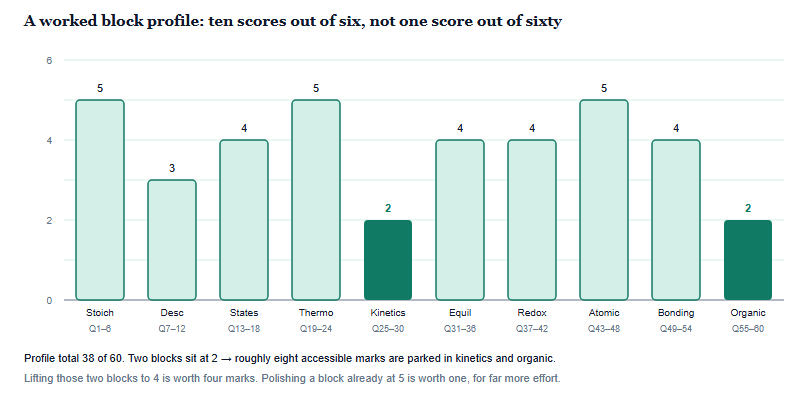
A profile answers “where”. It does not answer “why”, and the two questions need different instruments — a block score of two can mean you have never studied the content, or that you know it well and keep misreading the stem. Pair the profile with a mistake log if you want both answers.
Once you know your two weakest blocks, route by what kind of block they are, because in our teaching team’s experience they do not respond to the same treatment.
- Recall-led blocks — Descriptive / Laboratory, Atomic Structure / Periodicity, Bonding / Molecular Structure, and much of Organic / Biochemistry. These respond to spaced retrieval practice in short, frequent sessions. They convert fastest, which makes them the right first target if your window is weeks rather than months.
- Derivation-led blocks — Thermodynamics, Kinetics, Equilibrium, Oxidation–Reduction. These respond to worked problems and, above all, to practising the set-up rather than the arithmetic. They convert slowly and hold well, which makes them the right first target when you are a year out.
- Execution-led blocks — Stoichiometry / Solutions and much of States of Matter. Here the chemistry is rarely the obstacle and speed under time pressure is. Train them with timed repetition, not with more reading.
The routing matters because, in our teaching team’s experience, students often mis-spend their weakest weeks. Faced with two thin blocks eight weeks before a paper, the instinct is to start with the one that feels most intellectually serious — usually thermodynamics or equilibrium. If the exam is close, that is the wrong order: the recall-led block will usually convert faster than the derivation-led one, which is why our coaches put it first when time is short.
Where the blueprint stops, and who can sit these papers
The blueprint governs the multiple-choice papers. It does not extend in the same form to the rest of the National Exam, and you should not invent one. What ACS publishes is that Part II is 8 written questions in 105 minutes on chemical theories and models, and Part III is 2 laboratory practicals in 90 minutes. Plan those by format — roughly 13 minutes per written question, 45 per practical — rather than by topic block, and confirm the current structure on acs.org.
Scale is worth knowing too, because it sets what a profile is aiming at. ACS states that more than 1,000 students sit the three-part National Exam each April, that approximately the top 50 students are recognised as High Honors and the next 100 as Honors, and that the 20 top-scoring students are invited to a study camp to compete for a place on the U.S. team. Note the vocabulary: the recognitions are High Honors and Honors. Gold, silver and bronze bands belong to other organisations' events, not to ACS's.
Finally, who can actually sit these papers, because it is the question we are asked most and the honest answer is three answers. A student who is not a US citizen or permanent resident but attends a US high school may sit the Local Exam, and ACS states such students cannot be nominated for the National Exam. A US citizen or permanent resident studying abroad — including inside mainland China — at an accredited American-curriculum school, having been there a year and being under 20, can run the full route through an ACS International Chemical Sciences Chapter. A student on a Chinese passport at a mainland Chinese school has no ACS entry route at all. The National Exam citizenship requirement is a hard rule with a signed legal-status declaration attached. Our eligibility guide sets out all three cases in detail. If you are in the third case, the blueprint still earns its place: it is the most efficient map of a first-class general chemistry syllabus you will find, and the profile method works just as well when the goal is competence rather than a certificate.
Frequently asked questions
Are all ten topic areas really weighted equally?
ACS publishes six questions for each of ten areas across the 60. Weightings can change, so confirm the current blueprint on acs.org.
Does the blueprint apply to the Local Exam as well as Part I?
Both are 60 multiple-choice papers. ACS lists 110 minutes for the Local Exam and 90 minutes for Part I; confirm current details on acs.org.
Which block should I train first?
The one furthest below six on two consecutive timed runs, not the topic that feels hardest. Weeks out, start with recall-led blocks.
Can a student at a mainland Chinese school sit these papers?
Not through ACS on a Chinese passport at a Chinese school. Two other cases do have routes; see our eligibility guide for all three.
This is the USNCO information desk, synchronising official ACS information for chemistry students in China, operated by Hanlin Education. The USNCO is run by the American Chemical Society (ACS), which sets all official rules and eligibility. Always confirm current details on acs.org. Errors are corrected within 7 working days of notice.