
The hardest moment in a chemistry olympiad paper is not a topic. It is the twenty seconds after you read a question and recognise nothing. What is failing there is not your chemistry — it is your search. You are looking for a problem you have seen before, and competition questions are built so that you will not find one. This is a protocol for starting anyway.
The freeze is a search problem, not a knowledge problem
Ask a student who has just lost fifteen minutes to a question what went wrong and the answer is usually “I did not know how to do it.” Watch the same student work and something more specific is happening. They read the stem, scan memory for a matching worked example, fail to find one, read the stem again more slowly, and repeat. The loop is stable and expensive. It can absorb an entire paper.
The reason the loop never terminates is that it is searching on the wrong key. Students who have prepared by working through solutions have indexed their knowledge by surface: this is a titration question, that is a Hess's law question. Competition problems are written by people who know that index exists and deliberately change the surface — an unfamiliar compound, an industrial context, an unusual quantity asked for. The chemistry underneath is on the syllabus. The label on the outside is not in your index.
The repair is to search on structure instead. There are only a few things a chemistry question can be asking, and it is possible to determine which one within a minute of reading, without recognising the problem at all. Once you know that, you know which small set of relations can possibly be relevant, and the blank page ends.
It is worth being clear about the cost structure too, because it changes the decision at the end of the protocol. On the multiple-choice paper there is no partial credit, so a minute spent on a question you cannot start is a minute stolen from questions you can. On the free-response paper the arithmetic is reversed: an unstarted question scores nothing, but a question you have attacked correctly and not finished may still earn marks for the reasoning that is visible. Those are different games, and the same freeze needs a different exit from each.
Minute one: strip the question down to given, asked and units
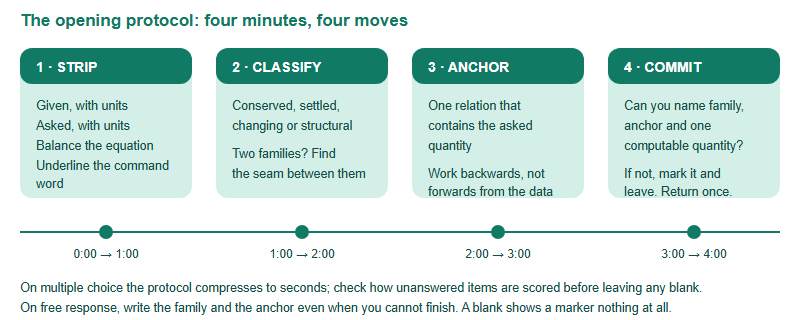
Before any chemistry, do three mechanical things. They take under a minute and they are the difference between reading a question and merely looking at it.
- Write what you are given, with units. Not in your head. In the margin. A quantity whose units you have not written is a quantity you have not really read, and unit changes buried in a stem are the single commonest source of a plausible-looking wrong answer.
- Write what is asked, with units. This is the one students skip, and it is the most valuable of the three. If you cannot state the units of the answer, you do not yet know what the question wants. “A concentration in mol per litre” and “a mass in grams” lead to different first moves even when the chemistry between them is identical.
- Underline the command word and note what is held fixed. Calculate, explain, justify, predict and account for demand different answer shapes; so does a stem that quietly tells you the temperature is constant, or the vessel is rigid, or the solution is saturated. Those clauses are not scene-setting. They are the conditions under which some relation is valid.
If an equation is mentioned, balance it now, while you are still calm. A balanced equation is the cheapest source of structure in the entire problem, and balancing it later, mid-calculation, is how coefficients get dropped.
Minute two: classify into one of four families
This is the move that replaces recognition. Instead of asking “what problem is this?”, ask “what is this question about?” — and the honest answer is always one of four things.
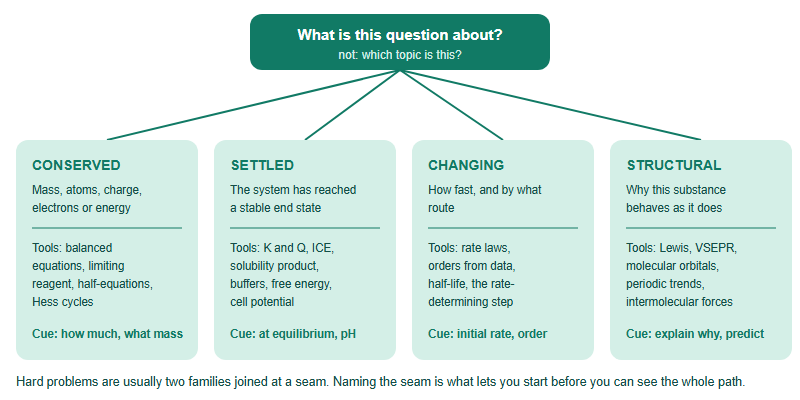
The classification also tells you something a topic label never does: where a hard question is joined together. Most difficult problems are two families stitched at a seam, and almost all of the marks that strong students lose are lost at the seam rather than inside either half.
| What the question looks like | Families involved | Where the seam sits | The step students skip |
|---|---|---|---|
| A weak acid, then some strong base is added; find the pH | Conserved, then settled | After the neutralisation stoichiometry, before the equilibrium relation | Recalculating what is actually left; they apply the equilibrium relation to the original amounts |
| A cell potential at non-standard concentrations | Settled, then conserved | Between the reaction quotient and the electron count | Balancing the half-equations, so the number of electrons transferred is wrong |
| Yield of a gas collected over water | Conserved, then settled | At the pressure correction | Subtracting the vapour pressure of water; skipping it makes every yield come out too high |
| Rate data plus a proposed mechanism | Changing, then structural | Between the experimental order and the proposed slow step | Checking that the mechanism actually predicts the observed order rather than merely sounding reasonable |
| Solubility of a salt in a solution that already contains one of its ions | Settled, then conserved | At the total concentration of the shared ion | Using the pure-water solubility instead of accounting for the ion already present |
| Free energy from enthalpy and entropy, then an equilibrium constant | Settled, then settled | At the temperature and the units | Mixing kilojoules and joules between the two relations |
Minutes three and four: find the anchor, then commit or bail
The anchor is one relation that contains the quantity you were asked for. That is the whole definition, and the constraint is what makes it useful. Most students work forwards from the data, computing whatever is computable and hoping to arrive somewhere; that strategy drowns as soon as a problem has more given quantities than it needs, which competition problems often deliberately do.
Working backwards instead: write the relation containing the target. If every other symbol in it is known, you have finished thinking and can start calculating. If one symbol is unknown, that unknown becomes your new target, and you repeat. Two or three rounds of that will usually reach the data. Take a constructed example — a weak acid partially neutralised by added base, with an acid dissociation constant supplied. The target is pH, so the anchor is the relation linking pH to the constant and the ratio of conjugate base to remaining acid. That ratio is now the target, which is a conservation question, which the stoichiometry answers. The path was built from the end.
Then the decision. After roughly three minutes you should be able to say three things aloud: the family, the anchor, and one quantity you can compute right now. If all three are present, commit and stop deliberating — hesitation after this point is almost always wasted. If any is missing, leave the question, and leave it properly.
Leaving properly means writing down, in ten seconds, what you did establish: the family you think it is, the relation you were reaching for, the assumption you were unsure about. Two things follow. On the free-response paper that written fragment is visible reasoning rather than a blank, and visible reasoning is what a marker can credit. And when you return — once, not three times — the return costs twenty seconds instead of starting over from the stem. Students who bail without writing anything pay the full start-up cost twice, which is why a second attempt so often feels worse than the first.
Training the opening move rather than the whole solution
Here is the inefficiency in ordinary preparation. If the skill that fails is the first two minutes, then solving a problem completely trains that skill once per twenty minutes. You can train it once per ninety seconds instead.
- The openings drill. Take twenty problems. For each, write only the family, the anchor and the first computable quantity, then stop. Do not solve. Thirty minutes, twenty repetitions of exactly the skill that breaks. Then check your family and anchor against the worked solutions and count how often you were right.
- The covered-numbers drill. Read a problem with all the numerical values hidden. Can you still name the family and the anchor? If yes, you are reading structure. If you need the numbers to know what kind of question it is, you are still reading surface.
- The seam drill. For any multi-part question, label the family of each part and mark where the seam falls. Then check the seam against the table above — you will find the same half-dozen joins recurring across years.
- The opening log. Four columns: the problem, the family you chose, the family it turned out to be, and the anchor you should have written. This is a different record from a log of arithmetic mistakes; it catches errors made before any arithmetic exists.
All four drills need real material, which means papers rather than textbook exercises, because textbook exercises are grouped by topic and therefore hand you the classification for free. The pack we have gathered, and a method for mining papers rather than merely attempting them, is set out in our guide to using past papers.
Two honest limits. The protocol converts chemistry you already know into marks; it does not create chemistry you do not have. If you cannot set up an ICE table, classifying a problem as “settled” will not save you, and the answer is content work, not technique. And whether the protocol is worth building at all depends on where you are in the pathway — if you are still deciding whether this competition is relevant to you, start with our overview of what it is and with the eligibility position, which differs sharply depending on your passport and your school. The competition is run by ACS, which sets all rules and formats, so confirm current details on acs.org.
Frequently asked questions
Is four minutes not far too long on a timed paper?
It is a training scaffold. Once the order is automatic the whole sequence takes seconds, and it replaces the far more expensive staring loop.
What if a problem does not fit any of the four families?
Then it usually fits two. Look for the seam: a stoichiometric step feeding an equilibrium, or rate data feeding a structural argument.
Should I write the anchor even if I cannot finish?
On free response, yes. A correct governing relation with a stated assumption is visible reasoning. A blank page is not, and cannot be credited.
How do I know my classification was wrong, not just my arithmetic?
Keep the two records separate. An opening log tracks family and anchor; an error log tracks execution. The fixes are completely different.
This is the USNCO information desk, synchronising official ACS information for chemistry students in China, operated by Hanlin Education. The USNCO is run by the American Chemical Society (ACS), which sets all official rules and eligibility. Always confirm current details on acs.org. Errors reported to us are corrected within 7 working days.