
Students who move from a Chinese-curriculum chemistry background into US olympiad-style chemistry usually report the same thing: they know the chemistry, but the paper feels like a different subject. They are half right. A large part of what they were trained to do transfers directly and is undervalued. A smaller, very specific part does not transfer at all — and that part is where the marks go.
The jump is real, and it is not about ability
This article is written from what we see in scripts, not from any comparison of official documents. The observations below come from marking work by students at international schools in China who did their earlier chemistry in a Chinese-curriculum classroom — many of them in Grade 8 or Grade 9 — and then met a US olympiad-style paper for the first time. The USNCO syllabus and exam format are set by ACS and are the only authority on what is examined; see our overview of the exam and its four tiers, and confirm current details on acs.org.
The pattern is consistent enough to be useful. These students are usually faster and more accurate at calculation than their peers, and stronger on the descriptive chemistry of the elements. They then lose marks in three places that have nothing to do with chemical knowledge: the language the question is asked in, the standard of written justification expected in a free-response answer, and the discipline of knowing when an approximation is permitted.
That is a much better problem to have than a knowledge gap, because it is fixable in weeks rather than months. But it is invisible if you diagnose by topic. A student who reads their score as “I am bad at equilibrium” when the truth is “I never justify an approximation” will spend a term relearning equilibrium and score the same.
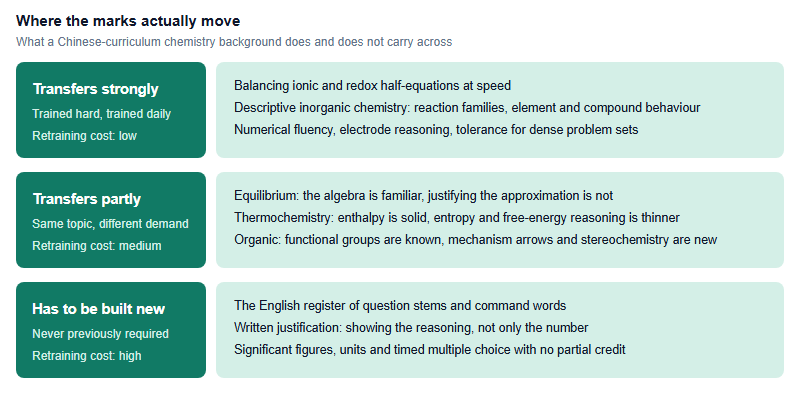
What transfers strongly, and is usually undervalued
The single most underrated asset these students bring is fluency in equation writing. Producing a balanced ionic equation, splitting a redox process into half-equations and balancing them in acid or base is, for them, close to automatic. That is a genuine advantage on any olympiad-style paper, where a multi-part question may hinge on getting a half-equation right in the first thirty seconds so the remaining four parts stay solvable.
The second is descriptive inorganic chemistry. Students arriving from this background typically carry a large working stock of element and compound behaviour — what reacts with what, what colour change signals what, which products are gases and which precipitate. Descriptive chemistry is precisely the material that students trained only on a conceptually elegant course tend to be thin on, and it is not a small part of the subject.
The third is calculation stamina. A student who has spent two years doing long, dense problem sets does not panic at a question with four sequential numerical steps. That composure is worth more than it looks on a timed paper, and it cannot be taught quickly to someone who does not already have it.
The practical implication is a planning one. Do not start the transition by revising inorganic chemistry and stoichiometry, however comforting that feels. Those are your strong assets. Start where the retraining cost is highest.
The three that only half transfer
Equilibrium. The mechanics — setting up an expression, running an ICE table, solving a quadratic — are usually secure. What is often missing is the habit of treating an approximation as a claim that must be tested. Writing that x is small compared with the initial concentration is not a licence granted by the textbook; it is a statement that has to be checked against the answer you obtained and abandoned if it fails. Olympiad-style problems are built specifically to punish an untested approximation, because that is a cheap way to separate students who can execute a procedure from students who understand what the procedure assumes.
Thermochemistry into thermodynamics. Enthalpy, Hess-type reasoning and energy bookkeeping tend to be strong. Entropy as a way of reasoning about whether a process happens, free energy as the quantity that combines the two, and the temperature dependence that follows, tend to be thinner — sometimes recognised as formulae and not as tools. This is the highest-yield topic in the partial band, because thermodynamics questions in the free-response section usually ask you to argue rather than to substitute.
Organic chemistry. Functional groups, naming and standard reaction lists are usually in place. The gap is in representation and mechanism: curly arrows showing where electron pairs move, drawing and interpreting stereochemistry, and reading a structure fluently enough to see what it will do. A student who has learned organic chemistry as a table of transformations can answer “what is the product” and stall completely on “explain why.”
What has to be built new
The small, expensive band has three items, and none of them is chemistry.
| Skill | Status coming in | Why it costs marks | First action |
|---|---|---|---|
| English question register | Not previously required | Command words such as explain, justify, predict and account for each demand a different answer shape | Build a personal list of stems and command words from real papers, not from a dictionary |
| Written justification | Underdeveloped | A correct final number with no visible reasoning is not a complete free-response answer | Rewrite three of your own past answers so a classmate can follow them unaided |
| Significant figures and units | Inconsistent | In our own marking, unclear units and figures make a correct method harder to credit | Fix the convention now; audit the last ten answers you wrote |
| Timed multiple choice | Familiar format, unfamiliar economics | No partial credit means a half-finished method scores the same as a blank | Practise deciding within the first few seconds whether to solve, estimate or move on |
| Approximation discipline | Procedural, not justified | Untested approximations are a deliberate trap in multi-step problems | Add one line to every solution stating why the approximation is allowed |
The language item deserves one clarification, because students often mishear it as a vocabulary problem. It is not, mostly. A student in this position almost always recognises the concept behind a term such as equilibrium constant; they learned it thoroughly, in another language. What they have not internalised is that explain in terms of is an instruction with a required answer shape, or that which of the following is the best explanation is telling you that more than one option will be defensible and only one will be strongest. Register, not vocabulary.
That distinction changes how you should study. Building a bilingual glossary of nouns — substances, quantities, apparatus — is quick and worth doing once. Building a list of verbs and question frames harvested from real papers is slower, less satisfying and worth considerably more, because the nouns already appear in your textbook while the frames appear only in exam questions. If you keep only one list, keep the second one.
An eight-week bridge
The block below attacks the expensive band first, repairs the partial band second, and only then puts a clock on anything. It assumes roughly four hours a week and a student whose school chemistry is already solid.
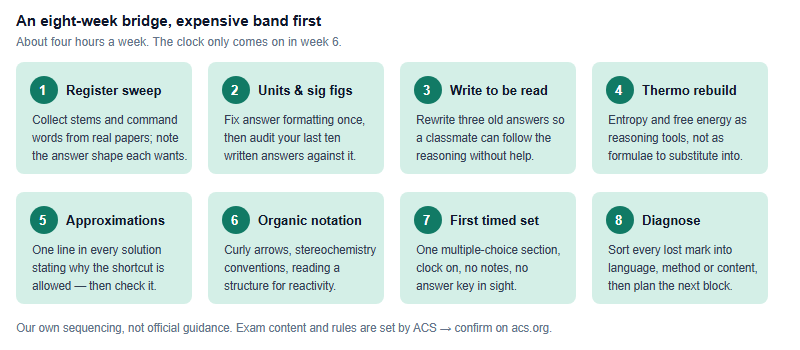
Week 8 is the one people skip and should not. Sorting lost marks into language, method and content is what tells you whether the next block is more chemistry or more writing, and after eight weeks the answer is often not the one you expected. The material to run all of this on is past papers, worked properly — one at a time, under conditions, with the solution out of sight until you are finished. We keep a gathered and organised pack for this, with worked solutions for some years only, and the method for using papers without burning them matters more than how many you have.
Finally, be clear about where this leads, because it differs by passport rather than by ability. A student who is not a US citizen or permanent resident but is enrolled at a US high school may sit the Local Exam; ACS states such students “can only participate in the Local Exam without the possibility of being nominated to sit for the National Exam.” A US citizen or permanent resident at an accredited American-curriculum school abroad, including in mainland China, enrolled there for at least a year and under 20, can run the full route through an ACS International Chemical Sciences Chapter. A student on a Chinese passport at a mainland-China school has no ACS entry route at all — for them this bridge is preparation for school chemistry, university-level study and whatever competitions they are eligible for, which is a real return but a different one. The detail is in our eligibility guide, and the rules are ACS's, so confirm them on acs.org.
Frequently asked questions
Is my chemistry actually behind?
Usually not. Calculation and descriptive inorganic chemistry tend to be ahead. The gaps are in language, written justification and approximation discipline.
Should I relearn everything in English?
No. Learn the question register — stems and command words — from real papers. Translating an entire textbook is slow and mostly wasted.
Which topic should I rebuild first?
Thermodynamics beyond enthalpy. Entropy and free energy as reasoning tools give the biggest return in the partial-transfer band.
Why does my method get marks at school but not here?
Free-response answers are marked on visible reasoning. A correct number with no argument is an incomplete answer, not a shortcut.
This is the USNCO information desk, synchronising official ACS information for chemistry students in China, operated by Hanlin Education. The USNCO is run by the American Chemical Society (ACS), which sets all official rules and eligibility. Always confirm current details on acs.org. Errors reported to us are corrected within 7 working days.