The honest answer: Grade 10 is the natural start and Grade 11 is where the real gains happen. But the year that matters most is not on the calendar — it is the year you finish school chemistry properly. Below is what each year from Grade 9 to Grade 12 is actually for, plus the enrolment rule that quietly decides which route, if any, is open to you at all.
Two ways to get the timing wrong
Almost every timing mistake we see is one of two shapes, and they look nothing alike from the outside.
The first is starting too early on the wrong thing. A Grade 9 student who is still shaky on mole reasoning and equation writing is handed a past paper, works through it with the answer key open beside them, and concludes that olympiad chemistry is a memory game. It is not. Every hour spent decoding a problem you lack the foundations for is an hour that would have paid three times over spent on the foundations themselves. Papers are a diagnostic instrument, not a teaching instrument, and pointing a diagnostic at a system that has not been built yet tells you nothing you did not already know.
The second is starting too late and refusing to admit it. A Grade 12 student who begins in September, in the middle of applications and predicted grades, is not running a preparation plan — they are running a rescue operation with the least available time and the highest competing stakes of any year in school. That does not mean nothing can be salvaged. It means the goal has to change, and pretending otherwise costs both the chemistry and the grades.
The binding constraint, in other words, is rarely ability. It is the date on which your school chemistry became solid enough to build on, and how many uninterrupted months sit between that date and the exam window. For what that exam window leads to, see our overview of what the USNCO is and how the four tiers fit together; the tiers, rules and dates are ACS territory, so confirm current details on acs.org.
There are two clocks, and only one of them is about chemistry
The chemistry clock is the one students think about. As a planning figure — ours, from coaching, not any official guidance — a first serious pass through material beyond a standard school course takes six to nine months at three to four focused hours a week. Timed practice then needs another three to four months before scores stop bouncing around. Call it a comfortable twelve months, or a compressed five to six if the foundations are genuinely already there.
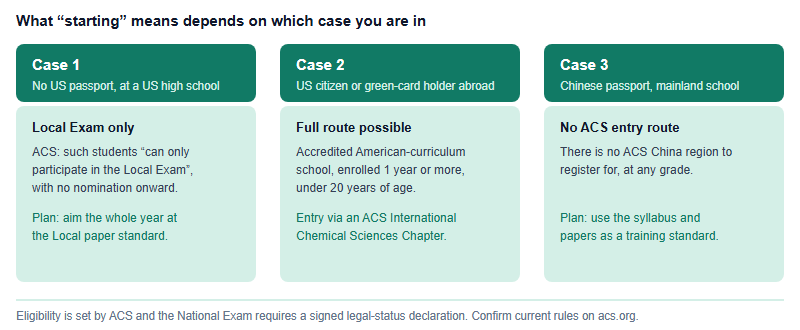
The route clock is the one that gets discovered too late, because it has nothing to do with how much chemistry you know. Entry to the USNCO is governed by ACS, and the position splits into three cases that must never be collapsed into one another:
- A student who is not a US citizen or permanent resident but who is enrolled at a US high school may sit the Local Exam. ACS states such students “can only participate in the Local Exam without the possibility of being nominated to sit for the National Exam.”
- A US citizen or permanent resident studying at an accredited American-curriculum school abroad — including inside mainland China — can run the full route from Local Exam through National Exam, Study Camp and Team USA selection, entering through an ACS International Chemical Sciences Chapter, provided they have been enrolled at that accredited school for at least a year and are under 20.
- A student on a Chinese passport at a mainland-China school has no ACS entry route. There is no ACS China region to register for, and the value of the syllabus for that student is as a stretch target and a training standard, not as an entry ticket.
Two details in that middle case are pure calendar planning, and they are why this belongs in a grade-by-grade article at all. The one-year enrolment condition means a student who transfers into an accredited American-curriculum school partway through Grade 11 may not have been there long enough for that season. The under-20 condition matters for anyone who has repeated a year. Accreditation is by a recognised US accrediting body — the list ACS publishes includes MSACS, WASC, SACS, NEASC, NCASC and NACS — and it is worth confirming your school's status with your own school office rather than assuming, because “American curriculum” and “accredited by one of those bodies” are not the same claim. The full position is set out in our guide to who can and cannot enter, and eligibility is decided by ACS, so confirm the current rules on acs.org before you plan a route around them.
What each year is actually for
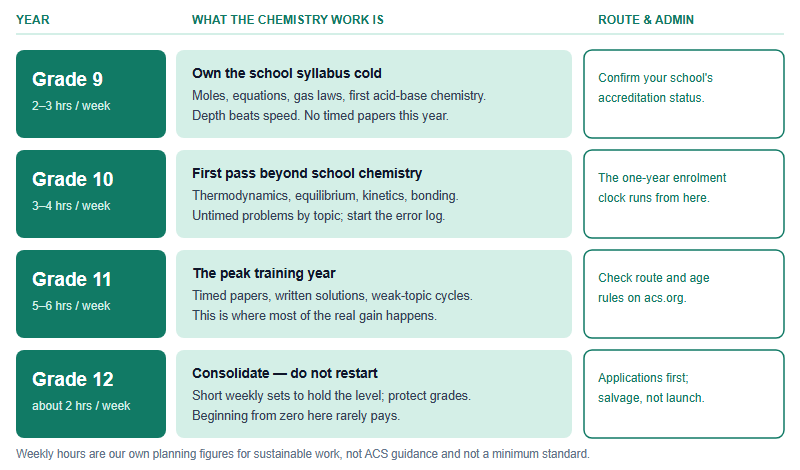
The progression below assumes an ordinary strong student at an international school, not a prodigy. The hours are our own planning figures for sustainable work alongside a full academic timetable; they are not ACS guidance and they are not a minimum standard.
| Year | Chemistry target | Olympiad work | Route admin | Most common mistake |
|---|---|---|---|---|
| Grade 9 | Own the school course cold: moles, equations, gas laws, first acid-base | None, or light enrichment problems with no clock | Confirm your school's accreditation status and note your enrolment date | Working past papers with the answer key open |
| Grade 10 | First pass beyond school chemistry: thermodynamics, equilibrium, kinetics, bonding | Untimed problem sets by topic; start an error log | If the citizens-abroad route may apply, the one-year enrolment clock is running now | Chasing breadth and never finishing a topic to competence |
| Grade 11 | Depth and connection: multi-step problems that cross topics | Timed papers, written free-response practice, weak-topic cycles | Check age and route conditions against the current rules on acs.org | Practising volume without diagnosing the lost marks |
| Grade 12 | Maintain, do not rebuild | Short weekly sets to hold the level; protect predicted grades | Confirm nothing has changed; re-check the current entry conditions on acs.org each season | Starting from zero in application season |
If you are in Grade 11 or Grade 12 right now
Grade 11 is not late. It is the year the whole progression is built around, and a student starting cleanly in the autumn of Grade 11 has enough runway for a full content pass and a real block of timed practice before the exam window, which has fallen in late winter and early spring in recent seasons — confirm the current dates on acs.org rather than planning from last year's. The compression is manageable: run the content pass and the practice partly in parallel rather than strictly in sequence, accept that the first timed papers will feel bad, and treat that discomfort as data rather than a verdict.
Grade 12 is genuinely different, and the difference is not chemistry. Application deadlines, predicted grades and school internal assessments all land in the same months, and an olympiad plan that assumes otherwise fails silently, usually taking a few percentage points of school grades with it. Our advice for a Grade 12 start is narrow and unglamorous: pick two or three topics you can plausibly finish, work them properly, and let the rest go. A student who genuinely masters thermodynamics and equilibrium in Grade 12 has gained something real for university chemistry. A student who skims eleven topics has gained a false sense of coverage.
Whatever year you are in, the practice material does the same job: it defines the standard. We keep a gathered and organised pack of past papers for exactly this purpose, with worked solutions for some years only, and the method for using them without wasting them is set out in our guide to working with past papers. The one rule that applies at every grade is that a paper worked with the solution visible has taught you nothing about yourself.
Move up when the signals say so, not when the calendar does
Grades are a rough proxy for readiness. These signals are better, and all four are things you can check yourself in an afternoon:
- You can finish a timed multiple-choice section without leaving questions unattempted. If you are running out of time, the problem is fluency in the basics, not the hard topics — go back a level.
- Your written solutions are followable by someone else. Hand a free-response answer to a classmate. If they cannot reconstruct your reasoning from what is on the page, you are not yet writing at the standard the paper rewards.
- Your error log is dominated by execution slips, not concept gaps. While most lost marks are still “I did not know this,” you are in a content phase and timed practice is premature.
- You can explain why an approximation is allowed before you use it. Students who cannot are not ready for the multi-step equilibrium and thermodynamics problems that separate the middle of the field from the top.
None of these depend on which grade you are in, which is the point. The calendar tells you how much time is left. The signals tell you what to do with it.
Frequently asked questions
Is Grade 11 too late to start?
No. Grade 11 is the normal peak training year. Starting in Grade 12, in the middle of applications, is the timing that genuinely costs you.
Should a Grade 9 student work past papers?
Rarely. Papers diagnose a system you have already built. Before the school course is solid they mostly teach discouragement.
Does the one-year enrolment rule apply to everyone?
No. It belongs to the citizens-abroad route for US citizens and permanent residents. Confirm which conditions apply to you on acs.org.
What if I have no entry route at all?
The syllabus still works as a stretch target and the papers as a training standard, which is the honest value for a mainland-school student on a Chinese passport.
This is the USNCO information desk, synchronising official ACS information for chemistry students in China, operated by Hanlin Education. The USNCO is run by the American Chemical Society (ACS), which sets all official rules and eligibility. Always confirm current details on acs.org. Errors reported to us are corrected within 7 working days.